Back
Google AI Contribution Pilot: Can Publishers Get Paid?
Google tests paying publishers whose content shapes AI Overviews, AI Mode, and Gemini.


Google is quietly testing something publishers have wanted since AI Overviews first launched, a real way to get paid when their content shapes an AI generated answer in Gemini, AI Overviews, or AI Mode. It's called the AI Contribution Pilot, and it lives inside Search Console. It's also raising almost as many questions as it answers, so here's what's actually going on.
What Exactly Is Google's AI Contribution Pilot?
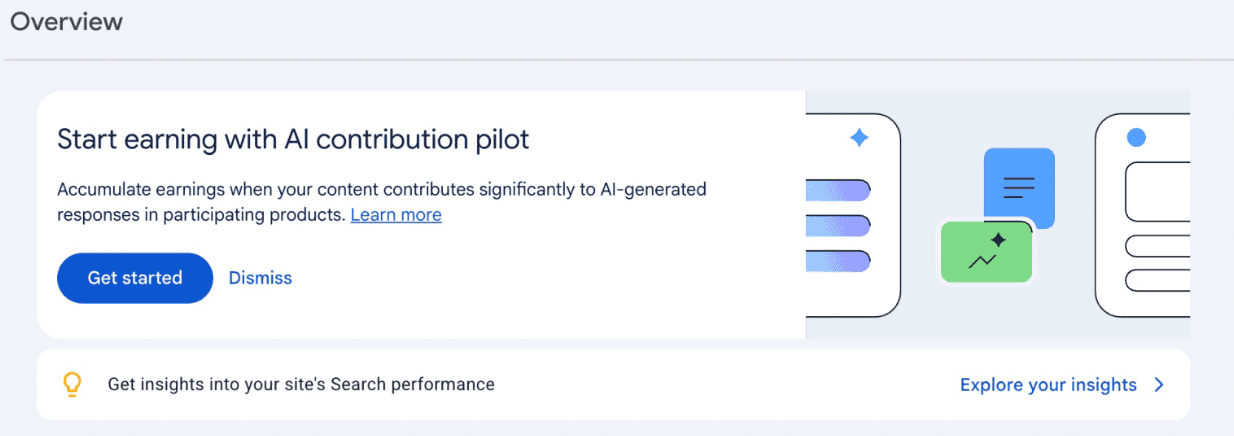
The AI Contribution Pilot is a small scale program where Google pays select publishers when their content plays a meaningful role in generating an AI answer. According to the program's help documentation, contribution is judged specifically at the generation stage, the moment web content actually shapes what an AI response says. Content that only gets fact checked against or linked to after a response has already been generated doesn't count toward it.
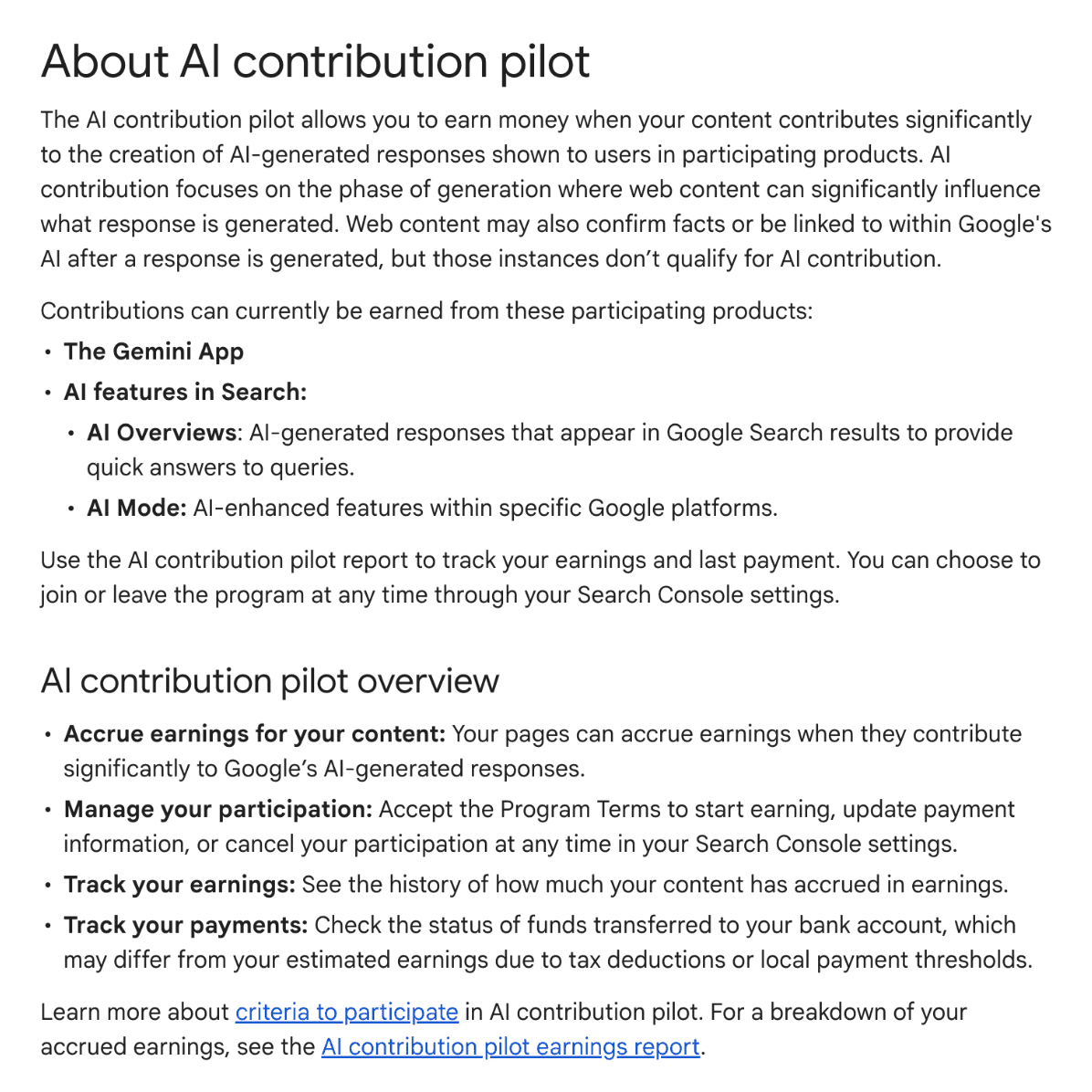
Publishers with access see a welcome screen in Search Console describing the program as a way to accumulate earnings whenever their content contributes significantly to AI generated responses in participating products.
How Did We Find Out Google Is Paying Publishers for AI Content?
Search Engine Roundtable first spotted an unexplained AI contribution report inside Search Console back in April 2026, though nobody quite understood what it was for at the time. A few months later, in August, Google rolled out a separate and publicly visible feature called the AI Performance Report, which tracks impressions from AI Overviews and AI Mode. Then on September 14, 2026, Digiday published a detailed report built on conversations with dozens of publishers, revealing that the April feature was actually a payment mechanism all along, something Google went on to confirm.
Even Barry Schwartz, who first flagged the report back in April, initially assumed it was just part of the AI Performance Report rather than a genuine earnings program.
How Does the AI Contribution Pilot Actually Work Inside Search Console?
Once a publisher accepts the Program Terms, a new AI contribution widget shows up in their Search Console dashboard. It displays a monthly earnings figure along with some historical data, tracks the status of any funds transferred to a bank account, which can end up differing from the estimated earnings once tax withholding or local payment thresholds are factored in, and lets publishers update their payment details or leave the program whenever they want.
One executive with access to the program described the level of detail Google currently shares as fairly limited. The panel shows a payout figure, but not much of the usage data behind it.
What Is AI Mode? Which Other Google Products Does This Cover?
The pilot spans three surfaces, the Gemini app, AI Overviews, and AI Mode, Google's conversational search experience that answers follow up questions using AI synthesized responses instead of a traditional results list. That's actually a wider scope than the AI Performance Report, which only counts impressions from AI Overviews and AI Mode and leaves Gemini out of the picture entirely.
Can You Actually Make Money From AI Overviews and AI Mode?
In theory, yes. That's the entire premise of the pilot. In practice, the numbers reported so far are modest. Publishers involved have described the early payouts as small compared with what they earn from advertising, and Google itself frames this as an early stage learning exercise rather than a mature revenue stream. Whether that changes as the program scales is really the open question the industry is watching.
How Are Payouts Calculated? Is It Really About Value, Not Clicks?
Unlike traditional licensing deals, which typically involve a fixed or upfront fee, Google says this program ties payment to the value a piece of content adds to an AI response rather than raw usage volume. In practice that means simply appearing in an AI answer isn't enough on its own. The content has to have materially shaped what the answer actually says.
Google hasn't published the underlying formula, and by most accounts the calculation itself is still evolving as Google gathers more data from participants.
Who Gets Invited to Join? Why Aren't Big Publishers First in Line?
Digiday's reporting found that Google has approached at least dozens of publishers, though an exact count hasn't been confirmed. Notably, the program seems more appealing to small and mid sized publishers than to major outlets, and it has expanded well beyond news sites into a much broader range of content categories.
Part of the explanation is probably that larger publishers already have negotiated licensing deals with Google. For smaller sites without that kind of leverage, the pilot offers a way to earn something from AI usage of their content without negotiating a bespoke agreement of their own.
Is This the AI Contribution Pilot or the AI Performance Report You're Looking At?
These two Search Console features get confused all the time, so here's how they actually differ.
Feature | AI Contribution Pilot | AI Performance Report |
Purpose | Pays publishers for content used in AI answers | Reports performance across AI surfaces |
Products covered | Gemini app, AI Overviews, AI Mode | AI Overviews and AI Mode only |
What you see | An estimated monthly earnings figure | Impression counts |
Who has access | A limited, invite only group of publishers | Any eligible site in Search Console |
Payment | Yes, value based, formula undisclosed | No, reporting only |
Is It Actually Worth Joining? Weighing the Upside Against the Risk
The upside
The most obvious upside is that this is the first real precedent for Google paying publishers directly for AI usage, rather than only through negotiated news deals. Some participants also see potential for something like a Search Console style feedback loop, except built for the AI inference layer instead of traditional search. Publishers already in the program describe Google's weekly check ins as genuinely collaborative rather than a formality.
The risk
The risks are just as real. Early earnings reportedly look small next to advertising revenue for some of the publishers already involved. One publishing executive warned that accepting the program could actually weaken a site's negotiating position if it ever wants a bigger licensing deal down the line, since Google could point to the pilot as payment it's already making. Others go further and argue the program functions less like meaningful compensation and more like legal cover for how Google uses publisher content across its AI products. With so little transparency into how the calculation actually works, it's hard for publishers to adjust their content strategy around it in any deliberate way.
What Does This Mean for Your AI Overviews SEO Strategy?
Beyond the payments themselves, the AI Contribution Pilot signals something bigger. Content usage inside AI answers is now something Google is actively measuring and, in a limited way, pricing. That shifts the question publishers should be asking from simply are we ranking to something closer to is our content actually shaping what Gemini, AI Overviews, and AI Mode say, and for which queries.
Traditional SEO metrics like rankings and click through rate don't really capture that shift. It's part of why more teams are turning to dedicated GEO tools and AEO tools to see how their brand is actually represented inside AI generated answers, rather than only whether their pages are indexed. Google attaching an actual dollar figure to AI contribution, however small right now, is a strong signal that AI visibility has moved from a nice to have into a real KPI.
How Do You Get Access to the AI Contribution Panel in Search Console?
There's currently no application process to speak of. Google selects eligible sites and sends invitations directly. The panel then appears under Search Console settings, and participation begins once the Program Terms are accepted. It can be canceled at any time, and if a site hasn't been invited, the panel simply won't show up in its account yet.
Where Is This Heading Next?
The AI Contribution Pilot is still small, still fairly opaque about how payouts are calculated, and still described by Google as an early learning exercise rather than a finished product. Even so, it's the clearest signal yet that direct payment for AI usage of publisher content is moving from theory into an actual test case.
This kind of shift is also pushing an entire category of AI SEO tools to expand well beyond keyword tracking into monitoring how content performs inside AI generated answers themselves. The two things worth watching next are how many more sites get invited, and whether Google ever makes its valuation formula public.
FAQ About the AI Contribution Pilot
What is Google's AI Contribution Pilot?
It's an early stage program, run through Google Search Console, that pays a limited group of publishers when their content significantly shapes an AI generated answer in Gemini, AI Overviews, or AI Mode. It's invite only, and Google hasn't published any kind of public sign up process.
How do I join Google's AI Contribution Pilot?
You can't really apply. Google selects eligible sites and extends invitations directly through Search Console. If a site is invited, a new panel appears under its Search Console settings where the owner can accept the Program Terms and start tracking earnings.
How does Google calculate AI Contribution payouts?
Google hasn't published a formula. What is known is that payment is tied to the value a piece of content adds to an AI generated response, not simply how often it appears, so impressions alone don't guarantee any earnings.
Which Google products does the AI Contribution Pilot cover?
Three, the Gemini app, AI Overviews, and AI Mode. That's one more surface than Search Console's separate AI Performance Report, which only counts impressions from AI Overviews and AI Mode.
What is AI Mode?
AI Mode is a conversational search experience inside Google Search that lets users ask follow up questions and get AI synthesized answers pulled from multiple web sources, rather than a traditional list of blue links. It's one of the three surfaces covered by the AI Contribution Pilot.
What's the difference between the AI Contribution Pilot and the AI Performance Report?
The AI Performance Report is a free, widely available tool that shows how often content appears across AI surfaces, and it doesn't pay anything. The AI Contribution Pilot is a separate, invite only program that adds real monetary payouts on top of that visibility.
Can I opt out of the AI Contribution Pilot?
Yes. Publishers can leave at any time through Search Console settings. Opting out stops the payment mechanism, but it doesn't stop Google's AI products from using that content elsewhere. It just removes the site from this particular earnings program.
When will the AI Contribution Pilot roll out to everyone?
Google hasn't shared a timeline. The company currently describes it as an early stage learning pilot, and reporting suggests it has quietly expanded to dozens of small and mid sized publishers well beyond the news industry, though broader availability still isn't confirmed.
How can I tell if my content is already showing up in AI Overviews?
Search Console's AI Performance Report is the first place to check, since it shows impressions from AI Overviews and AI Mode even for sites that aren't in the pilot. Dedicated AI visibility tools go a step further, tracking citations, share of voice, and how a brand is actually described across AI answers over time.

Latest posts
Discover other pieces of writing in our blog