All articles
·
4 min read
How Claude Marks AI-Generated Content?
Anthropic now marks Claude AI content with watermarks and metadata, changing AI content transparency.

If you publish content online, you’ve probably wondered whether search engines can tell when something was written by AI. With Anthropic’s new transparency commitments for Claude, that question just got a real answer, and it’s worth understanding before it affects your content strategy.
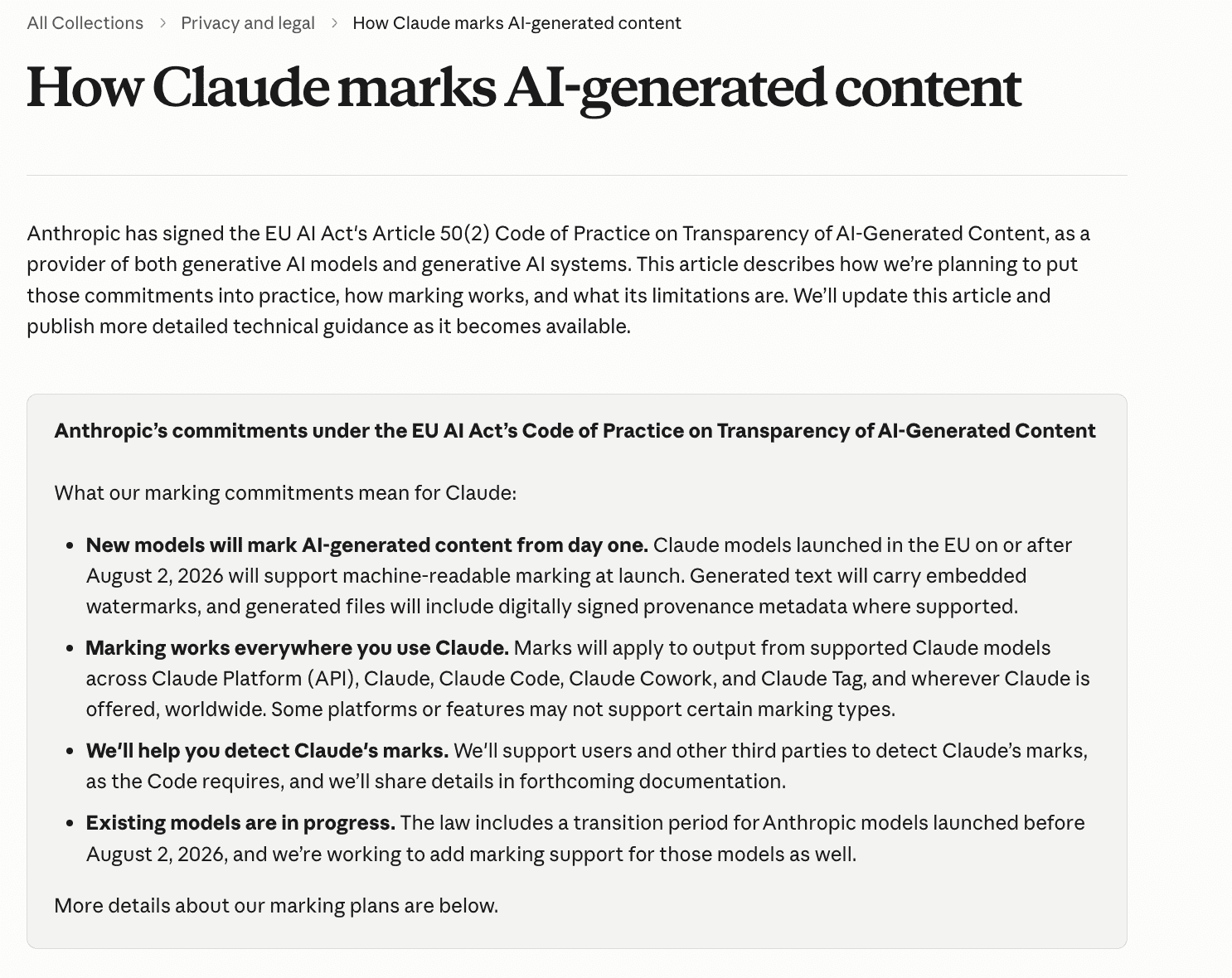
Anthropic has signed the EU AI Act’s Article 50(2) Code of Practice on Transparency of AI-Generated Content. In plain terms, this means Claude now embeds machine-readable marks into the content it generates. Below, we break down exactly how this works, what it covers, and what it doesn’t, based on Anthropic’s own documentation.
What Is Claude’s AI Content Marking?
Claude uses two separate methods to flag content as AI-generated or AI-processed. The first is an embedded watermark in text, an invisible signal woven directly into generated text that doesn’t change meaning, tone, or readability, and travels with the text even when copied and pasted elsewhere. The second is signed provenance metadata attached to supported file types like .svg, .png, and .jpg, following the C2PA (Coalition for Content Provenance and Authenticity) open standard used across the AI industry.
Both mechanisms work at the model level, meaning the mark is tied to the model generating the content, not to the specific app or interface you’re using.
Which Claude Models and Products Are Covered?
This is where nuance matters, and where a lot of confusion tends to start. Only models launched on or after August 2, 2026 support marking at launch, and Anthropic is still working on retroactive support for older models. Marking applies across every surface, including Claude Platform (API), the Claude app, Claude Code, Claude Cowork, and Claude Tag. Cloud partners are included too. If you access a supported Claude model through AWS, Google Cloud, or Microsoft Foundry, watermarking still applies, though provenance metadata support can vary by platform. Geographic scope is global, not just the EU, even though the legal obligation originates from EU regulation.
Will AI-Marked Content Get Penalized by Google or Other Search Engines?
This is the question most content teams actually care about, so let’s address it directly. Marking is not the same as ranking demotion. Google has repeatedly stated that its ranking systems reward high-quality, helpful content regardless of how it was produced. A watermark or provenance tag is a transparency signal, not a quality signal, and search engines don’t currently use C2PA metadata or text watermarks as a direct ranking factor.
That said, transparency expectations are shifting fast, and platforms building AI-detection tools into their own discovery systems could change this over time. If you’re optimizing for how AI systems and search engines discover and cite your content, it’s worth keeping an eye on how these standards evolve, and pairing that with a broader look at tools built for generative engine optimization. Our guide to the best GEO tools breaks down which platforms currently help you track and improve visibility inside AI-driven search results.
Can the Watermark Be Removed or Bypassed?
Technically, yes, in certain situations. According to Anthropic’s own documentation, a mark may not be detectable if the text has been heavily edited, paraphrased, translated, or blended with other writing, if the passage is too short to carry a reliable signal, if a file’s metadata was stripped through re-saving, screenshots, or format conversion, or if the content came from a model or feature that doesn’t support marking yet.
This matters for content teams: heavy human editing of AI drafts can naturally reduce or eliminate the detectable watermark, simply as a side effect of the editing process, not because anyone is trying to hide anything.
Does a Detected Mark Prove Content Was Written Entirely by AI?
No, and this is an important nuance Anthropic itself flags. A detected mark only confirms that Claude processed the content at some point. It doesn’t confirm that Claude was the original author, since many people use Claude to proofread, translate, or summarize existing human-written text, and it doesn’t confirm that the content hasn’t been edited, excerpted, or combined with other material afterward. In other words, a watermark tells you Claude touched the content. It doesn’t tell you how much, or in what way.
What About Content Created Before August 2026?
Anthropic has confirmed a transition period for models released before the Code of Practice deadline. Existing models don’t yet support this marking system, though Anthropic says it’s actively working to extend coverage to them. If your content library includes material generated with earlier Claude models, don’t expect retroactive watermarking, at least not yet.
What Should Content Creators and SEO Teams Do Now?
There’s no need to panic about rankings, since there’s no current evidence that watermarking or provenance metadata affects search visibility directly. Editorial review still matters too, and since heavy editing can strip or weaken watermarks, a solid human-review process remains your best practice regardless of transparency regulations. It’s also worth staying informed on evolving standards, because the EU AI Act is one of several regulatory efforts pushing AI transparency forward, and more platforms are likely to adopt similar marking requirements over time.
Finally, it pays to think beyond traditional SEO. As AI search assistants and generative engines increasingly cite and summarize web content, understanding how these systems evaluate and surface your pages is becoming just as important as classic keyword optimization. Check out our roundup of the best GEO tools if you want to get ahead of this shift.
Source: Claude Article
NEXT ARTICLE
