All articles
·
6 min read
How to Get Your Brand Mentioned by ChatGPT: 5 Tips
What the 2026 data shows about getting cited in ChatGPT, and five moves worth making first.

This guide from Visby, a platform that tracks brand visibility across ChatGPT, Claude, and Gemini, breaks down what actually determines whether ChatGPT names your brand when someone asks a relevant question, based on how these systems retrieve and select sources, not guesswork.
ChatGPT crossed 900 million weekly active users in February 2026, up from 400 million a year earlier. About 70% of consumers now say they turn to generative AI tools over traditional search when they’re looking for product or service recommendations, and 62% of shoppers already use AI for comparison shopping. That shift changes where the buying decision actually happens. By the time someone visits your site, an AI assistant may have already narrowed their options down to two or three names, and if yours wasn’t one of them, the visit never happens.
Here’s what separates brands that get named from brands that get skipped.
1. Write in citable chunks, not narrative buildup
ChatGPT does not read your page top to bottom looking for the best story. It retrieves candidate pages for a query, evaluates which ones it can pull a clean, self-contained answer from, and quotes only a fraction of what it finds. One March 2026 analysis of AI citation patterns found that roughly 44% of citations come from the first third of a page’s text.
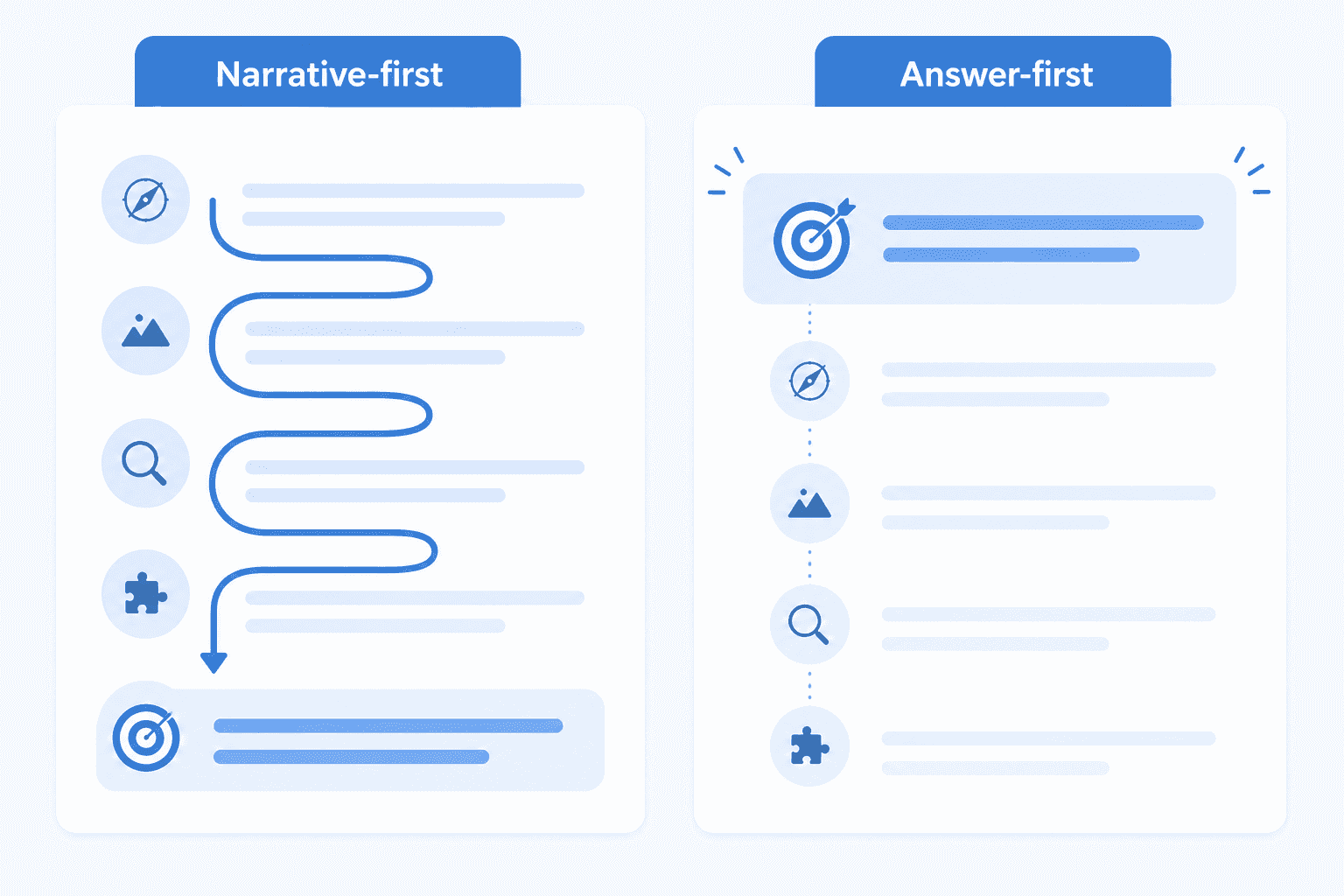
If your actual answer is sitting in paragraph four after three paragraphs of setup, the model has often already moved on to a competitor who answered in sentence one.
Practically, this means:
Open every section with the direct answer, then explain it. Save the context for after the answer, not before it.
Give each H2 or H3 a single, specific job. A section that tries to cover three ideas dilutes all three.
Keep paragraphs to four or five sentences. Long, winding paragraphs are harder to extract cleanly.
Write each section so it could be lifted out and still make sense on its own. If it depends on the paragraph before it, it’s less likely to get quoted.
This is also why some studies report meaningfully higher citation rates for FAQ, Article, and HowTo formatted content, since these formats are structurally built around the answer-first pattern AI retrieval favors.
2. Cover the follow-up questions, not just the headline one
Generative engines interpret intent, not just keywords. A search like “best project management tool for agencies” doesn’t stop at that one query. It branches into pricing, integrations, onboarding time, and alternatives, whether or not the user types those follow-ups out loud. Content that only answers the headline question misses the branches the model is also trying to fill in.
Start by mapping the real question cluster around your topic using tools like AlsoAsked or Google’s “People Also Ask” panel. If you want to compare platforms that support the full GEO workflow beyond question mapping, check out our guide to the best GEO tools. Then build the follow-ups into the same piece, either woven into the body or collected in a dedicated FAQ section. Direct Q&A pairs work well here specifically because they hand the model a ready-made block: question, then a concise, standalone answer.
3. Back claims with current, specific, original data
Recency and specificity function as trust signals for generative engines the same way they do for human readers. A page with a visible, current update date and freshly sourced statistics tends to outperform an identical page carrying data from several years back, since AI systems increasingly weight how current a source appears to be.
More importantly, original data is one of the few genuine differentiators left. Every competitor in your space can restate the same three-year-old industry statistic. Almost none of them can cite their own product usage numbers, their own customer survey, or an original observation from their own dataset. When multiple studies point to AI systems favoring pages that cite primary research and expert sourcing over generic restatement, that’s the gap worth closing first. If you have proprietary data, a customer count, a usage pattern, a survey result, that’s stronger GEO material than another rehash of public statistics.
One caveat worth knowing: results are mixed on whether schema markup itself changes citation rates. Some 2026 studies report citation lifts from FAQ and Article schema, while a large-scale Ahrefs study tracking nearly 1,900 pages found no statistically significant increase in ChatGPT or AI Mode citations after schema was added. Schema still has real value for classifying your content and supporting traditional search, so there’s little reason to skip it, just don’t treat it as the lever that gets you cited. The content itself is.
4. Keep your brand description consistent everywhere
AI models don’t just read your website. They cross-reference how your brand is described across your site, review platforms like G2 or Trustpilot, directories, and social profiles. When those sources tell slightly different stories, what you do, who you serve, what makes you different, that inconsistency makes it harder for the model to state anything about you with confidence. Ambiguity gets filtered out in favor of sources that agree with each other.
Audit your homepage, About page, review profiles, and any directory listings side by side. The core facts should match everywhere: what the product does, who it’s for, and what sets it apart. This kind of consistent “narrative identity” echoed across independent sources is increasingly cited as one of the stronger predictors of AI recommendation, arguably more reliable than any single on-page optimization.
5. Actually track whether any of this is working
Most marketing teams have no visibility into whether ChatGPT mentions them, which prompts trigger those mentions, or how they stack up against competitors on the same queries. Without that, every change to your content is a guess.
This is the gap Visby is built to close. It tracks how often your brand appears across ChatGPT, Claude, and Gemini, shows exactly which prompts surface those mentions, and turns the gaps it finds into specific, actionable tasks. Instead of wondering whether last month’s rewrite made any difference, you see the actual shift in how often, and how favorably, your brand comes up. If you’d rather evaluate the landscape yourself first, our roundup of the best AI SEO tools is a good place to start. Monitoring also surfaces what competitors are doing right. If a competitor keeps getting named for a query you’d expect to win, that’s a concrete signal to investigate rather than a hunch to sit on.
FAQ About Mentioned by ChatGPT
How is GEO different from SEO?
SEO gets you ranked in search engine results pages. GEO gets you cited or named directly inside AI-generated answers from tools like ChatGPT, Claude, and Gemini. The disciplines overlap, especially around content quality and structure, but the mechanics of getting selected are different: there’s no ranked list to climb, just a retrieval and extraction decision the model makes per query.
Can a small brand outrank a bigger competitor in ChatGPT?
Yes, more easily than in traditional search. Since ChatGPT selects whichever source it can extract the clearest, most complete answer from, a well-structured page from a smaller brand can beat a vague, buried answer from a larger competitor. Domain authority still helps, but it isn’t the deciding factor the way it often is in classic SEO rankings.
Does structured data actually help get cited by ChatGPT?
The evidence is mixed. Several 2026 studies report higher citation rates on pages using FAQ or Article schema, while at least one large-scale study found no meaningful lift. Structured data is still worth having for traditional SEO and content classification, but content clarity and answer-first structure are the more consistently supported drivers of AI citation.
How often should I check my brand’s ChatGPT visibility?
Monthly is a reasonable baseline for most brands, and more frequently around content pushes, launches, or PR moments, since those are the windows where visibility tends to shift fastest.
NEXT ARTICLE
