All articles
·
6 min read
Which AI Search Prompts Are Brands Monitoring Most in 2026?
Based on 24,387 prompts brands are actively tracking on Visby

Most research on AI search looks at it from the user’s side. What are people searching for? How are queries changing? What does AI answer versus what it skips?
This report flips that perspective. Instead of looking at what users type into ChatGPT or Claude, we looked at what brands decide to monitor. Which queries did they add to their AI tracking dashboards? Where are they spending their visibility budget? What does their prompt selection tell us about where they feel the most competitive pressure?
This dataset comes from Visby - over 24,000 prompts configured by more than 2,000 brands across 35+ countries and 15+ languages.
About Visby
Visby is an AI visibility tracking and AEO/GEO platform used by 2,500+ brands worldwide. It monitors brand presence across ChatGPT, Gemini, and Claude, and generates actionable optimization tasks to improve AI search rankings. Visby is rated as a High Performer and Easiest to Use tool on G2.
How Brands Are Tracking Every Stage of the Funnel in AI Search
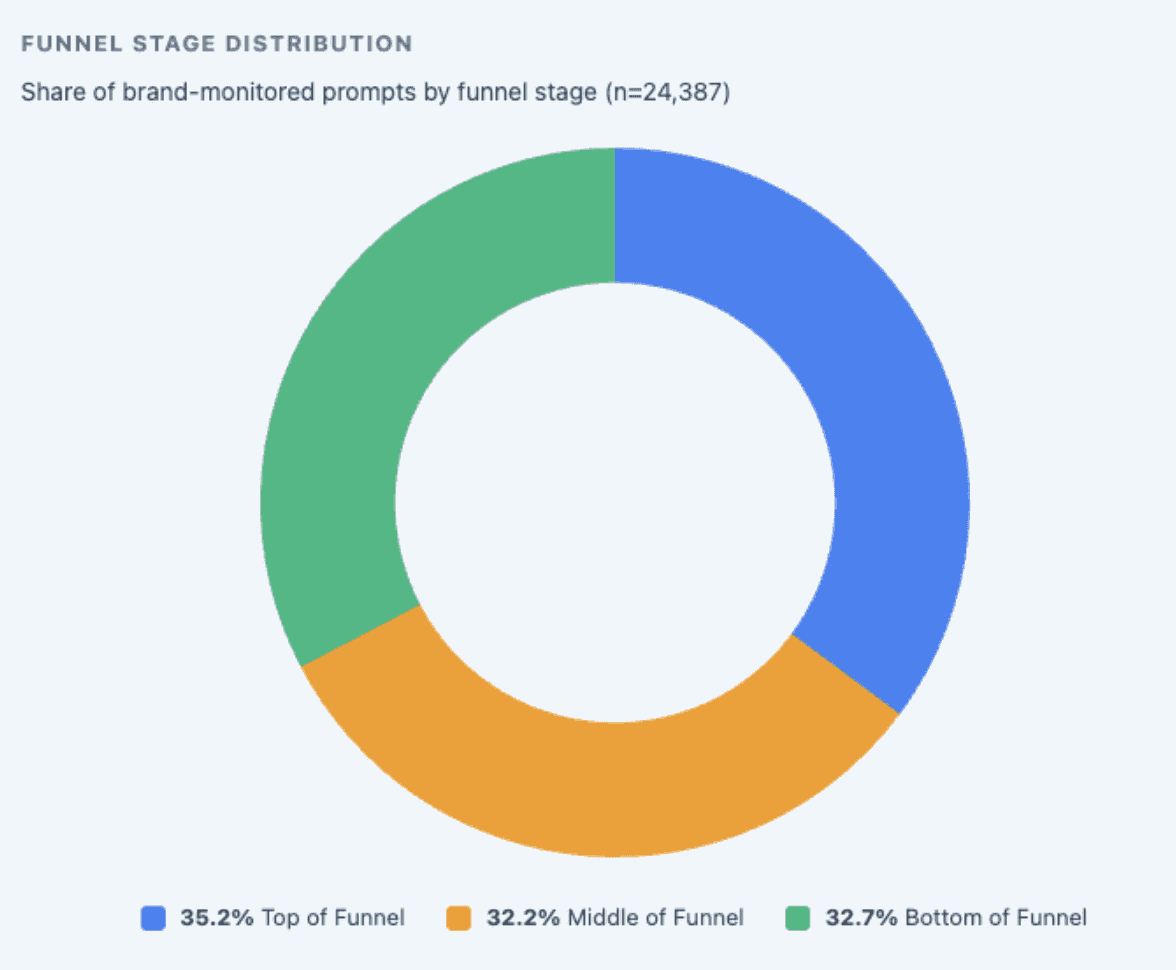
One of the most striking things in the data is how evenly distributed brands’ prompt choices are across the buyer funnel.”One of the most striking things in the data is how evenly distributed brands’ prompt choices are across the buyer funnel. If you assumed that most AI monitoring is about awareness, the numbers say otherwise.
Author’s note: This near-equal funnel distribution likely reflects how early we still are. As brands get more sophisticated about AI traffic, and as they better understand their sector dynamics and competitive position, I’d expect this to shift. Future cohorts will probably show much tighter, more intentional funnel targeting.
Which AI Search Intents Do Brands Actually Prioritize?
We classified all 24,387 prompts into 13 intent categories. The goal was to move past vague groupings and get specific about what brands are actually trying to capture in AI search.

The largest single category is Specific Brand Query at 36.4%. These are prompts where the brand’s own name or product name appears in the query itself, for example “How does [Brand] compare to competitors?” or “What is [Brand]’s return policy?” Brands clearly want to know exactly how AI talks about them when someone already knows their name.
The second biggest is How/What/Why at 27.1%. These are educational, informational queries: “How does this technology work?”, “What are the benefits of X?”, “Why should I care about Y?”. This is the content layer where AI does most of its explanatory work, and brands know they need to show up here.

Why Brands Frame Their AI Prompts as Questions, Not Keywords
There is a meaningful gap between how people search on Google and how they interact with AI. On Google, you type “best project management software.” In ChatGPT, you ask “What’s the best project management software for a remote team of 15 people?” The format is different, and the brands that understand this are building their monitoring strategies around it.
If there is one thing this data confirmed for me, it is that brands have adapted to this shift faster than they have on most other emerging channels. The prompt choices they are making are conversational, question-led, and contextually specific - which tells you they already understand how AI search works, even at this early stage.

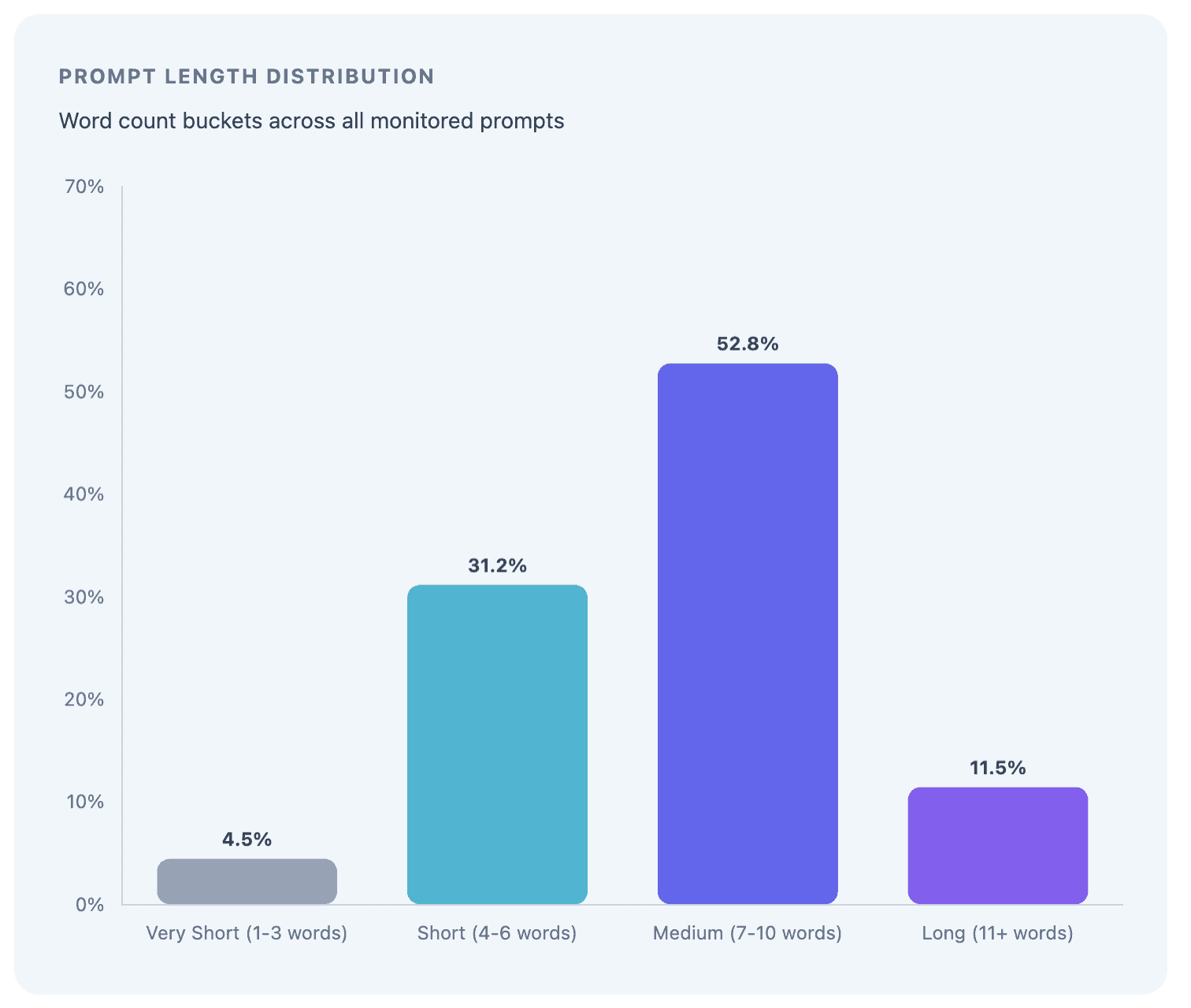
Four out of five brand-monitored prompts end with a question mark. The median prompt length is 7 to 10 words, which is the conversational range where AI engines are best at understanding and responding to user intent.
This has a direct implication for content strategy. GEO-optimized content needs to be structured around questions, not keywords. A page titled “Project Management Software Features” is built for Google. A page that opens with “What should a remote team look for in project management software?” is built for AI. The brands that are already tracking question-format queries are the ones building content to match them.
Which User Sentiments Are Brands Targeting in AI Search?
Beyond what brands are searching for, the prompts they choose to monitor also reveal which user mindsets they are trying to reach. Is the user they care about curious and learning? Ready to buy? Skeptical and comparing options? Actively dealing with a problem?

The dominant sentiment brands are targeting is Curious / Informational at 86.3%. This tells you that most brands still see AI primarily as an educational channel - they want to be present when users are learning, exploring, and forming opinions about a category or solution.
But the 8.4% targeting Purchase Ready sentiment is where things get strategically interesting. These brands are specifically monitoring the moments when a user has already decided they want something and is now asking AI where or how to get it. A small share of total volume, but extremely high intent - and the brands tracking these prompts know exactly what they are worth.
Comparison / Skeptical at 4.5% is nearly entirely MoFu, sitting at 89% middle-of-funnel. The brands monitoring these prompts are trying to win the deliberation stage - the moment when a user has a shortlist and is asking AI to help them choose. If your brand is not showing up favorably in these comparison queries, you are losing deals you never even knew were in play.
Where Brands Stand on AI Visibility Tracking - and What Is Still Being Figured Out
What the data actually shows is a market that has grasped the basics faster than expected, but is still working out the details.
On the positive side, brands have grasped some of the core GEO and AEO fundamentals earlier than expected. They understand that AI search spans the full funnel. They know that question-format prompts are the dominant format. They are proactively monitoring non-branded queries, not just their own name. These are not obvious things, and the data shows a meaningful level of strategic awareness at what is still a very early stage.
But there is still real uncertainty in the market. Questions like which funnel stage to prioritize, which user sentiment to target, how to balance informational coverage against high-intent purchase queries - these do not have clear consensus answers yet. The near-equal ToFu/MoFu/BoFu split we saw likely reflects that ambiguity as much as it reflects deliberate strategy. Many brands are monitoring everything because they are not yet sure where AI is driving the most impact for them specifically.
What is not ambiguous is this: the most critical move any brand can make right now is simply to start tracking. Not because the strategy is fully clear, but because you cannot optimize what you cannot see. Brands that are not measuring their AI visibility today are making strategic decisions blind.
This is exactly where Visby’s two newest capabilities become important. Citations Analysisshows brands which specific URLs and sources AI engines are pulling from when generating responses to monitored prompts - a direct window into what content LLMs are actually reading and citing. Gap Analysis surfaces the prompts where competitors are being mentioned and a brand is not, alongside insight into what type of content LLMs tend to favor for those queries. Together, these features move AI visibility from a passive monitoring exercise into something genuinely actionable: brands using Visby can now see not just where they stand, but exactly which prompts to target and what kind of content to build to get there.

