Back

Back

ChatGPT Ads Are Here: What It Means for AI Visibility and GEO

OpenAI now shows ads. Here is why organic AI visibility matters more than ever.

Feb 10, 2026

Chatgpt ads
Chatgpt ads

ChatGPT ads are no longer a rumor or a prediction. On February 9, 2026, OpenAI officially began testing advertisements inside ChatGPT for logged-in adult users on the Free and Go subscription tiers. For marketers, SEO professionals, and brand owners who have been watching the AI search space closely, this is a defining moment. It confirms what many in the GEO (Generative Engine Optimization) community have been saying for months: AI-powered search is becoming the primary discovery channel, and the rules of visibility are changing fast.

This guide from the Visby AI team breaks down what OpenAI announced, what the early data shows about algorithmic shifts tied to this launch, and what brands need to do right now to protect and grow their AI visibility. Whether you are an agency managing multiple clients or a brand trying to understand where your traffic is heading, the implications of ChatGPT ads go far beyond a new ad placement.

What OpenAI Actually Announced

OpenAI published a detailed blog post on February 9, 2026, confirming the rollout of ads in ChatGPT. Here are the key details every marketer needs to understand.

The ads are currently being tested with logged-in adult users in the United States on the Free and Go subscription tiers. Users on Plus, Pro, Business, Enterprise, and Education plans will not see ads. OpenAI also noted that Free tier users can opt out of ads in exchange for fewer daily free messages.
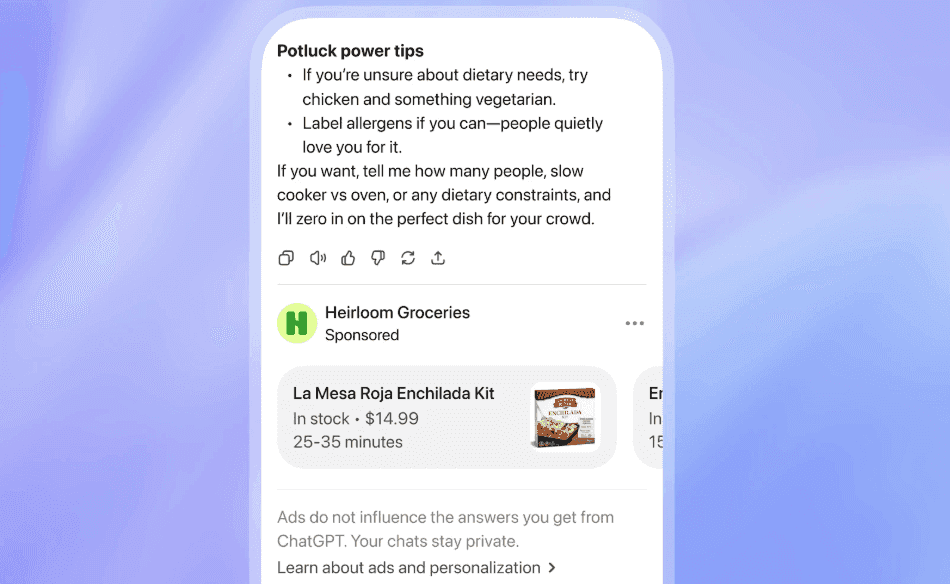
The ad format is a "sponsored recommendation" that appears below the organic AI-generated answer. Each ad is clearly labeled as sponsored and visually separated from ChatGPT's response. OpenAI emphasized repeatedly that ads do not influence the answers ChatGPT gives. The organic response remains independent.

Ad targeting works by matching advertiser submissions with the topic of the user's conversation, past chats, and previous interactions with ads. If you are researching recipes, for example, you might see an ad for a meal kit or grocery delivery service. Advertisers do not have access to individual user chats, chat history, memories, or personal details. They only receive aggregate performance data such as views and clicks.

OpenAI also confirmed that ads will not appear near sensitive or regulated topics like health, mental health, or politics. Accounts identified as belonging to users under 18 are excluded from seeing ads entirely.

Users get meaningful controls including the ability to dismiss ads, share feedback, learn why a specific ad is being shown, delete ad data with one tap, and manage ad personalization settings at any time. There is a dedicated "Ads Controls" panel with options for viewing ad history, managing interests, toggling personalization on or off, and choosing whether past chats and memory are used for ad relevance.

The Algorithm Was Already Changing Before Ads Went Live

Here is where things get really interesting for anyone tracking AI visibility. The ad announcement did not happen in a vacuum. Research from Seer Interactive, published in late January 2026, revealed that ChatGPT's algorithm had been quietly shifting for 46 days before OpenAI made its public announcement.

Seer Interactive's research lab conducted a forensic analysis of 206,412 ChatGPT responses across 43 brands, covering the period from November 14, 2025 to January 22, 2026. What they found was striking.

Starting around December 1, 2025, citations per response jumped 81%, rising from an average of 5.7 to 10.4. This was not a gradual shift. It was a measurable, statistically significant change (p<0.01) that happened before anyone outside OpenAI knew ads were coming. The researchers described this as ChatGPT building "credibility infrastructure" for the ad environment.

Throughout December 2025, brand visibility increased to 46.2%, up 4.9 percentage points from the control period. But the distribution shifted toward commercial intent queries. "Advice" stage queries grew by 31%, which are exactly the types of queries that advertisers pay premium rates for.

By early January 2026, before the announcement, visibility normalized back to 43.7% and brand rankings shuffled. The data shows that 55.8% of tracked brands lost visibility during this period. Seer Interactive described this as creating organic reach "scarcity" before launching the paid product, a pattern familiar to anyone who watched Facebook's evolution from organic reach to pay-to-play.

On January 16, the day ChatGPT first publicly discussed advertising principles, visibility spiked briefly to 45.98% before immediately returning to the declining trend. Seer called this a possible "showcase" effect to minimize backlash on announcement day before returning to the new baseline.

The implications are significant. By the time ads are publicly announced on any AI platform, the algorithmic groundwork has likely already been laid. Brands that are not continuously monitoring their AI visibility cannot see these shifts until it is too late to respond proactively.

Why Organic AI Visibility Just Got More Valuable

One of the biggest misconceptions about ChatGPT ads is that they reduce the importance of organic AI visibility. The opposite is true. Ads make organic visibility more valuable, not less.

Here is why. ChatGPT ads appear below the organic answer. They sit alongside a response that the user already perceives as authoritative and independent. If a brand is already mentioned in the organic answer and then appears in the ad space as well, the effect is compounding. The user sees the brand twice, once as a trusted recommendation and once as a sponsored suggestion, which reinforces familiarity and credibility.

But if a brand has no organic presence in the AI answer and only appears as a paid ad, the dynamic is completely different. The brand is introducing itself after the model has already framed the problem and suggested solutions. In a trust-heavy conversational interface, that gap between organic presence and paid-only presence matters enormously.

This pattern is not unique to ChatGPT. Google has already integrated ads into AI Overviews for commercial queries. The convergence is clear: every major AI platform will eventually monetize its answer layer. The brands that have already established organic authority in those answers will be in the strongest position when paid placements arrive.

There is also a timing dimension that makes this urgent. As one analysis put it, waiting for AI ad products to mature carries real risk. By the time ad formats stabilize, the organic answer layer will already reflect a set of default authorities. Displacing those brands later will be harder and more expensive than earning visibility now.

The message is clear: organic and paid AI visibility are not competing strategies. They are complementary layers, and the organic foundation determines how effective the paid layer will be.

How Ads in ChatGPT Impact GEO and AEO Strategies

For anyone working in GEO (Generative Engine Optimization) or AEO (Answer Engine Optimization), ChatGPT ads represent a structural shift in how these disciplines operate. GEO is no longer an experimental or forward-looking practice. It is now a core marketing function.

Here is what changes practically.

Entity signals become critical. ChatGPT does not just match keywords. It understands entities, which include brands, products, people, and concepts. When ads enter the picture, the model's understanding of your brand entity directly affects both organic placement and how relevant your paid presence feels. Brands with weak entity signals will struggle in both channels.

Content authority determines organic placement. AI systems decide which brands and sources to mention before any ad appears. That decision is driven by relevance, coverage, consistency, and perceived credibility. If your content does not meet the bar for organic inclusion, you are starting every interaction at a disadvantage, regardless of ad spend.

Answer-first content structure matters more. With ads sitting below the organic response, the answer itself becomes the prime real estate. Content that is structured for chunk optimization, with clear, self-contained sections that AI can extract and reference, has a better chance of being included in the organic answer layer. This is classic GEO practice, and it is now directly tied to business outcomes.

Measurement and attribution face new complexity. Once ads are live in ChatGPT, brands will need to distinguish between organic AI visibility and paid AI visibility. Knowing that "ChatGPT sent traffic" is not enough. You need to understand whether that visibility was earned organically or purchased, how it appeared in the conversation flow, and how it influenced buyer behavior over time. This is a new measurement challenge that most analytics stacks are not built to handle yet.

Commercial intent queries are being prioritized. Seer Interactive's data showed a 31% increase in "advice" stage queries in the period before ads launched. These high-commercial-intent queries are exactly where advertisers want to appear. Brands that optimize their content for these specific query types will benefit from both organic and paid visibility in the moments that matter most for conversion.

The convergence of paid and organic in AI search mirrors what happened in traditional search over the past two decades. But the timeline is compressed. What took Google 10 to 15 years to evolve is happening in AI search within months.

What Brands Should Do Right Now

The brands that act now will have a structural advantage as AI advertising scales across platforms. Here is what we recommend based on what we are seeing in the market.

Start tracking your AI visibility continuously. If you are not monitoring how your brand appears across ChatGPT, Google AI Overview, Perplexity, Claude, and Gemini on an ongoing basis, you are flying blind. The Seer Interactive data proved that algorithmic shifts happen weeks or months before public announcements. You need historical data to detect patterns and respond proactively. Visby AI are built specifically for this purpose, providing cross-platform AI visibility tracking with actionable insights.

Audit your content for AI readiness. Review your most important pages and ask whether each section can stand alone if extracted by an AI model. Is your content structured with clear H2 and H3 sections that answer specific questions? Does each chunk lead with the answer before expanding? Content that is optimized for chunk extraction performs better in AI-generated responses.

Strengthen your brand entity signals. AI models build an understanding of your brand from multiple sources across the web. Ensure your brand appears consistently across authoritative publications, industry directories, review platforms, and your own content ecosystem. The stronger your entity footprint, the more likely AI models are to recognize and reference your brand organically.

Benchmark against competitors in AI search. Understanding your share of voice relative to competitors in AI-generated answers is essential for strategic planning. This is not the same as traditional search rankings. A competitor that ranks poorly in Google might dominate AI recommendations if their content is structured for generative engines.

Prepare for paid AI advertising without neglecting organic. If your budget allows, start planning for ChatGPT ad testing when it becomes more broadly available. But do not make the mistake of treating paid and organic AI visibility as separate tracks. Your paid messaging should reinforce what AI models already know about your brand. The most effective approach is an integrated strategy where organic GEO work creates the foundation that paid ads amplify.

Set up referral tracking and attribution now. Make sure your analytics infrastructure can identify traffic from AI platforms. Configure UTMs, GA4 events, and tracking parameters specifically for AI referral sources. When ads scale across multiple AI platforms, you will need this data to measure ROI and optimize spend.

FAQ

Will ChatGPT ads affect the organic answers the model gives?

No. OpenAI has explicitly stated that ads do not influence ChatGPT's organic responses. Ads appear below the answer and are clearly labeled as sponsored. The organic answer is generated independently based on what ChatGPT determines is most helpful to the user.

Which ChatGPT users will see ads?

Currently, ads are being tested with logged-in adult users in the United States on the Free and Go subscription tiers. Users on Plus, Pro, Business, Enterprise, and Education plans will not see ads. Free tier users can also opt out of ads in exchange for fewer daily messages.

How do ChatGPT ads target users?

Ad targeting is based on the topic of the current conversation, the user's past chats, and previous interactions with ads. Advertisers do not have access to individual conversations, chat history, memories, or personal details. They only receive aggregate performance metrics.

What is GEO and why does it matter now?

GEO stands for Generative Engine Optimization. It refers to the practice of optimizing your brand's content and digital presence to appear in AI-generated answers across platforms like ChatGPT, Google AI Overview, Perplexity, and Claude. With ads now entering these platforms, organic AI visibility has become even more valuable as a complement to paid strategies.

How can I track my brand's visibility in AI search?

AI visibility tracking tools monitor how often your brand appears across major AI search engines. Visby AI provides comprehensive tracking across ChatGPT, Gemini, and Claude along with actionable GEO and SEO tasks to improve your presence.

ChatGPT ads are no longer a rumor or a prediction. On February 9, 2026, OpenAI officially began testing advertisements inside ChatGPT for logged-in adult users on the Free and Go subscription tiers. For marketers, SEO professionals, and brand owners who have been watching the AI search space closely, this is a defining moment. It confirms what many in the GEO (Generative Engine Optimization) community have been saying for months: AI-powered search is becoming the primary discovery channel, and the rules of visibility are changing fast.

This guide from the Visby AI team breaks down what OpenAI announced, what the early data shows about algorithmic shifts tied to this launch, and what brands need to do right now to protect and grow their AI visibility. Whether you are an agency managing multiple clients or a brand trying to understand where your traffic is heading, the implications of ChatGPT ads go far beyond a new ad placement.

What OpenAI Actually Announced

OpenAI published a detailed blog post on February 9, 2026, confirming the rollout of ads in ChatGPT. Here are the key details every marketer needs to understand.

The ads are currently being tested with logged-in adult users in the United States on the Free and Go subscription tiers. Users on Plus, Pro, Business, Enterprise, and Education plans will not see ads. OpenAI also noted that Free tier users can opt out of ads in exchange for fewer daily free messages.

The ad format is a "sponsored recommendation" that appears below the organic AI-generated answer. Each ad is clearly labeled as sponsored and visually separated from ChatGPT's response. OpenAI emphasized repeatedly that ads do not influence the answers ChatGPT gives. The organic response remains independent.

Ad targeting works by matching advertiser submissions with the topic of the user's conversation, past chats, and previous interactions with ads. If you are researching recipes, for example, you might see an ad for a meal kit or grocery delivery service. Advertisers do not have access to individual user chats, chat history, memories, or personal details. They only receive aggregate performance data such as views and clicks.

OpenAI also confirmed that ads will not appear near sensitive or regulated topics like health, mental health, or politics. Accounts identified as belonging to users under 18 are excluded from seeing ads entirely.

Users get meaningful controls including the ability to dismiss ads, share feedback, learn why a specific ad is being shown, delete ad data with one tap, and manage ad personalization settings at any time. There is a dedicated "Ads Controls" panel with options for viewing ad history, managing interests, toggling personalization on or off, and choosing whether past chats and memory are used for ad relevance.

The Algorithm Was Already Changing Before Ads Went Live

Here is where things get really interesting for anyone tracking AI visibility. The ad announcement did not happen in a vacuum. Research from Seer Interactive, published in late January 2026, revealed that ChatGPT's algorithm had been quietly shifting for 46 days before OpenAI made its public announcement.

Seer Interactive's research lab conducted a forensic analysis of 206,412 ChatGPT responses across 43 brands, covering the period from November 14, 2025 to January 22, 2026. What they found was striking.

Starting around December 1, 2025, citations per response jumped 81%, rising from an average of 5.7 to 10.4. This was not a gradual shift. It was a measurable, statistically significant change (p<0.01) that happened before anyone outside OpenAI knew ads were coming. The researchers described this as ChatGPT building "credibility infrastructure" for the ad environment.

Throughout December 2025, brand visibility increased to 46.2%, up 4.9 percentage points from the control period. But the distribution shifted toward commercial intent queries. "Advice" stage queries grew by 31%, which are exactly the types of queries that advertisers pay premium rates for.

By early January 2026, before the announcement, visibility normalized back to 43.7% and brand rankings shuffled. The data shows that 55.8% of tracked brands lost visibility during this period. Seer Interactive described this as creating organic reach "scarcity" before launching the paid product, a pattern familiar to anyone who watched Facebook's evolution from organic reach to pay-to-play.

On January 16, the day ChatGPT first publicly discussed advertising principles, visibility spiked briefly to 45.98% before immediately returning to the declining trend. Seer called this a possible "showcase" effect to minimize backlash on announcement day before returning to the new baseline.

The implications are significant. By the time ads are publicly announced on any AI platform, the algorithmic groundwork has likely already been laid. Brands that are not continuously monitoring their AI visibility cannot see these shifts until it is too late to respond proactively.

Why Organic AI Visibility Just Got More Valuable

One of the biggest misconceptions about ChatGPT ads is that they reduce the importance of organic AI visibility. The opposite is true. Ads make organic visibility more valuable, not less.

Here is why. ChatGPT ads appear below the organic answer. They sit alongside a response that the user already perceives as authoritative and independent. If a brand is already mentioned in the organic answer and then appears in the ad space as well, the effect is compounding. The user sees the brand twice, once as a trusted recommendation and once as a sponsored suggestion, which reinforces familiarity and credibility.

But if a brand has no organic presence in the AI answer and only appears as a paid ad, the dynamic is completely different. The brand is introducing itself after the model has already framed the problem and suggested solutions. In a trust-heavy conversational interface, that gap between organic presence and paid-only presence matters enormously.

This pattern is not unique to ChatGPT. Google has already integrated ads into AI Overviews for commercial queries. The convergence is clear: every major AI platform will eventually monetize its answer layer. The brands that have already established organic authority in those answers will be in the strongest position when paid placements arrive.

There is also a timing dimension that makes this urgent. As one analysis put it, waiting for AI ad products to mature carries real risk. By the time ad formats stabilize, the organic answer layer will already reflect a set of default authorities. Displacing those brands later will be harder and more expensive than earning visibility now.

The message is clear: organic and paid AI visibility are not competing strategies. They are complementary layers, and the organic foundation determines how effective the paid layer will be.

How Ads in ChatGPT Impact GEO and AEO Strategies

For anyone working in GEO (Generative Engine Optimization) or AEO (Answer Engine Optimization), ChatGPT ads represent a structural shift in how these disciplines operate. GEO is no longer an experimental or forward-looking practice. It is now a core marketing function.

Here is what changes practically.

Entity signals become critical. ChatGPT does not just match keywords. It understands entities, which include brands, products, people, and concepts. When ads enter the picture, the model's understanding of your brand entity directly affects both organic placement and how relevant your paid presence feels. Brands with weak entity signals will struggle in both channels.

Content authority determines organic placement. AI systems decide which brands and sources to mention before any ad appears. That decision is driven by relevance, coverage, consistency, and perceived credibility. If your content does not meet the bar for organic inclusion, you are starting every interaction at a disadvantage, regardless of ad spend.

Answer-first content structure matters more. With ads sitting below the organic response, the answer itself becomes the prime real estate. Content that is structured for chunk optimization, with clear, self-contained sections that AI can extract and reference, has a better chance of being included in the organic answer layer. This is classic GEO practice, and it is now directly tied to business outcomes.

Measurement and attribution face new complexity. Once ads are live in ChatGPT, brands will need to distinguish between organic AI visibility and paid AI visibility. Knowing that "ChatGPT sent traffic" is not enough. You need to understand whether that visibility was earned organically or purchased, how it appeared in the conversation flow, and how it influenced buyer behavior over time. This is a new measurement challenge that most analytics stacks are not built to handle yet.

Commercial intent queries are being prioritized. Seer Interactive's data showed a 31% increase in "advice" stage queries in the period before ads launched. These high-commercial-intent queries are exactly where advertisers want to appear. Brands that optimize their content for these specific query types will benefit from both organic and paid visibility in the moments that matter most for conversion.

The convergence of paid and organic in AI search mirrors what happened in traditional search over the past two decades. But the timeline is compressed. What took Google 10 to 15 years to evolve is happening in AI search within months.

What Brands Should Do Right Now

The brands that act now will have a structural advantage as AI advertising scales across platforms. Here is what we recommend based on what we are seeing in the market.

Start tracking your AI visibility continuously. If you are not monitoring how your brand appears across ChatGPT, Google AI Overview, Perplexity, Claude, and Gemini on an ongoing basis, you are flying blind. The Seer Interactive data proved that algorithmic shifts happen weeks or months before public announcements. You need historical data to detect patterns and respond proactively. Visby AI are built specifically for this purpose, providing cross-platform AI visibility tracking with actionable insights.

Audit your content for AI readiness. Review your most important pages and ask whether each section can stand alone if extracted by an AI model. Is your content structured with clear H2 and H3 sections that answer specific questions? Does each chunk lead with the answer before expanding? Content that is optimized for chunk extraction performs better in AI-generated responses.

Strengthen your brand entity signals. AI models build an understanding of your brand from multiple sources across the web. Ensure your brand appears consistently across authoritative publications, industry directories, review platforms, and your own content ecosystem. The stronger your entity footprint, the more likely AI models are to recognize and reference your brand organically.

Benchmark against competitors in AI search. Understanding your share of voice relative to competitors in AI-generated answers is essential for strategic planning. This is not the same as traditional search rankings. A competitor that ranks poorly in Google might dominate AI recommendations if their content is structured for generative engines.

Prepare for paid AI advertising without neglecting organic. If your budget allows, start planning for ChatGPT ad testing when it becomes more broadly available. But do not make the mistake of treating paid and organic AI visibility as separate tracks. Your paid messaging should reinforce what AI models already know about your brand. The most effective approach is an integrated strategy where organic GEO work creates the foundation that paid ads amplify.

Set up referral tracking and attribution now. Make sure your analytics infrastructure can identify traffic from AI platforms. Configure UTMs, GA4 events, and tracking parameters specifically for AI referral sources. When ads scale across multiple AI platforms, you will need this data to measure ROI and optimize spend.

FAQ

Will ChatGPT ads affect the organic answers the model gives?

No. OpenAI has explicitly stated that ads do not influence ChatGPT's organic responses. Ads appear below the answer and are clearly labeled as sponsored. The organic answer is generated independently based on what ChatGPT determines is most helpful to the user.

Which ChatGPT users will see ads?

Currently, ads are being tested with logged-in adult users in the United States on the Free and Go subscription tiers. Users on Plus, Pro, Business, Enterprise, and Education plans will not see ads. Free tier users can also opt out of ads in exchange for fewer daily messages.

How do ChatGPT ads target users?

Ad targeting is based on the topic of the current conversation, the user's past chats, and previous interactions with ads. Advertisers do not have access to individual conversations, chat history, memories, or personal details. They only receive aggregate performance metrics.

What is GEO and why does it matter now?

GEO stands for Generative Engine Optimization. It refers to the practice of optimizing your brand's content and digital presence to appear in AI-generated answers across platforms like ChatGPT, Google AI Overview, Perplexity, and Claude. With ads now entering these platforms, organic AI visibility has become even more valuable as a complement to paid strategies.

How can I track my brand's visibility in AI search?

AI visibility tracking tools monitor how often your brand appears across major AI search engines. Visby AI provides comprehensive tracking across ChatGPT, Gemini, and Claude along with actionable GEO and SEO tasks to improve your presence.

ChatGPT ads are no longer a rumor or a prediction. On February 9, 2026, OpenAI officially began testing advertisements inside ChatGPT for logged-in adult users on the Free and Go subscription tiers. For marketers, SEO professionals, and brand owners who have been watching the AI search space closely, this is a defining moment. It confirms what many in the GEO (Generative Engine Optimization) community have been saying for months: AI-powered search is becoming the primary discovery channel, and the rules of visibility are changing fast.

This guide from the Visby AI team breaks down what OpenAI announced, what the early data shows about algorithmic shifts tied to this launch, and what brands need to do right now to protect and grow their AI visibility. Whether you are an agency managing multiple clients or a brand trying to understand where your traffic is heading, the implications of ChatGPT ads go far beyond a new ad placement.

What OpenAI Actually Announced

OpenAI published a detailed blog post on February 9, 2026, confirming the rollout of ads in ChatGPT. Here are the key details every marketer needs to understand.

The ads are currently being tested with logged-in adult users in the United States on the Free and Go subscription tiers. Users on Plus, Pro, Business, Enterprise, and Education plans will not see ads. OpenAI also noted that Free tier users can opt out of ads in exchange for fewer daily free messages.

The ad format is a "sponsored recommendation" that appears below the organic AI-generated answer. Each ad is clearly labeled as sponsored and visually separated from ChatGPT's response. OpenAI emphasized repeatedly that ads do not influence the answers ChatGPT gives. The organic response remains independent.

Ad targeting works by matching advertiser submissions with the topic of the user's conversation, past chats, and previous interactions with ads. If you are researching recipes, for example, you might see an ad for a meal kit or grocery delivery service. Advertisers do not have access to individual user chats, chat history, memories, or personal details. They only receive aggregate performance data such as views and clicks.

OpenAI also confirmed that ads will not appear near sensitive or regulated topics like health, mental health, or politics. Accounts identified as belonging to users under 18 are excluded from seeing ads entirely.

Users get meaningful controls including the ability to dismiss ads, share feedback, learn why a specific ad is being shown, delete ad data with one tap, and manage ad personalization settings at any time. There is a dedicated "Ads Controls" panel with options for viewing ad history, managing interests, toggling personalization on or off, and choosing whether past chats and memory are used for ad relevance.

The Algorithm Was Already Changing Before Ads Went Live

Here is where things get really interesting for anyone tracking AI visibility. The ad announcement did not happen in a vacuum. Research from Seer Interactive, published in late January 2026, revealed that ChatGPT's algorithm had been quietly shifting for 46 days before OpenAI made its public announcement.

Seer Interactive's research lab conducted a forensic analysis of 206,412 ChatGPT responses across 43 brands, covering the period from November 14, 2025 to January 22, 2026. What they found was striking.

Starting around December 1, 2025, citations per response jumped 81%, rising from an average of 5.7 to 10.4. This was not a gradual shift. It was a measurable, statistically significant change (p<0.01) that happened before anyone outside OpenAI knew ads were coming. The researchers described this as ChatGPT building "credibility infrastructure" for the ad environment.

Throughout December 2025, brand visibility increased to 46.2%, up 4.9 percentage points from the control period. But the distribution shifted toward commercial intent queries. "Advice" stage queries grew by 31%, which are exactly the types of queries that advertisers pay premium rates for.

By early January 2026, before the announcement, visibility normalized back to 43.7% and brand rankings shuffled. The data shows that 55.8% of tracked brands lost visibility during this period. Seer Interactive described this as creating organic reach "scarcity" before launching the paid product, a pattern familiar to anyone who watched Facebook's evolution from organic reach to pay-to-play.

On January 16, the day ChatGPT first publicly discussed advertising principles, visibility spiked briefly to 45.98% before immediately returning to the declining trend. Seer called this a possible "showcase" effect to minimize backlash on announcement day before returning to the new baseline.

The implications are significant. By the time ads are publicly announced on any AI platform, the algorithmic groundwork has likely already been laid. Brands that are not continuously monitoring their AI visibility cannot see these shifts until it is too late to respond proactively.

Why Organic AI Visibility Just Got More Valuable

One of the biggest misconceptions about ChatGPT ads is that they reduce the importance of organic AI visibility. The opposite is true. Ads make organic visibility more valuable, not less.

Here is why. ChatGPT ads appear below the organic answer. They sit alongside a response that the user already perceives as authoritative and independent. If a brand is already mentioned in the organic answer and then appears in the ad space as well, the effect is compounding. The user sees the brand twice, once as a trusted recommendation and once as a sponsored suggestion, which reinforces familiarity and credibility.

But if a brand has no organic presence in the AI answer and only appears as a paid ad, the dynamic is completely different. The brand is introducing itself after the model has already framed the problem and suggested solutions. In a trust-heavy conversational interface, that gap between organic presence and paid-only presence matters enormously.

This pattern is not unique to ChatGPT. Google has already integrated ads into AI Overviews for commercial queries. The convergence is clear: every major AI platform will eventually monetize its answer layer. The brands that have already established organic authority in those answers will be in the strongest position when paid placements arrive.

There is also a timing dimension that makes this urgent. As one analysis put it, waiting for AI ad products to mature carries real risk. By the time ad formats stabilize, the organic answer layer will already reflect a set of default authorities. Displacing those brands later will be harder and more expensive than earning visibility now.

The message is clear: organic and paid AI visibility are not competing strategies. They are complementary layers, and the organic foundation determines how effective the paid layer will be.

How Ads in ChatGPT Impact GEO and AEO Strategies

For anyone working in GEO (Generative Engine Optimization) or AEO (Answer Engine Optimization), ChatGPT ads represent a structural shift in how these disciplines operate. GEO is no longer an experimental or forward-looking practice. It is now a core marketing function.

Here is what changes practically.

Entity signals become critical. ChatGPT does not just match keywords. It understands entities, which include brands, products, people, and concepts. When ads enter the picture, the model's understanding of your brand entity directly affects both organic placement and how relevant your paid presence feels. Brands with weak entity signals will struggle in both channels.

Content authority determines organic placement. AI systems decide which brands and sources to mention before any ad appears. That decision is driven by relevance, coverage, consistency, and perceived credibility. If your content does not meet the bar for organic inclusion, you are starting every interaction at a disadvantage, regardless of ad spend.

Answer-first content structure matters more. With ads sitting below the organic response, the answer itself becomes the prime real estate. Content that is structured for chunk optimization, with clear, self-contained sections that AI can extract and reference, has a better chance of being included in the organic answer layer. This is classic GEO practice, and it is now directly tied to business outcomes.

Measurement and attribution face new complexity. Once ads are live in ChatGPT, brands will need to distinguish between organic AI visibility and paid AI visibility. Knowing that "ChatGPT sent traffic" is not enough. You need to understand whether that visibility was earned organically or purchased, how it appeared in the conversation flow, and how it influenced buyer behavior over time. This is a new measurement challenge that most analytics stacks are not built to handle yet.

Commercial intent queries are being prioritized. Seer Interactive's data showed a 31% increase in "advice" stage queries in the period before ads launched. These high-commercial-intent queries are exactly where advertisers want to appear. Brands that optimize their content for these specific query types will benefit from both organic and paid visibility in the moments that matter most for conversion.

The convergence of paid and organic in AI search mirrors what happened in traditional search over the past two decades. But the timeline is compressed. What took Google 10 to 15 years to evolve is happening in AI search within months.

What Brands Should Do Right Now

The brands that act now will have a structural advantage as AI advertising scales across platforms. Here is what we recommend based on what we are seeing in the market.

Start tracking your AI visibility continuously. If you are not monitoring how your brand appears across ChatGPT, Google AI Overview, Perplexity, Claude, and Gemini on an ongoing basis, you are flying blind. The Seer Interactive data proved that algorithmic shifts happen weeks or months before public announcements. You need historical data to detect patterns and respond proactively. Visby AI are built specifically for this purpose, providing cross-platform AI visibility tracking with actionable insights.

Audit your content for AI readiness. Review your most important pages and ask whether each section can stand alone if extracted by an AI model. Is your content structured with clear H2 and H3 sections that answer specific questions? Does each chunk lead with the answer before expanding? Content that is optimized for chunk extraction performs better in AI-generated responses.

Strengthen your brand entity signals. AI models build an understanding of your brand from multiple sources across the web. Ensure your brand appears consistently across authoritative publications, industry directories, review platforms, and your own content ecosystem. The stronger your entity footprint, the more likely AI models are to recognize and reference your brand organically.

Benchmark against competitors in AI search. Understanding your share of voice relative to competitors in AI-generated answers is essential for strategic planning. This is not the same as traditional search rankings. A competitor that ranks poorly in Google might dominate AI recommendations if their content is structured for generative engines.

Prepare for paid AI advertising without neglecting organic. If your budget allows, start planning for ChatGPT ad testing when it becomes more broadly available. But do not make the mistake of treating paid and organic AI visibility as separate tracks. Your paid messaging should reinforce what AI models already know about your brand. The most effective approach is an integrated strategy where organic GEO work creates the foundation that paid ads amplify.

Set up referral tracking and attribution now. Make sure your analytics infrastructure can identify traffic from AI platforms. Configure UTMs, GA4 events, and tracking parameters specifically for AI referral sources. When ads scale across multiple AI platforms, you will need this data to measure ROI and optimize spend.

FAQ

Will ChatGPT ads affect the organic answers the model gives?

No. OpenAI has explicitly stated that ads do not influence ChatGPT's organic responses. Ads appear below the answer and are clearly labeled as sponsored. The organic answer is generated independently based on what ChatGPT determines is most helpful to the user.

Which ChatGPT users will see ads?

Currently, ads are being tested with logged-in adult users in the United States on the Free and Go subscription tiers. Users on Plus, Pro, Business, Enterprise, and Education plans will not see ads. Free tier users can also opt out of ads in exchange for fewer daily messages.

How do ChatGPT ads target users?

Ad targeting is based on the topic of the current conversation, the user's past chats, and previous interactions with ads. Advertisers do not have access to individual conversations, chat history, memories, or personal details. They only receive aggregate performance metrics.

What is GEO and why does it matter now?

GEO stands for Generative Engine Optimization. It refers to the practice of optimizing your brand's content and digital presence to appear in AI-generated answers across platforms like ChatGPT, Google AI Overview, Perplexity, and Claude. With ads now entering these platforms, organic AI visibility has become even more valuable as a complement to paid strategies.

How can I track my brand's visibility in AI search?

AI visibility tracking tools monitor how often your brand appears across major AI search engines. Visby AI provides comprehensive tracking across ChatGPT, Gemini, and Claude along with actionable GEO and SEO tasks to improve your presence.

Cem Ozcelik

Growth Marketer at Visby

Cem Ozcelik

Growth Marketer at Visby

Latest posts

Discover other pieces of writing in our blog