All articles
·
7 min read
How to Track Brand Visibility in AI Search?
Track your brand visibility across ChatGPT, Gemini, Claude and AI search.

AI visibility is the measurable presence a brand has inside the answers generated by tools such as ChatGPT, Gemini, Claude, Perplexity, and Google AI Overviews. Instead of tracking a position on a results page, AI visibility tracks whether a brand gets mentioned at all, how often, and in what position, when an AI model answers a question about a category, a product, or a comparison between competitors.
This is different from classic SEO, and it matters because a growing number of buyers now ask an AI assistant for a recommendation instead of running a search and scanning ten blue links. Visby was built specifically to close that gap: it measures how brands appear in AI generated answers, and it does so at real scale, with more than 2,500 clients across over 30 countries, five or more AI engines tracked, and over one million prompt runs analyzed every month. Its client base spans banking, retail, fashion, technology, and FMCG, with a strong presence in markets such as Turkey.
Visby is one platform in a wider category. If you are still comparing options, our roundup of the best GEO tools breaks down how different platforms approach the same problem.
Why AI Search Visibility Is Different From Traditional SEO Rankings?
A traditional search engine returns a fixed list of pages for a given query, and that list barely changes from one search to the next. An AI model works differently. It regenerates its answer from scratch every time it is asked, which means the brands it mentions, and the order it mentions them in, can shift from one run to the next even when the question stays exactly the same.
That variability is not a glitch. It reflects two separate things: the underlying probability distribution behind a given prompt, and how volatile or settled the category itself is. A category where one brand dominates nearly every answer behaves very differently from a category where several brands trade places constantly.
Measuring How “Hot” a Category Is
Visby’s methodology scores this behavior using three metrics that, taken together, describe how contestable a category is inside AI answers.
Mention Stability: the percentage of runs in which a brand appears at all, broken down by model, market, or funnel stage.
Position Variance: how much a brand’s rank shifts from run to run. Low variance points to an entrenched position; high variance points to a category that is still up for grabs.
Category Temperature: a concentration index that shows whether one brand effectively owns the answer or whether several brands are still competing for it.
Visby groups the result into four bands: cold categories show high consensus around one answer, warm categories are partly settled, hot categories are open to challenge, and very hot categories show high volatility from run to run. We cover this scoring in more depth, including a worked example, in What Is Category Temperature?
AI Visibility Tracking Example: Fuel Retail vs. Insurance
Visby ran the same methodology, the same model, and the same funnel across two different categories, with 100 runs per category, as part of its Category Temperature pilot study. The results show just how differently two categories can behave.
Metric | Fuel Retail | Insurance |
|---|---|---|
Leader’s share of rank one | 95% | 49% |
Concentration index (HHI) | 0.90 | 0.42 |
Distinct brands winning rank one | 3 | 5 |
Distinct brands mentioned overall | 19 | 41+ |
Answers naming no brand at all | 0% | 11% |
Most stable brand’s rank std. dev. | 0.20 | 0.74 |
Individual brand names are omitted; the figures reflect the most stable brand observed in each category.
Fuel retail turned out to be a cold category: one leader wins nearly every top spot, and answers reliably name a brand. Insurance turned out to be much hotter, with a wider spread of brands mentioned and a meaningfully higher share of answers that mention no brand at all.
Why AI Mention Rate and AI Ranking Are Different Metrics?
Looking at individual insurance brands from the same pilot study shows why mention rate and rank one are not the same thing.
Brand | Mention Rate | Avg. Rank | Rank Std. Dev. |
|---|---|---|---|
Brand A | 79% | 2.46 | 0.76 |
Brand B | 77% | 1.75 | 0.74 |
Brand C | 60% | 3.47 | 0.62 |
Brand D | 57% | 1.35 | 0.98 |
Brand E | 32% | 5.00 | 1.97 |
Brand F | 25% | 5.28 | 0.96 |
Brand names anonymized. The pattern, not the identity of any single company, is the point.
Brand D appears in only 57% of answers, yet when it does appear it is almost always ranked first. Brand A shows up far more often, at 79%, but lands at an average rank of 2.46. In other words, lifting how often a brand is mentioned and winning the top spot are two different problems, and they usually call for two different fixes. We explain how to calculate mention rate, share of voice, and a combined score in our AI visibility measurement guide.
How Visby Measures Brand Visibility?
Visby’s process runs in six steps, from defining the prompts that matter to a business through to turning the findings into work a team can actually schedule.
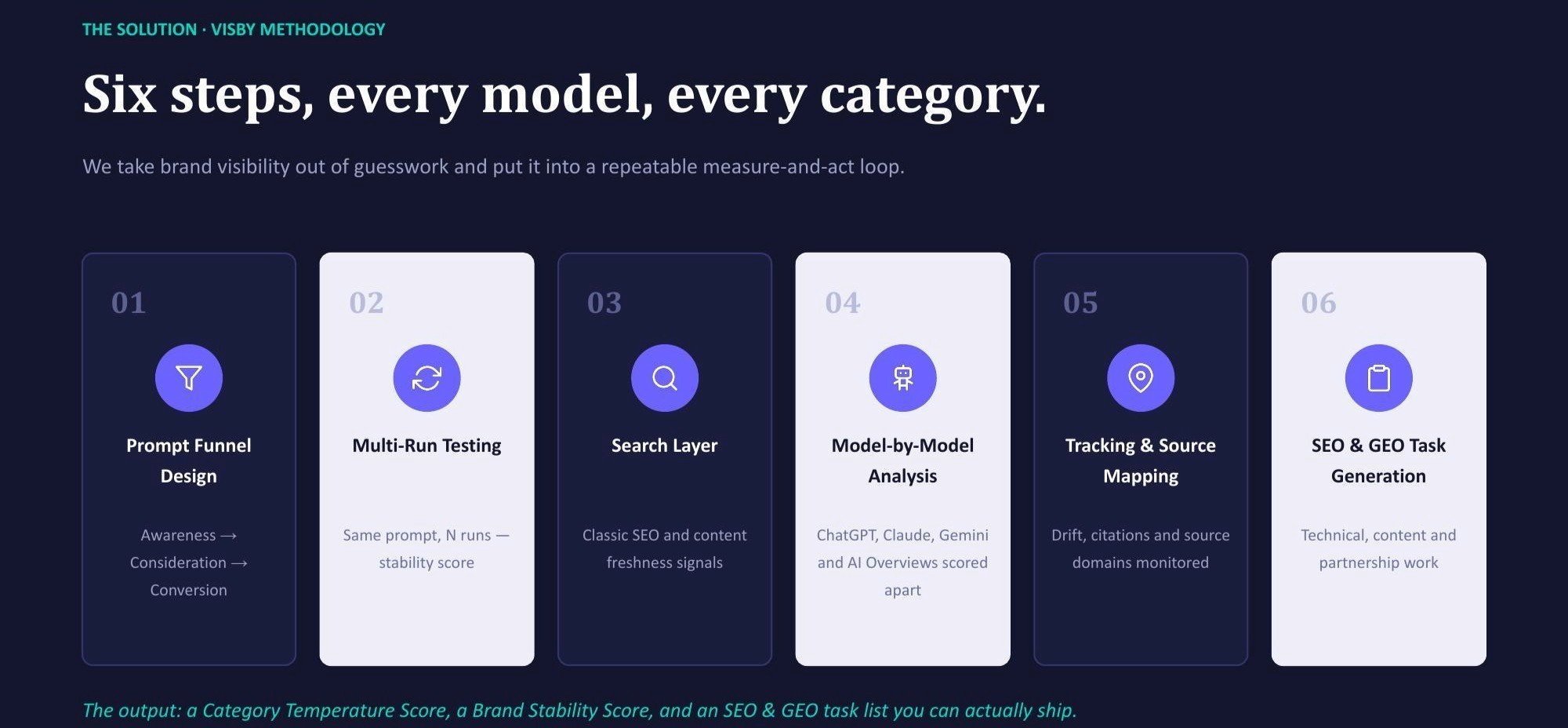
Prompt Funnel Design: building prompts across awareness, consideration, and conversion stages.
Multi-Run Testing: running the same prompt many times to produce a stability score instead of a single snapshot.
Search Layer: layering in classic SEO and content freshness signals.
Model-by-Model Analysis: scoring ChatGPT, Claude, Gemini, and AI Overviews separately, since each one weighs sources differently.
Tracking & Source Mapping: monitoring drift, citations, and the source domains feeding each answer.
SEO & GEO Task Generation: turning findings into technical, content, and partnership tasks.
The output is a Category Temperature score, a Brand Stability score, and a prioritized SEO and GEO task list, according to Visby, which is what turns a one-off audit into a process a team can keep running.
Which Brands Use Visby for AI Visibility Tracking?
Among Visby’s more than 2,500 clients spanning over 30 countries, its roster includes well known names across banking, retail, fashion, technology, and FMCG. In Turkey, for example, its client list includes the following brands, named in Visby’s own materials.
Sector | Brands |
|---|---|
Banking & Finance | QNB, Yapı Kredi, Kuveyt Türk, Gedik Yatırım |
Retail & E-commerce | Kelebek, Atelier Rebul, Pastel Cosmetics, Doğtaş |
Fashion | dossha, Silk and Cashmere, DCEY, Brandroom |
Technology & SaaS | Navlungo, Pronet, Purunity, TransferChain |
FMCG | Saf, İmuneks Farma, Ersu |
Agencies | TierOne, Adinteraction |

Visby is also listed as an OpenAI Select Partner, which places it among the vendors OpenAI has recognized for building on its models.
Visby AI Visibility Tracking: Platform vs. Managed Consulting
Visby offers two ways to run the platform, and both follow the same underlying methodology.
Visby Platform (Self-serve)
Full access to the dashboard: run scans, configure prompts and competitors, and read the scores directly. This fits teams that:
Already have SEO or GEO expertise in-house
Want hands-on control of the tool
Prefer a lean, self-managed setup
Visby + Consulting (Managed)
Everything in the platform, plus a dedicated strategist who designs the prompt funnel, builds the backlog, and executes it together with the client. This fits teams that:
Want expert judgment behind every recommendation
Would rather focus on execution than analysis
want technical, content, and partnership work handled for them
Both paths follow the same four-step process: a 30-minute discovery call, a first scan and baseline in week one, an SEO and GEO backlog built in weeks two and three, and ongoing tracking of impact after that.
Visby Reviews and Industry Recognition
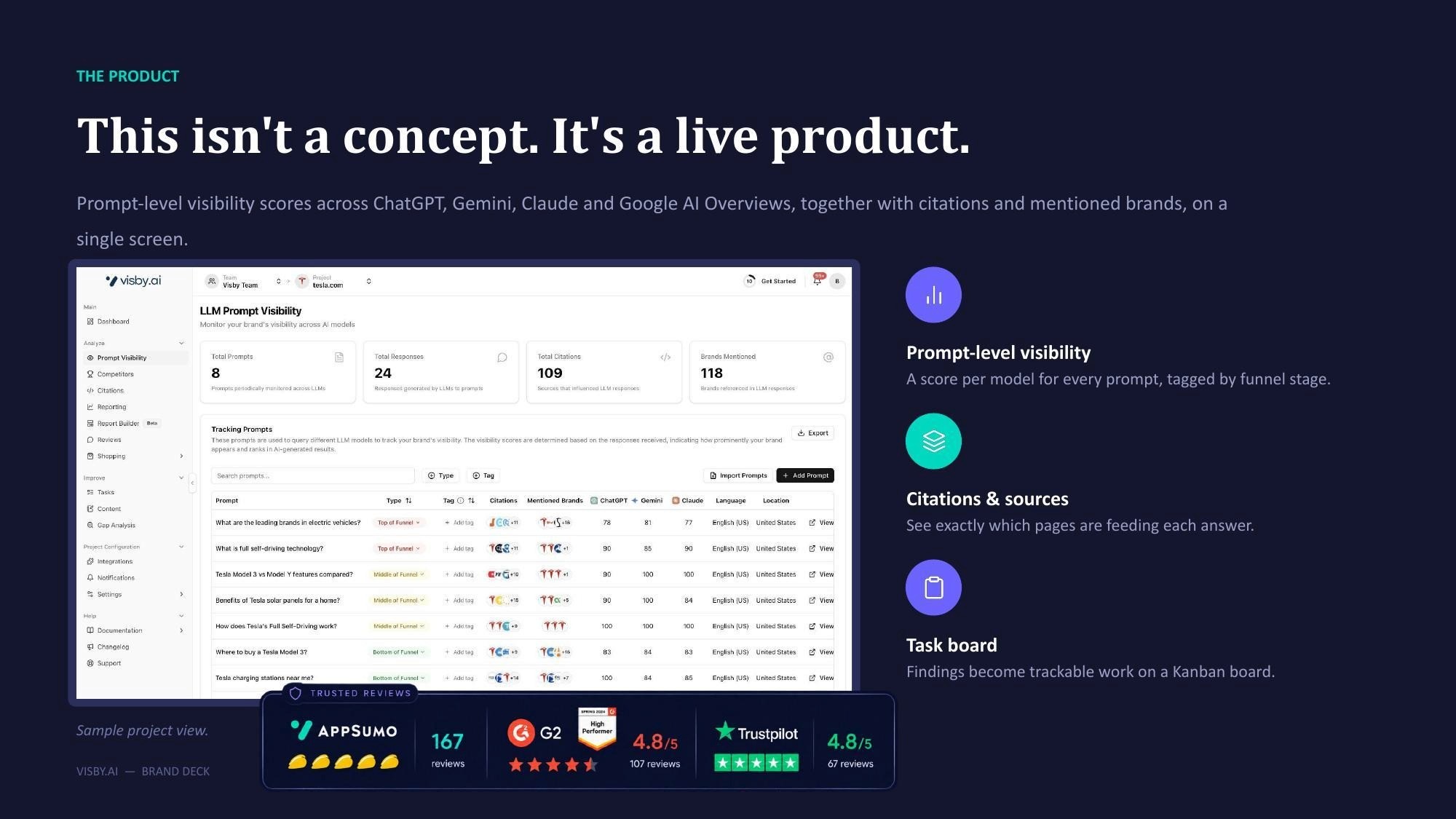
The product side of this story holds up under scrutiny too. Visby has been named in several G2 Summer 2026 categories, including High Performer, Best Results, Best Usability, Best Relationship, and Most Implementable, along with matching small business categories. It also holds a 4.8 out of 5 rating on G2 from 107 reviews and a 4.8 out of 5 rating on Trustpilot from 67 reviews, plus 167 reviews on AppSumo, according to the badges shown in Visby’s brand deck. That is a consistent pattern across three independent review platforms, not a single flattering number.

Frequently Asked Questions
What does AI visibility mean?
AI visibility describes how often, and how prominently, a brand is mentioned when an AI model such as ChatGPT or Gemini answers a question related to that brand’s category.
How is AI visibility different from SEO?
SEO optimizes a page to rank on a results list that stays largely fixed. AI visibility (also called GEO, or generative engine optimization) focuses on being mentioned or recommended inside a generated answer, which can change from one run to the next, so it is measured as a distribution across many runs rather than a single position.
What is category temperature?
Category temperature is a concentration score that shows whether one brand effectively owns an AI generated answer or whether several brands are still competing for it. Cold categories show high consensus; very hot categories show high volatility.
Which AI engines does Visby track?
Visby tracks ChatGPT, Gemini, Claude, and Google AI Overviews, with more than five engines covered overall.
Do I need in house SEO or GEO expertise to use Visby?
No. Teams with existing SEO or GEO expertise can run the self-serve Visby Platform directly, while teams that would rather not manage it themselves can use Visby + Consulting, where a strategist builds and executes the backlog.

