All articles
·
16 min read
10 AI SEO Best Practices to Rank in AI Search Results
Learn 10 proven AI SEO best practices to rank in AI search results, get cited by ChatGPT, Gemini and Claude.

Search is changing faster than most teams can keep up. Google AI Overviews, ChatGPT, Claude, Perplexity, Copilot and Gemini are no longer just novelties. They are now primary research tools for millions of people every day. ChatGPT alone reached 800 million weekly active users as of late 2025, doubling in just eight months. For businesses and content teams, this shift means that showing up on page one of Google is no longer the full picture. You also need to show up inside the AI-generated answers that users are reading instead of clicking through to websites.
This is where AI SEO comes in. It is the practice of optimizing your content so that AI search engines can find it, understand it, and cite it in their responses. In this guide, we walk through 10 best practices that cover both the technical and content side of the equation, so your brand stays visible whether someone searches on Google or asks ChatGPT for a recommendation.
What Is AI SEO? How Is It Different from Traditional SEO?
AI SEO refers to optimizing content for AI-powered search platforms alongside traditional search engines. While traditional SEO focuses on ranking in the blue-link results on Google or Bing, AI SEO is about being selected as a source when generative engines like ChatGPT, Gemini, Perplexity, or Google AI Overviews compose an answer for a user. The goal is not just a ranking position. It is a citation inside a generated response that millions of people read and trust.
The difference in how these systems work is significant. Traditional search engines match keywords to pages. AI search engines interpret the intent behind a query, look across multiple sources, and synthesize a single answer. Generative AI engines no longer process queries through simple keyword logic. They evaluate context, meaning, and topical relevance to find the most useful answer for the user.
Factor | Traditional SEO | AI SEO / GEO |
|---|---|---|
Goal | Rank in the top 10 blue links | Get cited in AI-generated answers |
Keyword logic | Exact keyword matching | Intent and context interpretation |
Content format | Long-form, keyword-dense pages | Self-contained, question-answering chunks |
Authority signals | Backlinks, domain authority | E-E-A-T, fresh data, expert citations |
Success metric | SERP position, organic CTR | AI citation rate, share of voice |
User behavior | Click through to website | Read AI answer, may or may not click |
Platforms | Google, Bing | ChatGPT, Gemini, Perplexity, AI Overviews |
This does not mean traditional SEO becomes irrelevant. Strong SEO is still the foundation that makes AI visibility possible. Many searches still produce overlapping results between top Google rankings and AI citations, and maintaining solid organic performance gives you the best starting position for GEO as well. What changes is the layer you build on top of it, one that speaks directly to how generative systems evaluate and cite content.
How Do AI Search Engines Like ChatGPT and Gemini Rank Content?
AI search engines do not rank content the way Google does. There is no traditional position 1, 2, or 3. Instead, these systems scan a wide pool of sources, assess each one for relevance, authority, and clarity, and then decide which pieces of information to include in a generated response. If traditional SEO was about earning a spot among 10 blue links, GEO is about earning a place among the two to seven domains a large language model typically cites in a single response.
Several factors influence whether your content gets picked up. Content depth and readability carry the most weight when it comes to AI citations, while traditional metrics like backlinks and traffic volume have a surprisingly small impact. Pages that load fast, answer questions directly, and are structured with clear headings and schema markup consistently outperform longer but poorly organized content.
Which Content Types Get Cited Most in AI Search?
Content Type | AI Citation Share | Why It Performs Well |
|---|---|---|
Listicles | 21.9% | Easy to extract individual items as answers |
Articles | 16.7% | Deep coverage of a single topic |
Product pages | 13.7% | Structured data, specs, and direct answers |
Guides | 11.2% | Step-by-step format matches AI query patterns |
Blog posts | 8.4% | Fresh, conversational, and often question-led |
One important nuance is that different AI platforms pull from different types of sources. Listicles account for the highest share of AI citations at around 22%, followed by articles and product pages. This means content format is a real strategic choice, not just a style preference. Writing in the formats AI systems favor increases your chances of being cited across multiple platforms.
It also matters whether AI crawlers can actually access your pages. A surprising number of sites block AI bots without realizing it, particularly after certain CDN providers updated their default security configurations. Before worrying about optimization, make sure your robots.txt file and server settings are not accidentally keeping AI systems out.
1. Map Your Content to AI Search Intent, Not Just Keywords
Traditional keyword research tells you what people type into a search bar. AI intent research tells you what those people actually want to accomplish and what related questions they will likely ask next. These two things are often very different, and generative search engines are built to answer the second, not just the first.
Research from Semrush in April 2026 found that between 65% and 85% of ChatGPT prompts have no matching keyword in their database. This is a major signal. If you are writing content only around known keywords, you are missing the majority of AI-driven queries. Effective AI SEO requires you to think about the full landscape of intent surrounding a topic, not just the entry point.
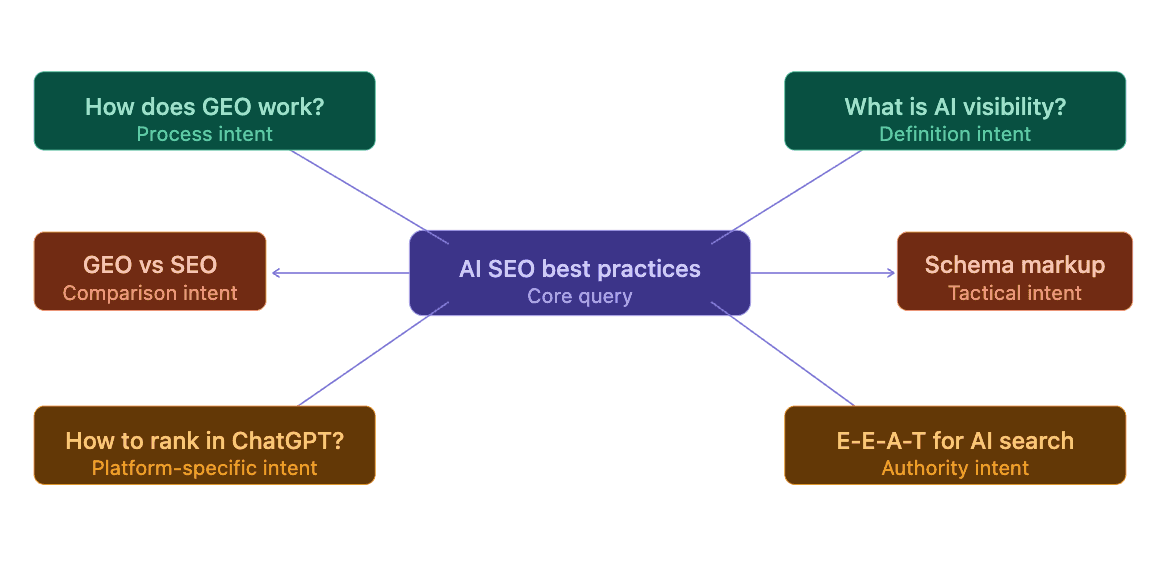
The fan-query technique is a practical way to build this kind of coverage. Start with a core topic and map out every related question, comparison, and follow-up that a user might have. If someone searches for “AI SEO best practices,” they might also want to know how GEO works, how it differs from traditional SEO, which platforms to optimize for, and what tools to use. All of these questions should be addressed within your content or across your internal linking structure.
Tools like AlsoAsked.com and AnswerThePublic show you exactly how one query branches into dozens of related needs. Use these to build content that covers not just the main query but the surrounding intent cluster. This makes your content far more useful to generative engines, which interpret queries in context rather than in isolation. You can explore more about how Visby AI tracks these intent signals in its AI visibility platform.
2. Structure Your Content to Answer AI Search Queries
AI systems do not read your article the way a human does. They scan for clear, self-contained sections that can be extracted and used as part of a generated answer. If your content is structured as flowing prose without distinct sections, it is much harder for an AI engine to pull out the specific answer it needs. Chunk-based writing is the structural principle behind most high-performing AI SEO content.
Each H2 and H3 in your article should represent a specific question or idea. The opening sentence of each section should deliver the answer directly, before adding context or detail. This structure matches how AI systems process content. They prioritize the most information-dense sentence at the top of a section. Sections that bury the answer in the third or fourth sentence are less likely to be cited.
A study analyzing 10,000 real-world queries found that pages containing structured lists, statistics, and direct quotes had 30 to 40% higher visibility in AI responses. Short numbered or bulleted lists within sections are also highly effective because they give AI engines clean, extractable data points. Use them whenever you are explaining a process, listing criteria, or summarizing key takeaways. Avoid using lists as filler. Every item should carry real informational value.
Finally, avoid vague transitions between sections. Phrases like “as mentioned above” or “now let us talk about” reduce the standalone clarity of a section. Each part of your article should be able to stand on its own if extracted, quoted, or cited without the surrounding context.
3. Build Topical Authority to Boost AI Visibility
Topical authority means covering a subject in enough depth and breadth that AI systems recognize your site as a reliable source on that topic. It is not about having one well-optimized page. It is about having a cluster of interlinked, high-quality content that signals genuine expertise across related subtopics. Generative search engines are more likely to cite sources that consistently appear across multiple dimensions of a topic.
Building topical authority starts with a content strategy. Identify the core subject you want to own, map the subtopics around it, and build individual pages for each one. For example, if you want to rank for GEO-related terms, you should have separate content covering what GEO is, how it differs from SEO, how to measure AI visibility, how to optimize for specific platforms like ChatGPT and Perplexity, and so on.
Content that includes specific statistics, expert quotes, and clearly attributed sources tends to get cited more frequently by AI systems. This means topical authority is not just about volume. It is about quality signals within each piece. Citing recent research, referencing authoritative reports, and including expert perspectives all reinforce the trustworthiness of your content in the eyes of generative engines.
Internal linking is also a key part of this strategy. When your pages link to each other using relevant anchor text, they create a connected web of content that makes the topical structure of your site visible to both AI systems and traditional search engines.
4. Optimize for Conversational Search and Natural Language
The way people ask questions in AI search tools is fundamentally different from how they type into a search bar. Users talk to ChatGPT or Gemini in full sentences, with context and nuance. They say things like “I run a small e-commerce business and want to know how AI search will affect my product pages” rather than just “AI search e-commerce.” Content that is written in a natural, direct tone is much better positioned to match these conversational queries.
This does not mean your content should be informal or imprecise. It means you should write the way a knowledgeable person explains something to a colleague, clearly, without unnecessary jargon, and with the reader’s actual question in mind. Short sentences work better than long complex ones. One idea per paragraph is easier for AI systems to process than paragraphs that mix several points together.
Avoid writing that sounds like it was assembled from a template. Formulaic phrases that do not add informational value are unlikely to appear in AI-generated citations. Generative engines favor content that sounds like it was written by a real expert trying to actually help someone, not content padded with stock phrases or buzzwords.
Conversational search also means anticipating follow-up questions. After answering your main heading question, think about what the reader would logically ask next and address it in the same section or the next one. This kind of anticipatory writing directly mirrors how AI systems string together answers to queries with multiple layers of intent.
5. Use Schema Markup to Help AI Engines Understand Your Content
Schema markup is backend code that tells AI systems exactly what your content is about, in a format they can process without any ambiguity. Where a human reader understands context from tone and structure, an AI crawler reads structured data. Adding the right schema to your pages removes interpretation from the equation and tells the system precisely what type of content it is looking at and what it means.
Research consistently shows that pages with proper schema markup achieve significantly higher AI visibility, with some studies pointing to a 30 to 40% improvement. This holds across platforms. The most useful schema types for AI SEO are FAQ schema, Article schema, HowTo schema, Product schema, and Review schema. FAQ schema is particularly powerful because it explicitly tells AI systems that a section of your page is in question-and-answer format, exactly the format generative engines prefer to cite.
Schema markup essentially removes the guesswork for AI crawlers. When a system can immediately identify that a section of your page is a frequently asked question with a specific answer, it does not need to interpret your content structure. That clarity gives you a direct advantage over pages that rely on formatting alone to communicate meaning.
You do not need a developer to implement basic schema. Most CMS platforms support schema plugins, and Google’s Structured Data Markup Helper makes it straightforward to generate the right code. Start with FAQ schema on your most important informational pages, then expand to Article and HowTo schema as you build out your content library.
6. Keep Your Content Fresh and Up to Date
AI search engines have a strong preference for recent information. When a generative engine is composing an answer about a fast-moving topic, such as AI search trends, digital marketing, or industry data, it looks for sources that reflect the current state of things, not content that was accurate two years ago but may have since changed. Outdated content not only risks being inaccurate. It actively signals to AI systems that your source may not be trustworthy.
Some AI models show a clear preference for content freshness, consistently prioritizing sources with recent publication or update dates over older alternatives covering the same topic. This means publishing a great article once and leaving it is not enough. You need a process for regularly revisiting your most important pages to update statistics, replace outdated examples, add new research, and reflect any changes in the topic. Even small updates can send a freshness signal to AI systems.
For time-sensitive topics, include explicit date references in your content. Phrases like “as of early 2026” or “based on Q1 2026 data” tell AI systems when your information was last verified. This is a direct trust signal. You should also cite recent reports and studies wherever possible. Content that references sources from the past 12 months consistently performs better in AI citations than content relying on older data.
Freshness also matters for your overall domain. A consistent publishing cadence tells AI systems that your site is actively maintained. Even one or two new, high-quality articles per month is enough to keep your content profile looking current and engaged.
7. Target Featured Snippets and Zero-Click AI Answers
Featured snippets are the text boxes that appear at the top of Google results before the regular links. In the context of AI SEO, they are also one of the strongest signals that your content is formatted in a way generative engines can easily extract and cite. Pages that rank for featured snippets tend to also perform well in AI Overviews and other AI-generated answer formats, because the structural requirements are nearly identical.
According to 2025 research, brands that get cited in AI Overviews earn significantly more organic and paid clicks than those that do not appear in these results at all. Being inside the AI answer positions you as the trusted source on that topic, which increases both brand recognition and the quality of traffic you receive. This means targeting featured snippets and AI citations is not just about visibility. It has a direct impact on click-through and conversion.
To target featured snippets, format key answers as short, direct paragraphs of 40 to 60 words, placed immediately after the relevant H2 or H3 heading. Definition questions work best with a two or three sentence explanation. List-based questions work best with a clear numbered or bulleted list with a brief intro. How-to questions work best with a numbered step format where each step is one clear action.
Zero-click AI answers are not a reason to deprioritize content quality. Research shows that users who click through from an AI response convert at a much higher rate than standard organic visitors, because they arrive already informed and further along in their decision. Optimizing for AI citations is optimizing for conversion quality, not just reach.
8. Strengthen Your E-E-A-T Signals for Generative AI Rankings
E-E-A-T stands for Experience, Expertise, Authoritativeness, and Trustworthiness. It was introduced by Google to evaluate content quality, and it has become equally central to how generative search engines assess whether a source is worth citing. AI systems are trained to favor content that demonstrates genuine knowledge and credibility, not content that just appears to be authoritative on the surface.
E-E-A-T Signals Checklist for AI Search
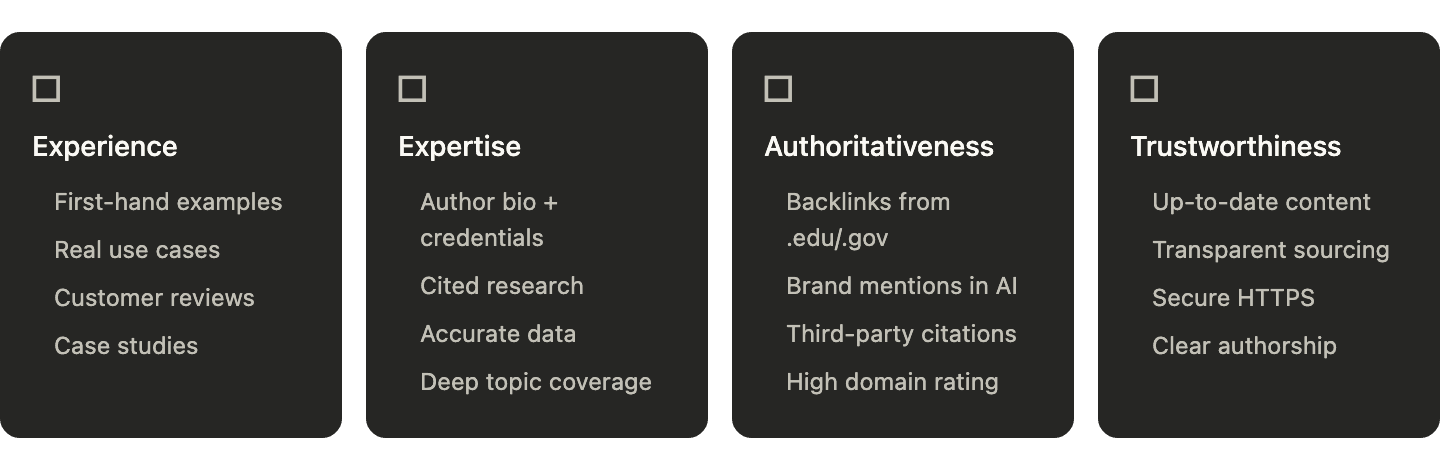
Experience signals come from first-hand knowledge: real examples, customer stories, data from your own platform, and content that reflects direct involvement with a topic rather than surface-level research. Expertise is shown through accurate, deep coverage of a subject, clearly attributed to a person or team with relevant credentials. Authoritativeness builds over time through backlinks from credible sources, third-party mentions, and citations in other published content.
Trustworthiness is the most directly actionable. Make sure your content is factually accurate, regularly updated, and sourced with transparent references. Include author bios on articles. Make it easy for users and AI systems to verify who wrote the content and why they are qualified to write it. User-generated content such as reviews on G2, discussions on Reddit, and community feedback also strengthens trust signals because it reflects real-world experience with your brand rather than self-reported claims.
For AI-specific visibility, third-party sources matter more than brand-owned pages. AI platforms tend to trust external mentions and citations over content that lives on your own domain. Invest in getting your brand mentioned and cited in industry publications, research reports, and authoritative community discussions. You can read more about how Visby measures brand authority in AI search in our guide onwhat AI visibility means and why it matters.
9. Use Internal Links to Show Topical Depth
Internal linking is one of the most underused tools in AI SEO. When you link between related pages on your site using descriptive anchor text, you are not just helping users navigate. You are creating a visible map of your content structure that both traditional search engines and AI crawlers can read. A well-linked content hub signals that your site has genuine depth on a topic, not just a single page that covers it superficially.
The anchor text you use matters. “Click here” or “learn more” tells AI systems nothing about where the link goes. Contextual anchor text like “how to build a GEO strategy” or “AI visibility tracking for e-commerce” is far more informative. It tells the linking system exactly what the destination page covers, strengthens the topical connection between both pages, and reinforces the keyword relevance of the target page.
Aim for at least two to three internal links per article, each going to a page that is genuinely related to the section you are linking from. Do not force links where they do not fit. Relevance is more important than volume. A useful internal link structure for anyone building a GEO content cluster might include pages like What Is GEO, GEO vs SEO, GEO Content Optimization, and How to Build a GEO Strategy.
Internal linking also prevents content cannibalization. When multiple pages on your site cover overlapping topics, clear internal linking and distinct angles for each page help AI systems understand which page is the definitive source for each specific query.
10. Add FAQs to Get Cited by AI Search Engines
FAQ sections are one of the most direct ways to increase your chances of being cited in AI-generated answers. Generative search engines are designed to answer questions, and a well-structured FAQ section gives them exactly what they need: a clear question followed immediately by a direct, self-contained answer. Pages that include FAQs with FAQ schema consistently outperform pages without them in AI visibility metrics.
The key is to write FAQs that reflect real user questions, not questions that are convenient for you to answer. Use tools like AlsoAsked.com, Google’s “People Also Ask” section, and Perplexity to find the actual questions users are asking about your topic. Focus on questions that are specific enough to have a clear answer but broad enough to be genuinely useful to your audience. Generic questions produce generic answers that AI systems will not prioritize.
Each FAQ answer should be between 40 and 80 words, long enough to be genuinely informative and short enough to be easily extracted. Start the answer with the key point, then add one or two supporting sentences. Avoid answers that require the user to read several sentences before getting to the point. Direct, structured, and factual answers are what get cited.
Placing your FAQ section at the end of each article, with FAQ schema in the backend, gives you two advantages at once: it increases your chances of appearing in featured snippets and AI answers, and it covers the question variants that your main body may not have addressed directly. It is one of the lowest-effort, highest-impact changes you can make to any existing piece of content.

