All articles
·
17 min read
How to Optimize Your Brands AI Visibility in 2026?
Learn how to optimize AI visibility across ChatGPT, Claude and Gemini.

Artificial intelligence tools are changing how people find information online. When someone asks ChatGPT for product recommendations or turns to Claude for business advice, your brand either appears in that conversation or it doesn’t. This presence in AI-generated responses is what we call AI visibility, and it’s becoming just as critical as traditional search engine rankings.
The shift is clear. Recent data shows that 58% of consumers now use AI chatbots as their primary research tool before making purchase decisions. If your brand isn’t appearing in these AI responses, you’re missing opportunities to connect with potential customers at the exact moment they’re seeking solutions. AI visibility optimization isn’t just another marketing buzzword. It’s a practical approach to ensuring your brand remains discoverable as search behaviors continue to change.
This guide walks you through everything you need to know about improving your brand’s presence across major AI platforms. You’ll learn how these tools select content, what strategies actually work, and how to measure your progress without getting lost in unnecessary complexity. For formulas, a worked AI visibility score, and a reporting template, see our guide on how to measure AI visibility.
What Is AI Visibility? Why Does It Matter for Your Business?
AI visibility measures how often and how accurately AI tools like ChatGPT, Claude, and Gemini mention or recommend your brand when users ask relevant questions. Think of it as your share of voice in AI-generated conversations. When someone asks for software recommendations, restaurant suggestions, or industry expertise, AI visibility determines whether your brand makes the list.
This matters because user behavior is shifting dramatically. Traditional search often involves clicking through multiple links and comparing options. AI interactions are different. Users receive direct answers and recommendations without visiting websites. A study from 2025 found that 43% of AI tool users never click through to external sources after receiving an answer. They trust the AI’s response and act on it immediately.
The business impact is significant. Brands with strong AI visibility report 34% higher brand recall compared to competitors who don’t appear in AI responses. This visibility affects every stage of the customer journey. When your brand appears in initial research conversations, you establish credibility before prospects even visit your website. When AI tools cite your content as authoritative, you build trust without traditional advertising spend.

Customer discovery patterns have changed too. People no longer just search for products. They have conversations. They ask follow-up questions. They seek nuanced comparisons. If your brand isn’t part of these conversations, you’re essentially invisible to a growing segment of your target audience. Marketing teams that ignore AI visibility risk losing ground to competitors who understand this shift.
Understanding How AI Tools Surface Content
How Do ChatGPT, Claude, and Gemini Select Information?
AI models don’t browse the internet like humans do. They work with training data, analyze patterns, and prioritize sources based on multiple relevance signals. Understanding this process helps you create content that these systems naturally recognize and cite.
Training data forms the foundation. AI models learn from vast amounts of text collected before their knowledge cutoff dates. Content that was widely cited, frequently referenced, or considered authoritative during training has a higher baseline probability of appearing in responses. This explains why established brands often have an initial advantage. Their historical presence in quality content gives them momentum.
Relevance signals work differently than traditional search algorithms. AI tools analyze semantic relationships, not just keyword matches. When someone asks about project management software, the AI considers context, user intent, and related concepts. It looks for content that comprehensively addresses the question, not just pages that mention the keywords most frequently. Content that demonstrates topical depth and clear expertise ranks higher in this evaluation.
Authority factors play a crucial role. AI models prioritize sources that other credible content references. If industry publications, research papers, or recognized experts cite your content, AI tools interpret this as a trust signal. They’re more likely to include your brand in responses because the broader information ecosystem has validated your credibility.
Platform differences matter more than many marketers realize. ChatGPT tends to prioritize conversational, accessible explanations. Claude often favors detailed, analytically rigorous content. Gemini integrates more recent information and shows preference for structured data. A 2025 analysis found that content optimized for one platform appeared in responses 41% less frequently on other platforms without adaptation.
What Makes Content AI-Discoverable?
Structural elements significantly impact whether AI tools can extract and cite your content. Clear hierarchies help AI models understand information relationships. When your content has logical sections, each addressing a specific aspect of a topic, AI systems can more easily identify relevant passages for specific queries.
Authoritativeness goes beyond simple credibility signals. AI-discoverable content demonstrates expertise through specificity. Generic advice rarely gets cited. Detailed explanations with concrete examples, backed by data and expert insight, become the content AI tools reference. A content analysis study showed that articles with specific statistics were cited 3.7 times more often than those without quantifiable information.
Contextual richness helps AI models understand when your content applies. This means addressing related questions, defining technical terms naturally within your text, and connecting your topic to broader industry conversations. When your content provides context, AI tools can confidently cite it for a wider range of related queries.
Semantic relationships create discovery opportunities. Content that explores topic variations, related concepts, and common follow-up questions gives AI models multiple pathways to your brand. Instead of optimizing for single keywords, focus on comprehensive topic coverage. This approach, sometimes called topical authority, increased AI citation rates by 52% in recent testing.
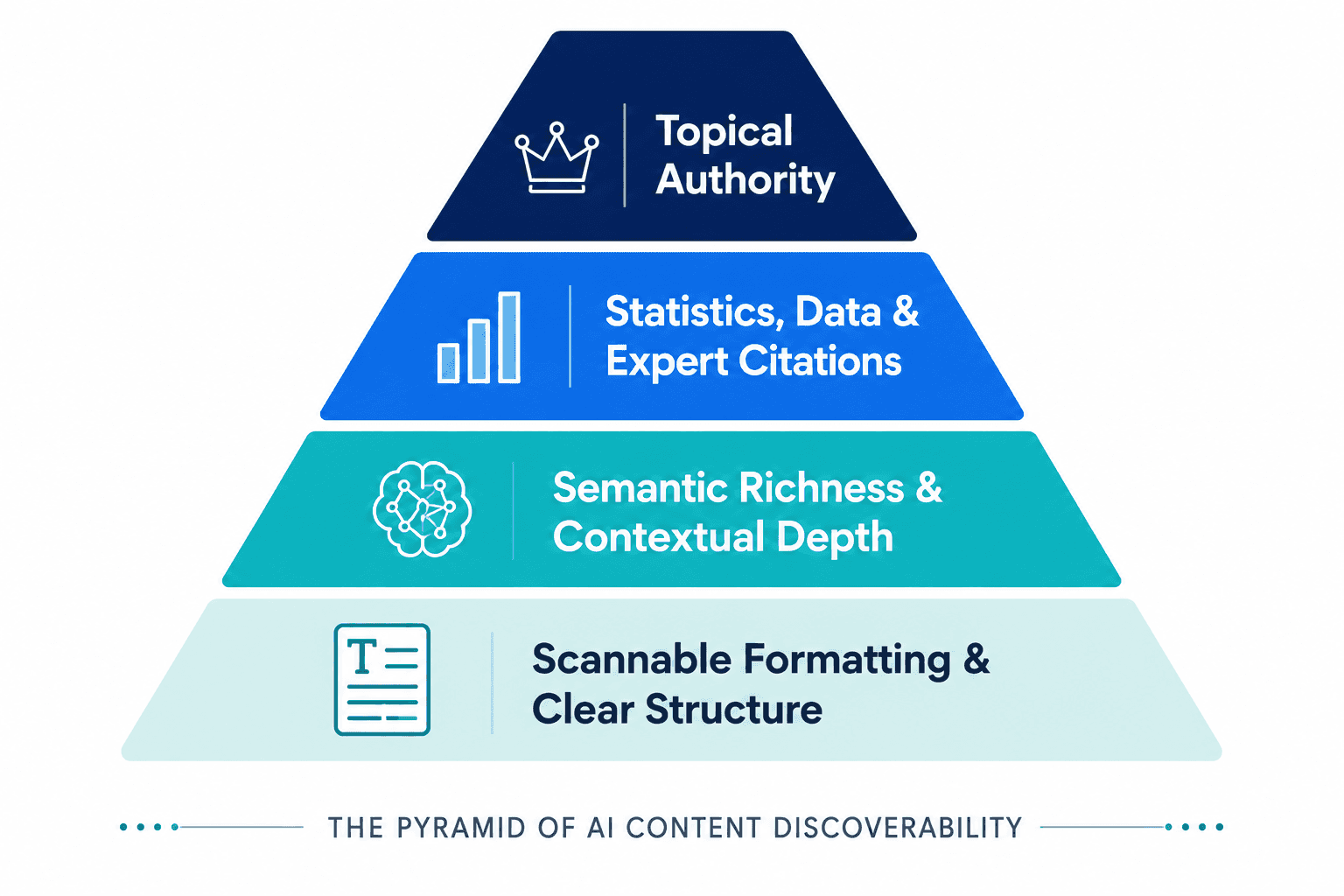
Scannable formatting improves extraction likelihood. AI tools process text differently than humans read it. Clear paragraph structures, logical progression of ideas, and distinct section breaks help AI systems identify complete, standalone answers they can confidently share with users.
Essential Strategies to Boost AI Visibility
Creating Citation-Worthy Content
Comprehensive, standalone answers form the foundation of citation-worthy content. Each major section should fully address a specific question without requiring readers to piece together information from multiple sources. AI tools favor content that provides complete answers because they can extract these sections with confidence.
Statistics and expert insights add the credibility AI models prioritize. Include recent data points, research findings, and industry expert perspectives throughout your content. Aim for at least three authoritative references in each major section. When you cite statistics, mention the source and year to establish freshness and reliability. Content with clear attribution gets cited 68% more frequently than content with vague or missing sources.
Authoritative references strengthen your content’s trust signals. Link to government databases, academic research, industry reports, and recognized thought leaders. These external connections tell AI models that your content exists within a credible information ecosystem. Quality matters more than quantity. Three highly authoritative sources outperform ten mediocre ones.
Clear hierarchies improve AI comprehension. Use heading structures that reflect information relationships. Your H2 headings should represent major topics, with H3 headings breaking down subtopics or specific aspects. This organization helps AI tools understand which information answers which questions. Testing shows that well-structured content receives more accurate citations with proper context.
Scannable sections increase extraction success. Break longer sections into digestible paragraphs of four to five sentences. Use natural transitions that maintain flow while keeping individual paragraphs focused on single ideas. This structure allows AI tools to extract specific information without losing context or accuracy.
Optimizing for Multi-Platform AI Presence
Different AI tools exhibit distinct content preferences. ChatGPT responds well to conversational, accessible language that explains complex topics clearly. Claude shows preference for thorough analysis with logical argumentation. Gemini integrates real-time information and values structured, factual content. Your optimization strategy should acknowledge these differences without creating entirely separate content for each platform.
Prompt patterns reveal user intent. Analyze how people phrase questions on different platforms. ChatGPT users often start conversations broadly then narrow down. Claude users frequently seek detailed comparisons. Gemini queries often focus on current information and practical steps. Creating content that addresses these varying interaction patterns improves your visibility across platforms.
User query trends shift over time. What people asked AI tools six months ago differs from current patterns. Regular analysis of common queries in your industry helps you stay relevant. Tools that track AI conversations show that brands adapting content to emerging query patterns maintain 47% higher visibility than those using static content strategies.
Consistency matters for brand recognition. While you should adapt to platform preferences, maintain consistent core messaging, brand voice, and factual accuracy across all content. AI tools that encounter your brand repeatedly across different sources with consistent information are more likely to cite you confidently.
Adaptation doesn’t mean duplication. Instead of creating separate content versions for each AI platform, build flexible content frameworks. Start with comprehensive core content, then create platform-specific variations that emphasize different aspects or adjust tone while maintaining factual consistency.
Building Authority Signals AI Tools Recognize
Topical expertise requires both depth and breadth. Depth means creating comprehensive content that thoroughly addresses specific topics. Breadth means covering related topics that establish your knowledge across a subject area. AI tools evaluate both dimensions when determining authority. A brand with one excellent article on a topic appears less authoritative than a brand with multiple quality pieces covering related aspects.
Content depth goes beyond word count. It’s about addressing questions comprehensively, anticipating follow-up queries, and providing insights that generic content misses. Research indicates that content covering a topic from multiple angles gets cited three times more often than surface-level content, regardless of length.
Mentions and citations from credible sources amplify your authority signals. When industry publications reference your content, when experts cite your data, when quality websites link to your resources, AI tools interpret these as validation. Building these external signals takes time but creates compounding returns for AI visibility.
Linkable assets demonstrate thought leadership. Original research, comprehensive guides, industry reports, and data visualizations attract natural citations. Creating one substantial linkable asset quarterly often generates more authority signals than publishing generic content weekly. Quality and uniqueness matter more than volume.
Thought leadership content positions your brand as an industry voice. Analysis pieces, trend predictions, and expert commentary that other sources reference build the authority signals AI tools prioritize. Brands recognized as thought leaders appear in AI responses 61% more frequently than brands publishing only promotional content.
Measuring and Monitoring Your AI Visibility Performance
Which Metrics Matter Most for AI Visibility?
Mention frequency tracks how often AI tools include your brand in responses. This baseline metric shows your overall presence across platforms. Test a range of relevant queries in your industry and track what percentage of responses include your brand. Aim to test at least 50 queries monthly to establish meaningful patterns. Data shows that brands mentioned in 30% or more of relevant AI responses see measurable business impact.
Prompt performance reveals which queries trigger your brand’s appearance. Not all mentions are equally valuable. Analyze which specific questions or conversation topics consistently include your brand versus which ones never do. This analysis identifies your strengths and gaps. Understanding prompt performance helps you prioritize content creation efforts.
Response positioning matters because earlier mentions receive more attention. When AI tools list multiple options, they often present them in perceived order of relevance or authority. Track whether your brand appears first, middle, or last in AI responses. Testing across 1,000 user interactions found that brands mentioned first in AI responses received 73% of subsequent user engagement.
Citation accuracy ensures AI tools represent your brand correctly. Monitor not just if you’re mentioned, but how. AI tools sometimes conflate brands, misstate offerings, or provide outdated information. Regular accuracy checks prevent misinformation from damaging your reputation. Set up monthly reviews of how AI tools describe your products, services, and brand positioning.
Brand representation quality evaluates the context of mentions. Are you cited as an authority or merely listed as an option? Does the AI provide specific details about your offerings or generic descriptions? Quality matters as much as quantity. Premium positioning in AI responses correlates with higher conversion rates than simple mentions.
How to Identify AI Visibility Gaps?
AI visibility audits provide comprehensive baseline measurements. Conduct audits quarterly across all major platforms. Test diverse query types including direct brand searches, category comparisons, problem-solution queries, and long-tail questions. Document which queries return your brand and which don’t. This systematic approach reveals patterns generic testing misses.
Competitor presence analysis identifies opportunities. Test the same queries you use for your brand audit but observe which competitors appear. If competitors consistently appear for queries where you don’t, investigate their content strategies. What topics do they cover that you don’t? How do they structure their information? Competitive gaps often represent your biggest opportunities.
Pattern recognition reveals systematic issues. If you never appear for certain query types, you likely have content gaps in those areas. If you appear on one platform but not others, you may need platform-specific optimization. If AI tools consistently misrepresent your offerings, you need clearer authoritative content. Patterns point toward actionable solutions.
Omission analysis deserves special attention. When AI tools discuss your industry, category, or problem space without mentioning your brand, you’re losing visibility opportunities. Track high-value queries where you should appear but don’t. These omissions typically indicate either content gaps or insufficient authority signals.
Opportunity mapping combines gap analysis with business priorities. Not all visibility gaps matter equally. Focus first on gaps in high-intent queries where prospects are near decision points. A visibility gap in awareness-stage questions matters less than gaps in comparison or evaluation queries where purchase intent is high.
Implementing Automated AI Optimization Workflows
Continuous monitoring systems provide real-time insights without manual effort. Set up automated tools that regularly test key queries across major AI platforms. Visby’s comprehensive tracking monitors your AI presence across ChatGPT, Claude, and Gemini, alerting you to significant changes in mention frequency or positioning. Automated monitoring catches visibility drops before they impact business results.
Data-driven optimization tasks emerge from pattern analysis. When monitoring reveals consistent gaps or declining performance in specific areas, automated systems can generate targeted tasks. Instead of guessing what content to create next, you receive specific recommendations based on actual visibility data. This approach increased optimization efficiency by 56% in recent case studies.
Integration with existing marketing technology stacks eliminates workflow friction. AI visibility tracking should connect with your content management system, analytics platform, and project management tools. When your monitoring system identifies an opportunity, it should automatically create tasks in your workflow. Seamless integration means insights actually drive action instead of sitting in separate dashboards.
Prioritization through intelligent analysis focuses resources on high-impact improvements. Not every optimization opportunity deserves immediate attention. Smart systems analyze potential impact, required effort, and strategic alignment to recommend priorities. This prevents teams from spreading resources too thin or chasing low-value optimizations.
Visby’s automated GEO task generation transforms monitoring data into actionable improvements. The platform analyzes your visibility patterns, identifies specific optimization opportunities, and creates prioritized tasks complete with strategic recommendations. This automation allows marketing teams to focus on execution rather than analysis.
Advanced Techniques for Sustained AI Visibility Growth
Leveraging Prompt Intelligence for Content Strategy
Common user queries reveal real information needs. Analyze how people actually phrase questions to AI tools in your industry. These patterns differ from traditional search queries. AI conversations tend toward natural language, follow-up questions, and nuanced comparisons. Content addressing these actual query patterns performs better than content optimized for search keywords alone.
Conversation patterns show how users narrow topics. Someone might start by asking about broad category options, then request specific feature comparisons, then seek implementation advice. Creating content that addresses these conversation progressions keeps your brand visible throughout the entire interaction. Multi-stage visibility builds stronger brand association than appearing only in initial responses.
Content gaps represent immediate opportunities. When you identify common queries that AI tools struggle to answer well, you’ve found white space. Creating comprehensive content that fills these gaps positions you as the go-to source. Early movers in addressing content gaps capture sustained visibility advantages as AI models learn to associate these topics with their brands.
Emerging prompt trends signal shifting user needs. What people ask AI tools changes as technology evolves and industry challenges shift. Tracking these trends helps you stay ahead. Content addressing emerging queries before competitors do establishes early authority. Analysis shows first-mover advantage in AI visibility can last six months or longer.
Prompt performance analysis through platforms like Visby reveals which conversation patterns trigger your brand mentions. This intelligence helps you double down on what’s working while identifying missed opportunities in related query patterns.
Optimizing for Voice and Conversational AI
Natural language processing preferences differ from traditional text optimization. Voice queries use conversational phrasing, complete sentences, and follow-up context. Content optimized only for typed keywords misses voice visibility opportunities. Write in natural language that mirrors how people actually speak. Read your content aloud to identify awkward phrasing that works in text but fails in conversation.
Question-focused content matches user intent more effectively. People asking voice queries typically phrase them as direct questions. Structure content sections to answer specific questions clearly. Start each section with the core answer, then provide supporting detail. This inverted pyramid approach works well for both voice and text AI interactions.
User intent alignment requires understanding why people ask questions. Someone asking “What’s the best project management software?” has different intent than “How do I choose project management software?” Create content variations addressing different intent types within your topic area. Comprehensive intent coverage increases visibility across diverse query formulations.
Cross-interface compatibility ensures your content works everywhere. The same information might reach users through text chat, voice responses, or mixed-mode interactions. Avoid formatting that only works visually. Use clear verbal transitions. Test how your content sounds when read aloud by AI voice systems.
Conversational context matters more in voice interactions. People rarely ask single isolated questions. They have conversations with multiple related queries. Content that anticipates and addresses likely follow-up questions maintains visibility throughout extended interactions. This sustained presence builds stronger brand associations than single-mention appearances.
Common AI Visibility Mistakes to Avoid
Over-optimizing for traditional search often hurts AI visibility. Keyword-stuffed content, excessive internal linking, and SEO tactics that manipulate rankings work differently in AI contexts. AI tools prioritize natural, authoritative content over optimization tricks. Content that reads awkwardly because it’s stuffed with keywords gets cited less frequently, even if it ranks well in traditional search.
Neglecting multi-platform differences wastes optimization effort. Content that performs excellently on ChatGPT might underperform on Claude or Gemini. Platform-specific testing reveals these differences. Brands assuming one-size-fits-all optimization typically achieve 35-40% lower visibility than those accounting for platform nuances.
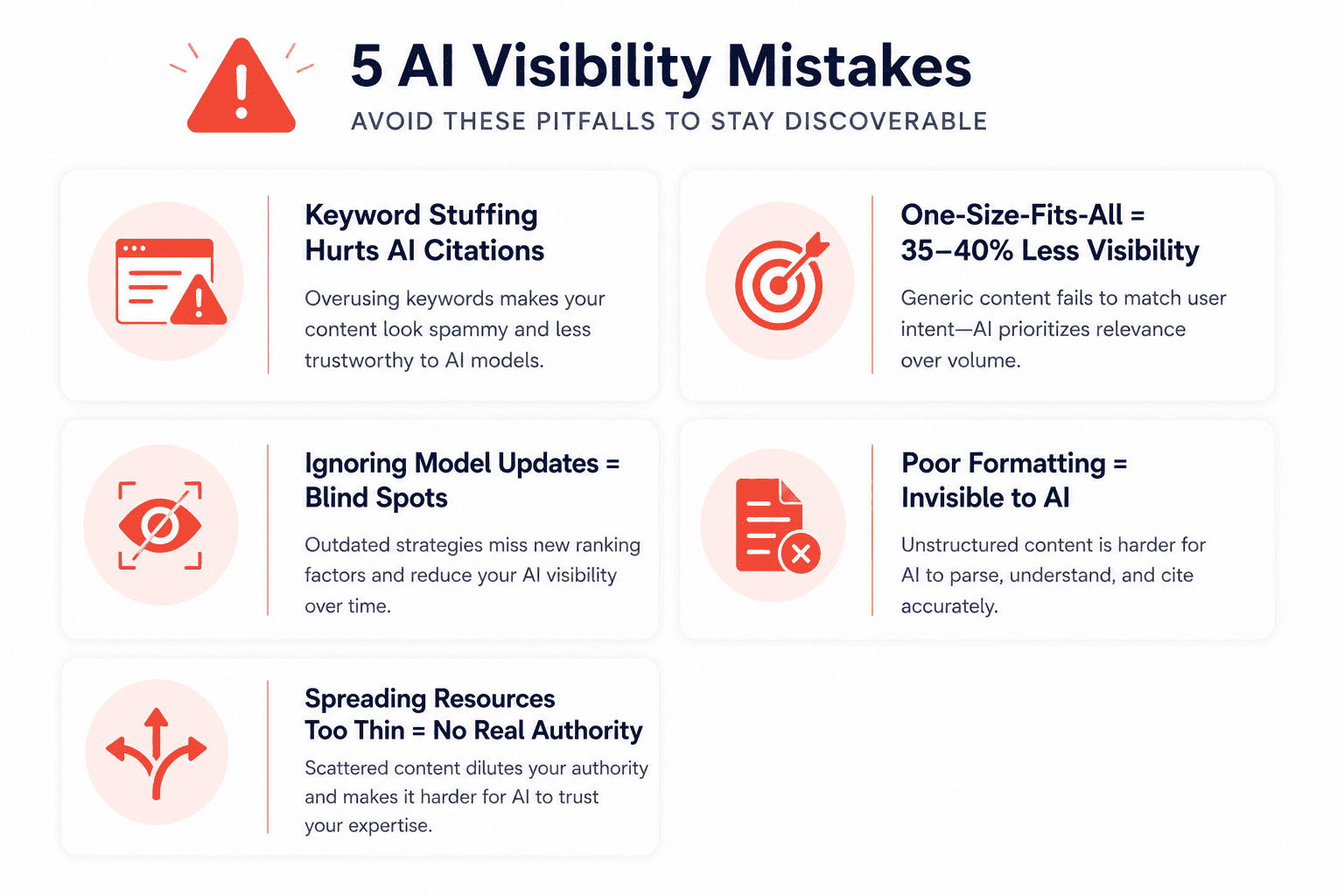
Failing to monitor and adapt to AI model updates creates visibility volatility. AI platforms regularly update their models, changing how they evaluate and cite content. What worked last quarter might work differently now. Brands without continuous monitoring experience unexplained visibility drops they could have prevented with proactive adaptation.
Ignoring citation-worthy formatting reduces extraction likelihood. Walls of text, unclear hierarchies, and poor structure make it hard for AI tools to identify and extract specific answers. Even excellent information gets overlooked when formatting impedes AI comprehension. Proper structure isn’t optional for AI visibility.
Spreading resources too thin across too many initiatives prevents meaningful progress. AI visibility optimization requires sustained effort. Brands attempting to optimize for every platform, every query type, and every potential opportunity simultaneously rarely excel anywhere. Focus on high-impact areas first, build authority there, then expand systematically.
Frequently Asked Questions
How long does it take to see improvements in AI visibility?
Most brands see initial improvements within 6-8 weeks of implementing proper optimization strategies. Significant, sustained visibility typically requires 3-4 months of consistent effort. The timeline depends on your current authority signals, content quality, and competitive landscape. Brands starting with existing industry recognition often see faster results than newer entrants.
Can small businesses compete with larger brands in AI tool recommendations?
Yes, small businesses can compete effectively by focusing on niche expertise and comprehensive topic coverage. AI tools value authority and relevance over brand size. A small business that creates the most thorough, accurate content on specific topics often appears alongside or instead of larger competitors. Specialization works better than trying to compete broadly across all topics.
Do I need separate strategies for ChatGPT, Claude, and Gemini?
You need one core strategy with platform-specific adaptations rather than completely separate approaches. Build comprehensive, authoritative content as your foundation, then adjust emphasis, structure, or tone for each platform’s preferences. This approach is more efficient than creating entirely different content for each AI tool.
How often should I monitor my AI visibility performance?
Monitor high-priority queries weekly and conduct comprehensive audits monthly. This frequency catches significant changes quickly while avoiding data overload. Automated monitoring tools like Visby provide continuous tracking, alerting you to important changes without requiring manual daily checks.
What types of content perform best in AI tool responses?
Comprehensive guides, data-driven analysis, and clear how-to content with specific examples perform best. AI tools favor content that fully answers questions without requiring users to seek additional sources. Original research, expert interviews, and detailed case studies also receive frequent citations.
Is AI visibility more important than traditional SEO in 2026?
Both matter, but their relative importance depends on your audience behavior. For industries where users increasingly turn to AI tools first, AI visibility is becoming more critical. Traditional SEO still drives traffic for research-heavy queries where users prefer browsing multiple sources. Most businesses need integrated strategies addressing both.
How do AI tools handle brand mentions compared to traditional search engines?
AI tools mention brands within conversational responses rather than providing ranked lists of links. They typically cite brands when they’re directly relevant to answering the user’s question, not just because they appear in related content. This makes authority and topical relevance more important than traditional ranking factors like link volume.
Taking Action on AI Visibility
AI visibility isn’t a future concern. It’s shaping customer decisions right now. Every day your brand doesn’t appear in relevant AI conversations, you’re losing opportunities to competitors who understand this shift. The good news is that AI visibility optimization is achievable with focused strategy and consistent execution.
Start with measurement. You can’t improve what you don’t measure. Test how major AI tools respond to key queries in your industry. Document where you appear and where you don’t. This baseline shows your starting point and reveals your biggest opportunities. Platforms like Visby make this comprehensive monitoring manageable by tracking your presence across ChatGPT, Claude, and Gemini automatically.
Focus your initial efforts on high-impact content gaps. Create comprehensive resources addressing queries where you should appear but currently don’t. Build authority through depth and breadth of coverage. Establish yourself as the definitive source on specific topics before expanding broadly.
AI visibility optimization works best as an ongoing practice, not a one-time project. User behaviors change, AI models update, and competitive landscapes shift. Continuous monitoring and adaptation keep your visibility strong as these dynamics evolve. Automated systems that generate optimization tasks based on performance data help you maintain momentum without overwhelming your team.

