All articles
·
9 min read
Peec AI vs Visby AI: Which AI Visibility Tool Earns Its Keep?
Peec AI vs Visby AI comparison

Most AI visibility tools answer one question well. Where does your brand show up?
That’s useful. But it’s not enough.
The harder question is what you actually do about it. And that’s where most platforms leave you alone with a dashboard and a vague list of suggestions.
That gap is exactly what this comparison is about.
I tested both Peec AI and Visby AI hands-on. Peec is a well-funded Berlin startup with $29M raised, 2,000+ customers, and a clean analytics product. Visby is our platform and I work on it, so take that for what it’s worth. I’ve tried to be fair. The data speaks for itself.
What Each Platform Is Actually Built For?
Peec AI is an AI search analytics platform. It tracks how your brand appears across AI engines, benchmarks you against competitors, and surfaces the sources driving AI mentions. It does this well. Clean interface, reliable data, fast setup.
Visby AI is built around a different premise. Measurement without action is just an expensive dashboard. The platform connects visibility data to a task system, content generation, and funnel-level competitive analysis all under one roof. It doesn’t just show you where you are. It tells you what to do next and produces the content to get there.
AI Model Coverage and What It Actually Costs?
This is one of the most misunderstood parts of the Peec pricing structure.
Every Peec AI plan includes 3 model slots. You choose from ChatGPT, Perplexity, Gemini, AI Overviews, and Copilot. Want to add Claude, DeepSeek, or Grok? That’s €20 to €30 per model per month on top of your base plan.
The math adds up fast. Starting at €89/month on Starter, adding Claude brings you to around €109 to €119. Add DeepSeek and you’re at €129 to €149. For genuinely comprehensive coverage, you can easily reach €169 to €209 per month before you’ve done anything else.
Visby AI includes ChatGPT, Claude, and Gemini from day one. No add-ons. No model upgrades. $79/month is $79/month.
This matters strategically, not just financially. Claude has become a critical platform for B2B brands specifically. Excluding it from your baseline tracking means you’re making strategy decisions with incomplete data and then paying extra to fix that gap later.
Peec AI vs Visby AI: First Impressions
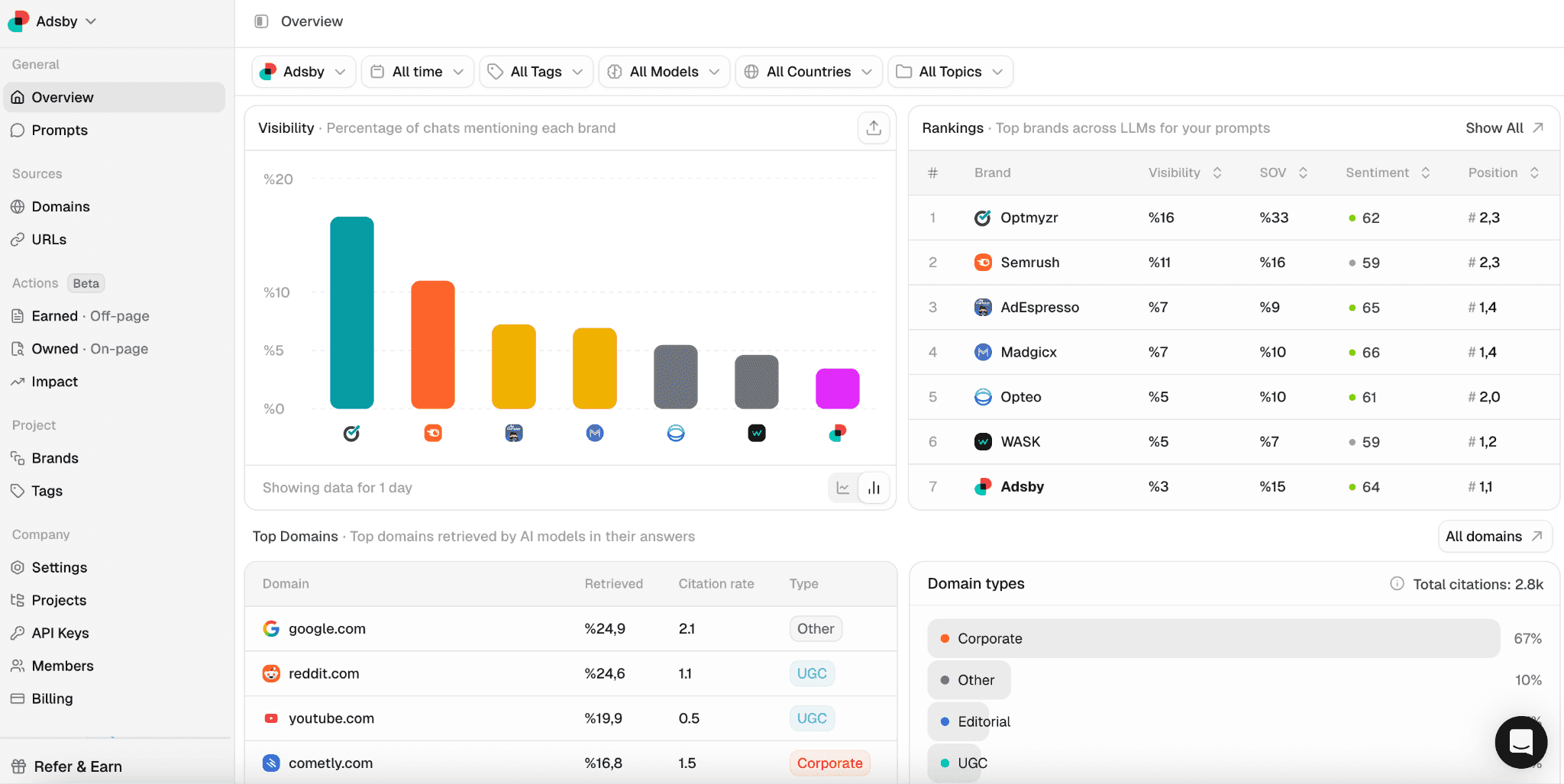
Peec AI’s dashboard is genuinely information-dense. You get your brand’s visibility percentage, competitive rankings with SOV and sentiment scores, which domains AI models are citing most, and a live feed of recent AI conversations on one screen. For analytically-minded teams this is a strong foundation.
Visby AI asks a different question. What will you do with this data?

The dashboard produces six interconnected scores across SEO, GEO, Content Match, SERP, Review, and Page Speed. These aren’t isolated metrics. Most AI chatbots run live web searches before generating responses, which means weak SEO directly weakens AI visibility. Visby makes that connection visible and ties each score to specific pending tasks you can action immediately.
There’s also a layer Peec doesn’t have. Visby shows you how many visitors actually came from ChatGPT, Gemini, Claude, Perplexity, and Copilot in a given date range. Not just are you mentioned, but is that mention sending people to your site.
Prompt Level Analysis in Peec AI vs Visby AI

Peec AI’s prompt detail view is one of the most analytically rich in this category. SOV, sentiment, position tracking, and fanout queries let you see exactly which secondary searches AI models run when answering a prompt. For competitive intelligence work this depth is hard to match.
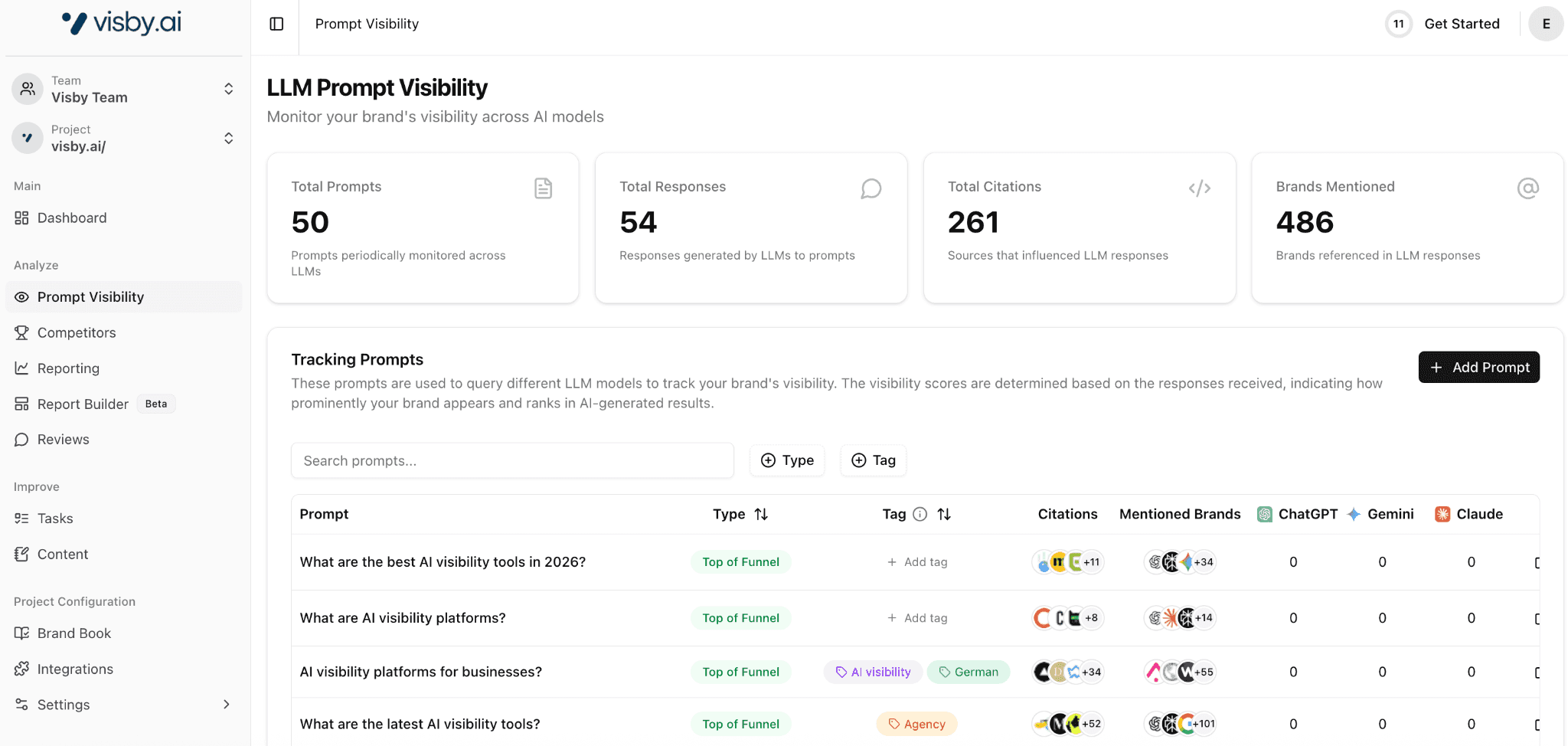
Visby AI adds a dimension Peec doesn’t offer. Every response gets an intent classification, either Commercial or Informational. This distinction matters more than it sounds. “What’s the best project management tool?” carries purchase intent. “What is project management?” does not. Knowing where you appear and where you disappear by intent type gives content strategy a level of precision that raw mention counts simply don’t provide.
Each response also comes with Citations and Mentioned Brands tabs showing exactly which sources the AI referenced and which other brands appeared alongside yours. Context that turns visibility data into something you can actually act on.
Competitor Tracking in AI Search: Peec AI vs Visby AI

Peec AI ranks competitors by mention count. You see who gets cited most, which is a reasonable baseline.

Visby AI breaks competitor performance down by funnel stage. Top of Funnel, Middle of Funnel, and Bottom of Funnel are each tracked separately. A competitor might dominate awareness-stage searches while trailing badly in purchase-intent queries. Without that breakdown you’re allocating budget and content resources against an incomplete picture.
The classification system goes further too. Direct, Indirect, and Not Competitor. Brands that appear in AI responses alongside yours but aren’t actually your competitors show up in their own category. Comparison sites, editorial sources, content platforms. Knowing who’s indirectly affecting your visibility is the first step to deciding whether that’s a partnership opportunity or something to route around.
Integrations That Connect AI Visibility to SEO
Integration | Peec AI | Visby AI |
|---|---|---|
Google Analytics | No | Yes |
Google Search Console | No | Yes |
Bing | No | Yes |
Shopify | No | Yes |
This gap matters more than it looks on paper.
Most AI chatbots run live web searches before generating their responses. That means your traditional SEO performance directly affects whether you show up in AI answers. If you can’t see your GSC data alongside your AI visibility scores in the same platform, you’re missing the connection between the two and making optimization decisions based on half the picture.
Bing and Shopify integrations widen that gap further. Bing is a major organic search channel in its own right, and brands that ignore it are leaving a meaningful slice of search visibility unmeasured. For e-commerce brands, Shopify integration means your product and sales data sits in the same view as your AI visibility scores, which is where attribution actually gets useful.
Peec has no native integration with any of these tools at any tier. Visby connects all four from day one, without any extra setup required.
Peec AI Actions vs Visby AI Tasks
This is where the two platforms separate most clearly.
Peec AI Actions
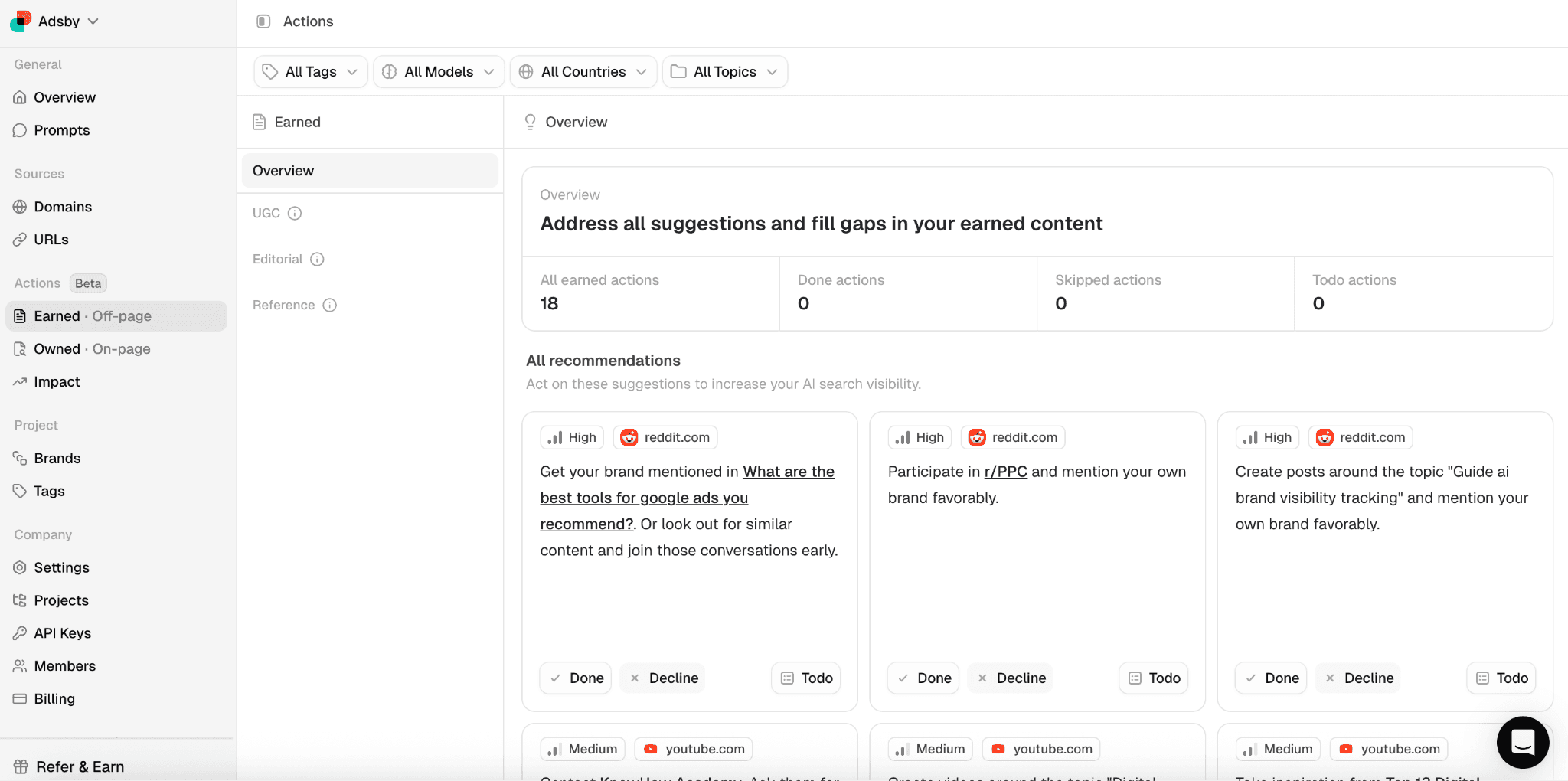
Peec AI Actions Earned / Off-Page

Peec AI Actions Owned / On-Page
Peec’s Actions feature converts visibility data into recommendation cards. The Earned side surfaces a handful of off-page suggestions covering Reddit threads and Wikipedia opportunities. The Owned side offers content suggestions pointing to high-performing competitor content as models, spanning content types like listicles, articles, category pages, how-to guides, and comparisons.
The direction is right. But each card ends at Done, Decline, or Todo. Who’s responsible? What’s the deadline? Which team member owns it? None of that exists inside the platform. And the entire feature carries a Beta label, which raises a reasonable question about how much weight to put on it when you’re paying monthly.
Peec users are left to interpret the data and build their own content strategy, source a separate tool for content creation, manage task assignment and tracking outside the platform, and bridge the gap between insight and execution independently.
Visby AI Tasks
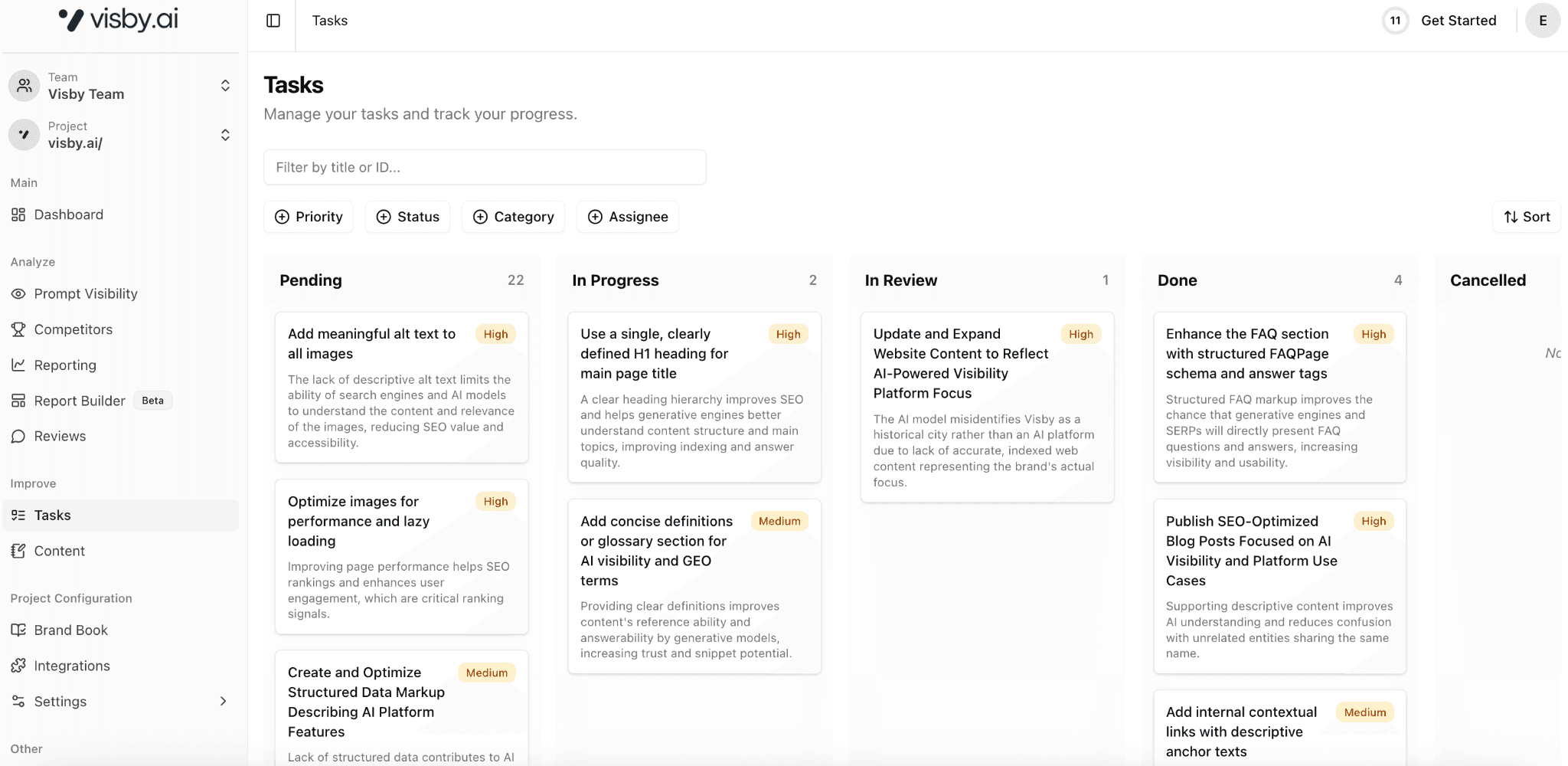
Visby AI generates tasks for the same domain and these aren’t suggestion cards, they’re real work items. Each task has a title, a detailed description of what to do and why, and a priority level. You move them through a Kanban board from Pending through to Done, assign them to team members, and track progress without leaving the platform.
Blog tasks don’t say write an article. They arrive with a full working title, target keywords, and the funnel stage the piece should address. Technical SEO tasks include schema markup recommendations. Review management tasks specify which platforms to focus on first.
Most marketing teams don’t have the in-house expertise to translate AI visibility metrics into a prioritized content and optimization roadmap. Visby shortens the distance between our visibility score is low and here’s exactly what gets published next week.
Content Generation for AI SEO & Visibility
Peec AI does not generate content. The platform doesn’t claim to. It’s built for measurement and analytics and is honest about that scope.
Visby AI puts content generation at the center of the product. And what’s on offer goes well beyond a basic AI writing tool.

The platform analyzes your site structure, cross-references visibility data to identify content gaps, and produces SEO-optimized articles built to improve AI citation rates.
Keyword optimization means target terms are integrated naturally rather than just inserted. Internal linking means generated content is automatically connected to existing pages, closing the gap most content workflows leave open. Funnel alignment means tone and structure are adapted to awareness, consideration, or conversion intent. Schema markup guidance arrives alongside the content itself.
5 articles per month on Starter. 15 on Growth. Peec offers zero at any tier.
For teams that struggle to turn AI visibility data into published content, which is most teams, this is the practical difference between a tool that informs you and a tool that moves the needle.
Peec AI vs Visby AI Pricing
Starter Plans
Feature | Peec AI Starter | Visby AI Starter |
|---|---|---|
Price | $95/month | $79/month |
Included AI Models | 3 of 7 (your choice) | ChatGPT + Claude + Gemini |
Content Generation | None | 5 articles/month |
Task Management | Actions (Beta) | Kanban (active) |
Google Search Console | No | Yes |
Google Analytics | No | Yes |
Funnel-Based Competitor Analysis | No | Yes |
Growth Plans
Feature | Peec AI Pro | Visby AI Growth |
|---|---|---|
Price | $245/month | $199/month |
Included AI Models | 3 of 7 (your choice) | ChatGPT + Claude + Gemini |
Content Generation | None | 15 articles/month |
GSC Integration | No | Yes |
Projects | 2 | 3 |
Choose Peec AI If
Granular domain and source analytics is your primary need. You want deep competitive metrics across SOV, sentiment scores, and fanout queries. Unlimited user seats across your organization is a deciding factor. Perplexity tracking is essential to your coverage. You have internal capacity to translate measurement data into strategy independently. You want measurement only and handle content creation with separate tools.
Choose Visby AI If
You want to see the actual AI responses to your tracked prompts, not just visibility scores. You need to know exactly which of your pages are being cited in AI answers and which ones are getting ignored. Funnel-stage competitive analysis matters to how you allocate budget and content resources. You want to go from visibility data to published, SEO-optimized content without switching platforms. Your team needs task assignment, ownership, and progress tracking built in so nothing falls through the cracks. You want Claude and Gemini included without paying per model. You need Google Search Console, Google Analytics, Bing, and Shopify connected from day one. You care about where you stand at every stage of the buyer journey, not just whether you showed up somewhere.
AI SEO & Visibility Tools Compared: What I Actually Found?
I tested both. I work on Visby AI, so I’m obviously not a neutral party here. But I tried to be fair throughout this comparison, and I think the gaps speak for themselves.
Peec AI is a genuinely good monitoring product. The data is reliable, the interface is clean, and if your team has the capacity to take raw visibility analytics and build a full strategy from scratch, it gives you a strong foundation to work with.
But here’s what I actually found when I used both.
Peec tells you what’s happening. Visby tells you what’s happening, what to do about it, and then helps you do it. The task system is real, not beta. The content it generates is SEO-optimized and internally linked, not just AI text dropped into a blank page. The competitor view breaks down by funnel stage because that’s how buying decisions actually work.
When someone asks ChatGPT “what’s the best CRM for a small sales team” they’re just starting to look around. When they ask “HubSpot vs Pipedrive for outbound sales” they’re narrowing it down. When they ask “does HubSpot have a free plan with email sequences” they’re about to make a decision. Those are three different moments that need three different content strategies. We track all of them and tell you exactly where you’re losing ground.
That’s why we built Visby AI. Not to be another dashboard, but to actually help you show up when it matters.

