Back

Back

What is Universal Commerce Protocol (UCP)?

Google launches UCP to standardize AI-driven commerce.

Jan 11, 2026

Universal Commerce Protocol (UCP)

Google has launched Universal Commerce Protocol (UCP), an open-source standard designed to enable AI agents to facilitate complete shopping journeys across different platforms.

This article written by Visby team, an AI visibility tracking platform that monitors brand presence across AI-powered search engines including ChatGPT, Claude, and more.

UCP represents a significant shift in how commerce operates within AI-driven environments, addressing fragmented shopping experiences that currently lead to cart abandonment and inconsistent customer journeys. This new protocol allows AI assistants, shopping agents, and business systems to work together without requiring custom integrations for each connection.
Why Google Developed the Universal Commerce Protocol

The rise of AI-powered shopping assistants has created a major challenge for e-commerce businesses. Each AI platform requires unique integrations, forcing retailers to build separate connections for ChatGPT, Google's Gemini, Perplexity, and other AI systems. This fragmentation increases development costs and creates inconsistent shopping experiences.

Google recognized that agentic commerce requires standardized communication between platforms. Cart abandonment rates remain high when shoppers move between different AI assistants and retailer websites. UCP solves this problem by establishing a common language that all participants in the commerce ecosystem can understand and implement.

The protocol emerged from collaboration between Google and major retail partners including Shopify, Etsy, Wayfair, Target, and Walmart. Over 20 additional companies across retail and payment processing sectors have already endorsed the standard, demonstrating industry-wide recognition of the need for commerce interoperability.

How Universal Commerce Protocol Works

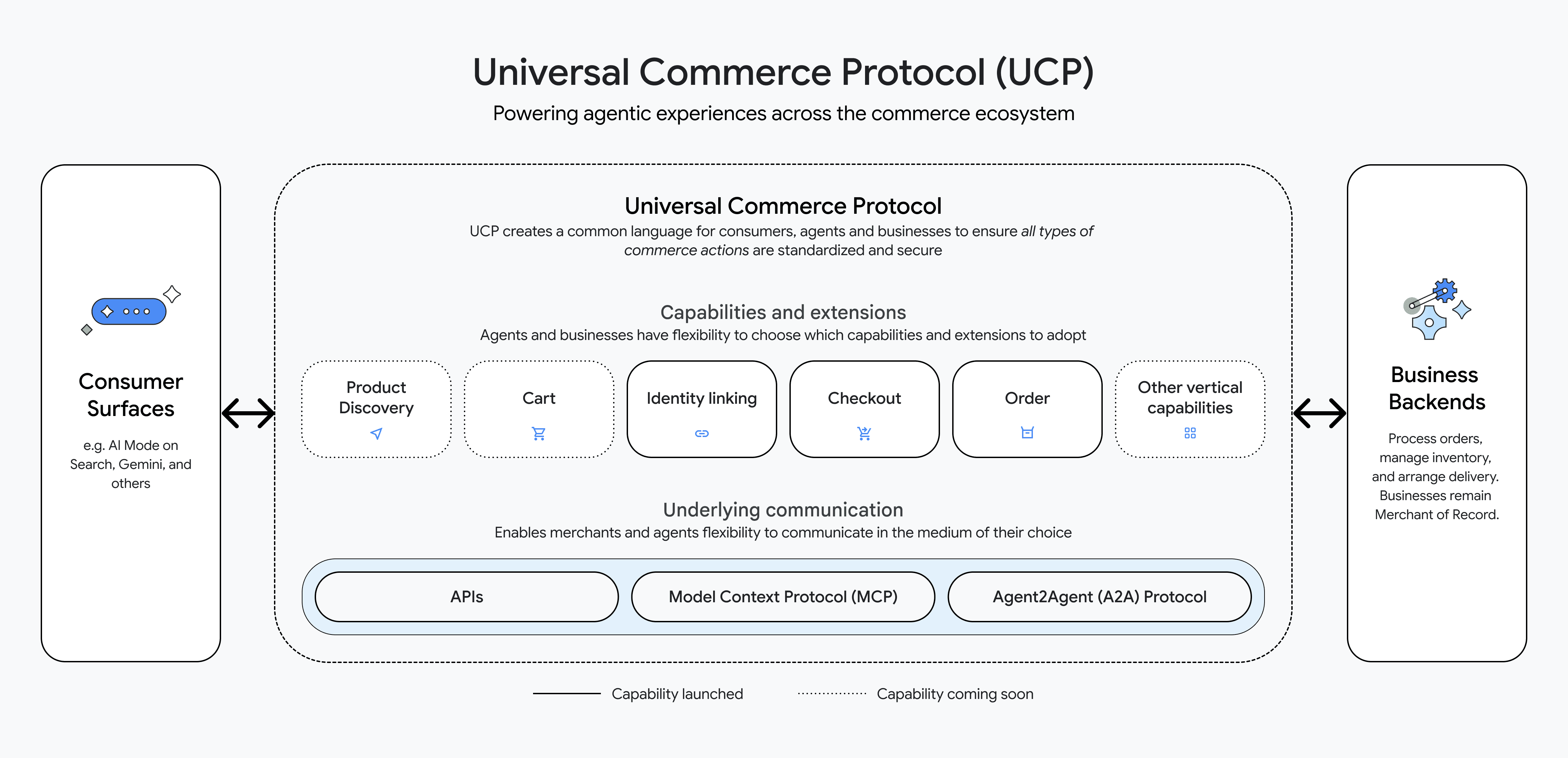
UCP builds on proven industry standards rather than creating entirely new systems. The protocol integrates with existing frameworks including REST and JSON-RPC for data transport, Agent Payments Protocol (AP2) for secure transactions, Agent2Agent (A2A) for cross-platform communication, and Model Context Protocol (MCP) for AI context management.

The system enables three core capabilities at launch. The Checkout capability handles complex cart logic, dynamic pricing, tax calculations, and shipping options through unified checkout sessions. Identity Linking uses OAuth 2.0 standards to maintain secure, authorized relationships between AI agents and retailer systems without sharing user credentials. Order Management provides real-time webhooks for purchase confirmation, shipment tracking, delivery updates, and return processing.

Businesses can choose between two implementation approaches. Native checkout allows AI platforms to integrate directly with a seller's checkout API, enabling custom UI and workflows while maintaining the retailer as the Merchant of Record. Embedded checkout lets retailers embed their existing checkout interface within AI platforms, supporting complex flows with bidirectional communication and payment delegation.

Key Benefits of UCP for E-Commerce Businesses

UCP delivers significant advantages for online retailers navigating the AI commerce landscape. The protocol reduces development overhead by eliminating the need for custom integrations with each AI platform. A single UCP implementation allows brands to appear across multiple AI shopping assistants including Google Search's AI Mode, Gemini app, and other compatible platforms.

Retailers maintain complete control over business logic, pricing rules, inventory management, and customer relationships. Unlike marketplace models where platforms control the experience, UCP ensures businesses remain the Merchant of Record with full ownership of transaction data and customer information.

The standardized approach reduces cart abandonment by creating seamless shopping experiences across AI touchpoints. Customers can research products through AI assistants, compare options, and complete purchases without encountering technical barriers or being forced to restart their shopping journey on different platforms.

Security and privacy protections are built into the protocol foundation. UCP leverages OAuth 2.0 for identity verification and AP2 for payment authentication, ensuring customer data remains protected throughout the transaction process. Payment methods are tokenized rather than directly shared, reducing security risks.

UCP vs Traditional E-Commerce APIs: What's the Difference?

Traditional e-commerce APIs require point-to-point integrations between retailers and each shopping platform. If a business wants to support purchasing through Google Shopping, Amazon, social commerce platforms, and AI assistants, they must build and maintain separate API connections for each. This approach is time-consuming, expensive, and difficult to scale.

UCP introduces a standardized protocol that works across platforms. Rather than building five different integrations, retailers implement UCP once and gain access to all compatible AI agents and shopping assistants. The protocol acts as a universal translator, enabling different systems to communicate without custom middleware.

Platform-specific APIs often lock retailers into proprietary systems with limited flexibility. UCP is open-source and extensible, allowing the commerce community to develop new capabilities and extensions. Developers can contribute improvements, and businesses can customize implementations to match their specific requirements.

The protocol addresses emerging commerce patterns that traditional APIs were not designed for. AI-driven shopping involves conversational interactions, context awareness across sessions, and the ability for agents to act on behalf of users. UCP includes these capabilities as core features rather than afterthoughts.

How to Implement Universal Commerce Protocol

Businesses can begin implementing UCP by accessing the complete technical specification and reference code through the public GitHub repository at github.com/Universal-Commerce-Protocol/ucp. The repository includes documentation, sample implementations, and SDK tools for common programming languages.

The implementation process starts with identity linking using OAuth 2.0. Retailers configure their authorization endpoints following standard OAuth flows, allowing AI agents to securely connect to customer accounts. This step ensures agents can access saved payment methods, shipping addresses, and order history with proper authorization.

Next, businesses implement the Checkout capability by exposing UCP-compliant REST endpoints or integrating via MCP binding. The checkout API handles cart management, pricing calculations, tax computation, shipping options, and payment processing. Retailers maintain full control over business rules while presenting a standardized interface to AI platforms.

Order Management capability involves setting up webhook endpoints for status updates. When orders are placed, shipped, or delivered, these webhooks notify connected AI agents so they can provide customers with real-time information through conversational interfaces.

Google provides integration support through developers.google.com/merchant/ucp, where retailers can find detailed implementation guides, test their integrations using the UCP playground at ucp.dev/playground, and access developer resources. Major e-commerce platforms including Shopify offer native UCP support, simplifying implementation for merchants on those platforms.

The Future of E-Commerce with UCP

The launch of UCP marks the beginning of agentic commerce, where AI assistants handle significant portions of the shopping journey on behalf of users. Google plans to expand UCP capabilities beyond the initial checkout, identity, and order features to include loyalty program integration, personalized recommendations, post-purchase support, and multi-channel inventory synchronization.

AI Mode in Google Search and the Gemini app will soon support UCP-powered checkout experiences for eligible product listings. Shoppers will be able to complete purchases while researching products through AI interfaces, using saved payment details with Google Pay and PayPal. This integration represents the first major deployment of agent-led commerce at scale.

Google is also launching Business Agent, a branded AI assistant that allows retailers to provide conversational support directly within Search results. Companies including Lowe's, Michael's, Poshmark, and Reebok are piloting this feature, creating virtual sales associates that answer questions in the brand's voice during high-intent shopping moments.

The advertising implications are significant. Google introduced Direct Offers, a new ad format within AI Mode that surfaces exclusive discounts when AI detects purchase intent. This format allows advertisers to influence AI-driven shopping decisions at critical moments, evolving beyond traditional search ads to AI-native commerce marketing.

Industry adoption will determine UCP's long-term impact. With endorsements from payment providers like Visa, Mastercard, PayPal, Stripe, and retailers including Best Buy, Kroger, Macy's, and Sephora, the protocol has strong initial support. As more platforms implement UCP, the network effects will increase value for all participants in the ecosystem.

FAQ

What is Universal Commerce Protocol?

Universal Commerce Protocol is an open-source standard that enables AI agents, shopping assistants, and business systems to interact throughout the complete shopping journey without requiring custom integrations for each platform connection.

Who developed UCP?

Google developed UCP in collaboration with major retail and technology partners including Shopify, Etsy, Wayfair, Target, Walmart, and over 20 endorsing companies across the commerce and payment industries.

How does UCP differ from traditional e-commerce APIs?

Unlike traditional APIs that require separate integrations for each platform, UCP provides a single standardized protocol that works across multiple AI shopping assistants and platforms, reducing development costs and maintaining consistency.

Do retailers maintain control over their business with UCP?

Yes, retailers remain the Merchant of Record and maintain complete control over pricing, inventory, business rules, and customer relationships when implementing UCP.

Is UCP secure for handling payments?

UCP leverages industry-standard security protocols including OAuth 2.0 for identity verification and Agent Payments Protocol (AP2) for payment authentication, ensuring customer data and transactions remain protected.

Which platforms currently support UCP?

Google's AI Mode in Search and Gemini app are implementing UCP-powered checkout. The protocol is designed to work with any AI platform or shopping assistant that adopts the standard.

How can businesses start using UCP?

Businesses can access the complete technical specification, documentation, and sample code through the public GitHub repository at github.com/Universal-Commerce-Protocol/ucp, and integration guides at developers.google.com/merchant/ucp.

What are the core capabilities of UCP?

The three initial core capabilities are Checkout (cart and payment processing), Identity Linking (secure account authorization), and Order Management (purchase tracking and updates).

Google has launched Universal Commerce Protocol (UCP), an open-source standard designed to enable AI agents to facilitate complete shopping journeys across different platforms.

This article written by Visby team, an AI visibility tracking platform that monitors brand presence across AI-powered search engines including ChatGPT, Claude, and more.

UCP represents a significant shift in how commerce operates within AI-driven environments, addressing fragmented shopping experiences that currently lead to cart abandonment and inconsistent customer journeys. This new protocol allows AI assistants, shopping agents, and business systems to work together without requiring custom integrations for each connection.

Why Google Developed the Universal Commerce Protocol

The rise of AI-powered shopping assistants has created a major challenge for e-commerce businesses. Each AI platform requires unique integrations, forcing retailers to build separate connections for ChatGPT, Google's Gemini, Perplexity, and other AI systems. This fragmentation increases development costs and creates inconsistent shopping experiences.

Google recognized that agentic commerce requires standardized communication between platforms. Cart abandonment rates remain high when shoppers move between different AI assistants and retailer websites. UCP solves this problem by establishing a common language that all participants in the commerce ecosystem can understand and implement.

The protocol emerged from collaboration between Google and major retail partners including Shopify, Etsy, Wayfair, Target, and Walmart. Over 20 additional companies across retail and payment processing sectors have already endorsed the standard, demonstrating industry-wide recognition of the need for commerce interoperability.

How Universal Commerce Protocol Works

UCP builds on proven industry standards rather than creating entirely new systems. The protocol integrates with existing frameworks including REST and JSON-RPC for data transport, Agent Payments Protocol (AP2) for secure transactions, Agent2Agent (A2A) for cross-platform communication, and Model Context Protocol (MCP) for AI context management.

The system enables three core capabilities at launch. The Checkout capability handles complex cart logic, dynamic pricing, tax calculations, and shipping options through unified checkout sessions. Identity Linking uses OAuth 2.0 standards to maintain secure, authorized relationships between AI agents and retailer systems without sharing user credentials. Order Management provides real-time webhooks for purchase confirmation, shipment tracking, delivery updates, and return processing.

Businesses can choose between two implementation approaches. Native checkout allows AI platforms to integrate directly with a seller's checkout API, enabling custom UI and workflows while maintaining the retailer as the Merchant of Record. Embedded checkout lets retailers embed their existing checkout interface within AI platforms, supporting complex flows with bidirectional communication and payment delegation.

Key Benefits of UCP for E-Commerce Businesses

UCP delivers significant advantages for online retailers navigating the AI commerce landscape. The protocol reduces development overhead by eliminating the need for custom integrations with each AI platform. A single UCP implementation allows brands to appear across multiple AI shopping assistants including Google Search's AI Mode, Gemini app, and other compatible platforms.

Retailers maintain complete control over business logic, pricing rules, inventory management, and customer relationships. Unlike marketplace models where platforms control the experience, UCP ensures businesses remain the Merchant of Record with full ownership of transaction data and customer information.

The standardized approach reduces cart abandonment by creating seamless shopping experiences across AI touchpoints. Customers can research products through AI assistants, compare options, and complete purchases without encountering technical barriers or being forced to restart their shopping journey on different platforms.

Security and privacy protections are built into the protocol foundation. UCP leverages OAuth 2.0 for identity verification and AP2 for payment authentication, ensuring customer data remains protected throughout the transaction process. Payment methods are tokenized rather than directly shared, reducing security risks.

UCP vs Traditional E-Commerce APIs: What's the Difference?

Traditional e-commerce APIs require point-to-point integrations between retailers and each shopping platform. If a business wants to support purchasing through Google Shopping, Amazon, social commerce platforms, and AI assistants, they must build and maintain separate API connections for each. This approach is time-consuming, expensive, and difficult to scale.

UCP introduces a standardized protocol that works across platforms. Rather than building five different integrations, retailers implement UCP once and gain access to all compatible AI agents and shopping assistants. The protocol acts as a universal translator, enabling different systems to communicate without custom middleware.

Platform-specific APIs often lock retailers into proprietary systems with limited flexibility. UCP is open-source and extensible, allowing the commerce community to develop new capabilities and extensions. Developers can contribute improvements, and businesses can customize implementations to match their specific requirements.

The protocol addresses emerging commerce patterns that traditional APIs were not designed for. AI-driven shopping involves conversational interactions, context awareness across sessions, and the ability for agents to act on behalf of users. UCP includes these capabilities as core features rather than afterthoughts.

How to Implement Universal Commerce Protocol

Businesses can begin implementing UCP by accessing the complete technical specification and reference code through the public GitHub repository at github.com/Universal-Commerce-Protocol/ucp. The repository includes documentation, sample implementations, and SDK tools for common programming languages.

The implementation process starts with identity linking using OAuth 2.0. Retailers configure their authorization endpoints following standard OAuth flows, allowing AI agents to securely connect to customer accounts. This step ensures agents can access saved payment methods, shipping addresses, and order history with proper authorization.

Next, businesses implement the Checkout capability by exposing UCP-compliant REST endpoints or integrating via MCP binding. The checkout API handles cart management, pricing calculations, tax computation, shipping options, and payment processing. Retailers maintain full control over business rules while presenting a standardized interface to AI platforms.

Order Management capability involves setting up webhook endpoints for status updates. When orders are placed, shipped, or delivered, these webhooks notify connected AI agents so they can provide customers with real-time information through conversational interfaces.

Google provides integration support through developers.google.com/merchant/ucp, where retailers can find detailed implementation guides, test their integrations using the UCP playground at ucp.dev/playground, and access developer resources. Major e-commerce platforms including Shopify offer native UCP support, simplifying implementation for merchants on those platforms.

The Future of E-Commerce with UCP

The launch of UCP marks the beginning of agentic commerce, where AI assistants handle significant portions of the shopping journey on behalf of users. Google plans to expand UCP capabilities beyond the initial checkout, identity, and order features to include loyalty program integration, personalized recommendations, post-purchase support, and multi-channel inventory synchronization.

AI Mode in Google Search and the Gemini app will soon support UCP-powered checkout experiences for eligible product listings. Shoppers will be able to complete purchases while researching products through AI interfaces, using saved payment details with Google Pay and PayPal. This integration represents the first major deployment of agent-led commerce at scale.

Google is also launching Business Agent, a branded AI assistant that allows retailers to provide conversational support directly within Search results. Companies including Lowe's, Michael's, Poshmark, and Reebok are piloting this feature, creating virtual sales associates that answer questions in the brand's voice during high-intent shopping moments.

The advertising implications are significant. Google introduced Direct Offers, a new ad format within AI Mode that surfaces exclusive discounts when AI detects purchase intent. This format allows advertisers to influence AI-driven shopping decisions at critical moments, evolving beyond traditional search ads to AI-native commerce marketing.

Industry adoption will determine UCP's long-term impact. With endorsements from payment providers like Visa, Mastercard, PayPal, Stripe, and retailers including Best Buy, Kroger, Macy's, and Sephora, the protocol has strong initial support. As more platforms implement UCP, the network effects will increase value for all participants in the ecosystem.

FAQ

What is Universal Commerce Protocol?

Universal Commerce Protocol is an open-source standard that enables AI agents, shopping assistants, and business systems to interact throughout the complete shopping journey without requiring custom integrations for each platform connection.

Who developed UCP?

Google developed UCP in collaboration with major retail and technology partners including Shopify, Etsy, Wayfair, Target, Walmart, and over 20 endorsing companies across the commerce and payment industries.

How does UCP differ from traditional e-commerce APIs?

Unlike traditional APIs that require separate integrations for each platform, UCP provides a single standardized protocol that works across multiple AI shopping assistants and platforms, reducing development costs and maintaining consistency.

Do retailers maintain control over their business with UCP?

Yes, retailers remain the Merchant of Record and maintain complete control over pricing, inventory, business rules, and customer relationships when implementing UCP.

Is UCP secure for handling payments?

UCP leverages industry-standard security protocols including OAuth 2.0 for identity verification and Agent Payments Protocol (AP2) for payment authentication, ensuring customer data and transactions remain protected.

Which platforms currently support UCP?

Google's AI Mode in Search and Gemini app are implementing UCP-powered checkout. The protocol is designed to work with any AI platform or shopping assistant that adopts the standard.

How can businesses start using UCP?

Businesses can access the complete technical specification, documentation, and sample code through the public GitHub repository at github.com/Universal-Commerce-Protocol/ucp, and integration guides at developers.google.com/merchant/ucp.

What are the core capabilities of UCP?

The three initial core capabilities are Checkout (cart and payment processing), Identity Linking (secure account authorization), and Order Management (purchase tracking and updates).

Google has launched Universal Commerce Protocol (UCP), an open-source standard designed to enable AI agents to facilitate complete shopping journeys across different platforms.

This article written by Visby team, an AI visibility tracking platform that monitors brand presence across AI-powered search engines including ChatGPT, Claude, and more.

UCP represents a significant shift in how commerce operates within AI-driven environments, addressing fragmented shopping experiences that currently lead to cart abandonment and inconsistent customer journeys. This new protocol allows AI assistants, shopping agents, and business systems to work together without requiring custom integrations for each connection.

Why Google Developed the Universal Commerce Protocol

The rise of AI-powered shopping assistants has created a major challenge for e-commerce businesses. Each AI platform requires unique integrations, forcing retailers to build separate connections for ChatGPT, Google's Gemini, Perplexity, and other AI systems. This fragmentation increases development costs and creates inconsistent shopping experiences.

Google recognized that agentic commerce requires standardized communication between platforms. Cart abandonment rates remain high when shoppers move between different AI assistants and retailer websites. UCP solves this problem by establishing a common language that all participants in the commerce ecosystem can understand and implement.

The protocol emerged from collaboration between Google and major retail partners including Shopify, Etsy, Wayfair, Target, and Walmart. Over 20 additional companies across retail and payment processing sectors have already endorsed the standard, demonstrating industry-wide recognition of the need for commerce interoperability.

How Universal Commerce Protocol Works

UCP builds on proven industry standards rather than creating entirely new systems. The protocol integrates with existing frameworks including REST and JSON-RPC for data transport, Agent Payments Protocol (AP2) for secure transactions, Agent2Agent (A2A) for cross-platform communication, and Model Context Protocol (MCP) for AI context management.

The system enables three core capabilities at launch. The Checkout capability handles complex cart logic, dynamic pricing, tax calculations, and shipping options through unified checkout sessions. Identity Linking uses OAuth 2.0 standards to maintain secure, authorized relationships between AI agents and retailer systems without sharing user credentials. Order Management provides real-time webhooks for purchase confirmation, shipment tracking, delivery updates, and return processing.

Businesses can choose between two implementation approaches. Native checkout allows AI platforms to integrate directly with a seller's checkout API, enabling custom UI and workflows while maintaining the retailer as the Merchant of Record. Embedded checkout lets retailers embed their existing checkout interface within AI platforms, supporting complex flows with bidirectional communication and payment delegation.

Key Benefits of UCP for E-Commerce Businesses

UCP delivers significant advantages for online retailers navigating the AI commerce landscape. The protocol reduces development overhead by eliminating the need for custom integrations with each AI platform. A single UCP implementation allows brands to appear across multiple AI shopping assistants including Google Search's AI Mode, Gemini app, and other compatible platforms.

Retailers maintain complete control over business logic, pricing rules, inventory management, and customer relationships. Unlike marketplace models where platforms control the experience, UCP ensures businesses remain the Merchant of Record with full ownership of transaction data and customer information.

The standardized approach reduces cart abandonment by creating seamless shopping experiences across AI touchpoints. Customers can research products through AI assistants, compare options, and complete purchases without encountering technical barriers or being forced to restart their shopping journey on different platforms.

Security and privacy protections are built into the protocol foundation. UCP leverages OAuth 2.0 for identity verification and AP2 for payment authentication, ensuring customer data remains protected throughout the transaction process. Payment methods are tokenized rather than directly shared, reducing security risks.

UCP vs Traditional E-Commerce APIs: What's the Difference?

Traditional e-commerce APIs require point-to-point integrations between retailers and each shopping platform. If a business wants to support purchasing through Google Shopping, Amazon, social commerce platforms, and AI assistants, they must build and maintain separate API connections for each. This approach is time-consuming, expensive, and difficult to scale.

UCP introduces a standardized protocol that works across platforms. Rather than building five different integrations, retailers implement UCP once and gain access to all compatible AI agents and shopping assistants. The protocol acts as a universal translator, enabling different systems to communicate without custom middleware.

Platform-specific APIs often lock retailers into proprietary systems with limited flexibility. UCP is open-source and extensible, allowing the commerce community to develop new capabilities and extensions. Developers can contribute improvements, and businesses can customize implementations to match their specific requirements.

The protocol addresses emerging commerce patterns that traditional APIs were not designed for. AI-driven shopping involves conversational interactions, context awareness across sessions, and the ability for agents to act on behalf of users. UCP includes these capabilities as core features rather than afterthoughts.

How to Implement Universal Commerce Protocol

Businesses can begin implementing UCP by accessing the complete technical specification and reference code through the public GitHub repository at github.com/Universal-Commerce-Protocol/ucp. The repository includes documentation, sample implementations, and SDK tools for common programming languages.

The implementation process starts with identity linking using OAuth 2.0. Retailers configure their authorization endpoints following standard OAuth flows, allowing AI agents to securely connect to customer accounts. This step ensures agents can access saved payment methods, shipping addresses, and order history with proper authorization.

Next, businesses implement the Checkout capability by exposing UCP-compliant REST endpoints or integrating via MCP binding. The checkout API handles cart management, pricing calculations, tax computation, shipping options, and payment processing. Retailers maintain full control over business rules while presenting a standardized interface to AI platforms.

Order Management capability involves setting up webhook endpoints for status updates. When orders are placed, shipped, or delivered, these webhooks notify connected AI agents so they can provide customers with real-time information through conversational interfaces.

Google provides integration support through developers.google.com/merchant/ucp, where retailers can find detailed implementation guides, test their integrations using the UCP playground at ucp.dev/playground, and access developer resources. Major e-commerce platforms including Shopify offer native UCP support, simplifying implementation for merchants on those platforms.

The Future of E-Commerce with UCP

The launch of UCP marks the beginning of agentic commerce, where AI assistants handle significant portions of the shopping journey on behalf of users. Google plans to expand UCP capabilities beyond the initial checkout, identity, and order features to include loyalty program integration, personalized recommendations, post-purchase support, and multi-channel inventory synchronization.

AI Mode in Google Search and the Gemini app will soon support UCP-powered checkout experiences for eligible product listings. Shoppers will be able to complete purchases while researching products through AI interfaces, using saved payment details with Google Pay and PayPal. This integration represents the first major deployment of agent-led commerce at scale.

Google is also launching Business Agent, a branded AI assistant that allows retailers to provide conversational support directly within Search results. Companies including Lowe's, Michael's, Poshmark, and Reebok are piloting this feature, creating virtual sales associates that answer questions in the brand's voice during high-intent shopping moments.

The advertising implications are significant. Google introduced Direct Offers, a new ad format within AI Mode that surfaces exclusive discounts when AI detects purchase intent. This format allows advertisers to influence AI-driven shopping decisions at critical moments, evolving beyond traditional search ads to AI-native commerce marketing.

Industry adoption will determine UCP's long-term impact. With endorsements from payment providers like Visa, Mastercard, PayPal, Stripe, and retailers including Best Buy, Kroger, Macy's, and Sephora, the protocol has strong initial support. As more platforms implement UCP, the network effects will increase value for all participants in the ecosystem.

FAQ

What is Universal Commerce Protocol?

Universal Commerce Protocol is an open-source standard that enables AI agents, shopping assistants, and business systems to interact throughout the complete shopping journey without requiring custom integrations for each platform connection.

Who developed UCP?

Google developed UCP in collaboration with major retail and technology partners including Shopify, Etsy, Wayfair, Target, Walmart, and over 20 endorsing companies across the commerce and payment industries.

How does UCP differ from traditional e-commerce APIs?

Unlike traditional APIs that require separate integrations for each platform, UCP provides a single standardized protocol that works across multiple AI shopping assistants and platforms, reducing development costs and maintaining consistency.

Do retailers maintain control over their business with UCP?

Yes, retailers remain the Merchant of Record and maintain complete control over pricing, inventory, business rules, and customer relationships when implementing UCP.

Is UCP secure for handling payments?

UCP leverages industry-standard security protocols including OAuth 2.0 for identity verification and Agent Payments Protocol (AP2) for payment authentication, ensuring customer data and transactions remain protected.

Which platforms currently support UCP?

Google's AI Mode in Search and Gemini app are implementing UCP-powered checkout. The protocol is designed to work with any AI platform or shopping assistant that adopts the standard.

How can businesses start using UCP?

Businesses can access the complete technical specification, documentation, and sample code through the public GitHub repository at github.com/Universal-Commerce-Protocol/ucp, and integration guides at developers.google.com/merchant/ucp.

What are the core capabilities of UCP?

The three initial core capabilities are Checkout (cart and payment processing), Identity Linking (secure account authorization), and Order Management (purchase tracking and updates).

Cem Ozcelik

Growth Marketer at Visby

Cem Ozcelik

Growth Marketer at Visby

Latest posts

Discover other pieces of writing in our blog