Back
Best AI Search Visibility Tools in 2026: We Tested & Compared
Discover the best AI search visibility tools in 2026 and find out which one is right for your team.
Jul 22, 2026

Being visible in AI search results has moved from a niche concern to a core marketing discipline in less than two years.
The reason is simple. When someone asks ChatGPT which project management tool to use, or asks Gemini to recommend an e-commerce platform, your traditional Google rankings do not decide whether you show up in the answer. AI search visibility does.
AI SEO search visibility is how well your brand, content, and digital presence align with what AI systems consider a credible, citable source. It covers everything from how your content is structured to how often you are cited across AI-generated responses. If you're new to the concept, this guide breaks down what AI search visibility means and why it's becoming a core part of modern search strategy.
The tools in this guide are built specifically to measure and improve AI search visibility. Some focus on monitoring where and how brands appear. Others go further, turning visibility data into concrete optimization tasks. A few come from established SEO platforms that are adapting to the shift.
Understanding the difference matters. Not every tool solves the same problem.
What is AI Search Visibility?
AI search visibility is the measure of how often, and how favorably, your brand appears inside AI-generated answers.
Unlike traditional SEO, where the goal is to rank on a search results page, AI search visibility is about whether AI systems like ChatGPT, Claude and Gemini include, recommend, or cite your brand when users ask relevant questions.
This distinction is fundamental. In traditional search, rankings exist on a spectrum. You can be first, fifth, or fiftieth. In AI-generated answers, visibility is closer to binary. Either your brand is part of the answer, or it is not.
What drives AI search visibility varies by platform, but common factors include content depth and clarity on topics relevant to your category, structural signals that help AI systems identify and extract information, brand mentions across authoritative third-party sources, and consistency between what AI systems know about you and what your site communicates.
AI search visibility tools and services have emerged to address exactly these factors, helping teams understand where they stand today and what needs to change to improve their position in AI-generated responses.
Why AI Search Visibility Needs Its Own Toolset?
Many teams assume their existing SEO tools will cover AI search visibility. That assumption creates a measurable blind spot.
Traditional SEO platforms are built around rankings, backlinks, keyword volume, and organic traffic. These signals matter and remain relevant. But they do not tell you whether ChatGPT recommends your software when a user asks for options in your category.
AI systems operate differently from search engines. They synthesize content from multiple sources rather than listing links. They assign credibility based on patterns across the web, not just page authority. They process queries in natural language rather than matching exact keywords. And their answers shift with model updates, not just content updates.
This means teams need a separate layer of measurement, one that monitors AI-generated answers directly, tracks how competitors appear in those answers, and translates that data into actionable improvements to AI search visibility.
The Best AI Search Visibility Tools in 2026
1. Visby AI
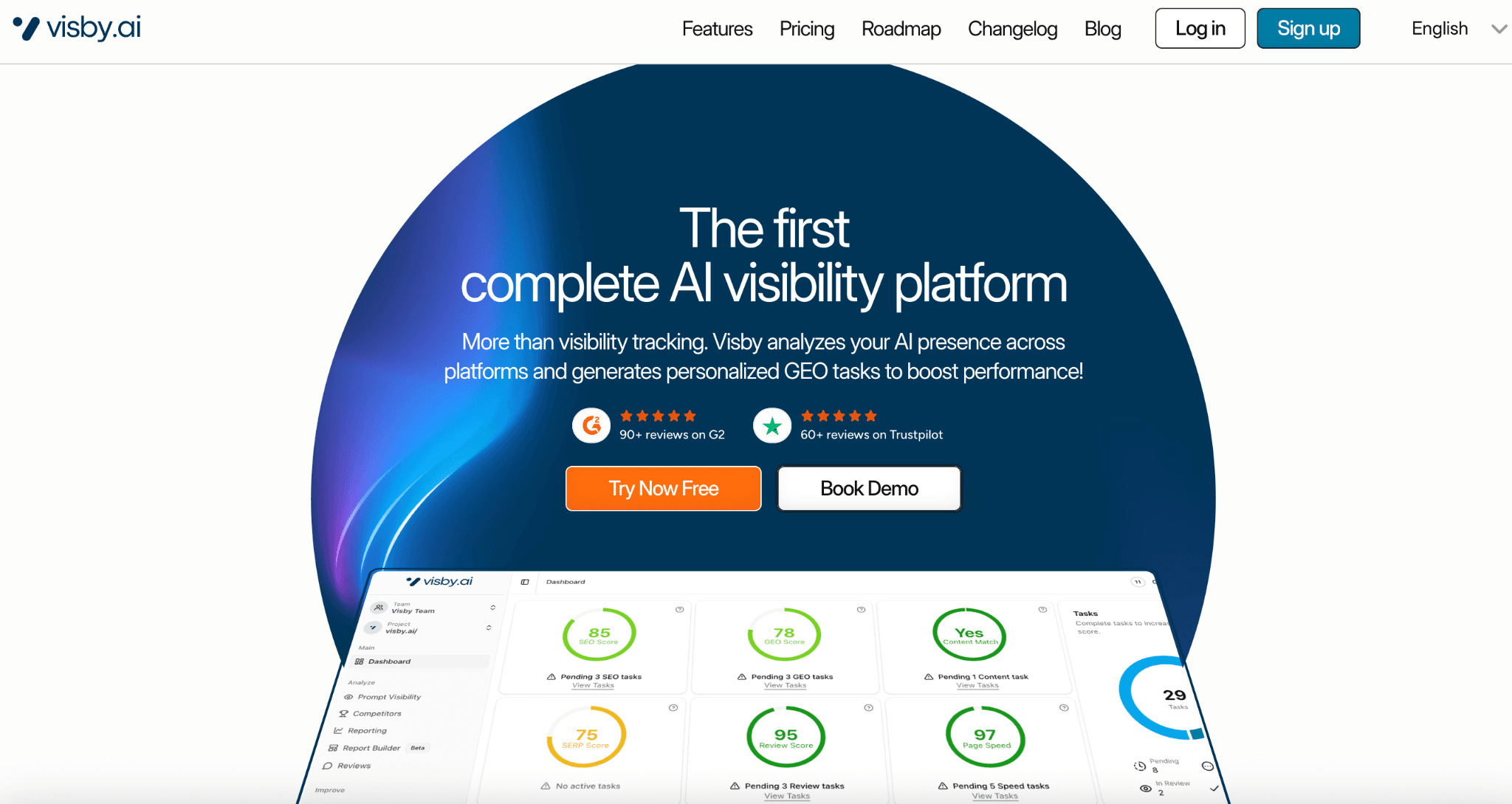
Visby AI is built for teams that want to move beyond monitoring and actually improve their AI visibility.
Most GEO platforms stop at reporting. They show you where your brand appears, how often it is mentioned, and how competitors compare. That data is useful, but it does not tell you what to do next. Visby is designed to close that gap.
The platform analyzes your visibility across ChatGPT, Claude and Gemini at the prompt level, then converts what it finds into site-specific optimization tasks. These are not generic best-practice suggestions. Each task is generated based on your actual gaps: the specific prompts where competitors are appearing and you are not, the content areas where your brand is missing, and the technical or structural changes most likely to move the needle on AI citation.
Visby monitors real queries across AI platforms and maps your brand's presence at each stage of the customer journey. Awareness prompts, consideration prompts, and conversion prompts are tracked separately, so you can see not just whether you appear, but where exactly in the funnel you lose ground to competitors. This level of granularity is what makes it possible to prioritize improvements by business impact rather than just visibility metrics.
The core of the platform is its task system. After analyzing your visibility data, Visby generates a prioritized list of actions tailored to your website. These can include content expansion based on missing query coverage, FAQ and structured content recommendations, internal linking improvements aligned with AI citation patterns, technical fixes affecting how AI systems crawl and interpret your pages, and reputation signals that influence how AI models describe your brand. Each task includes clear instructions and an expected outcome, so teams know what they are doing and why.
Visby also connects AI visibility data with traditional SEO signals. Content relevance, technical performance, and external reputation factors are evaluated together, giving teams a single view of what is driving AI recommendations and where organic search performance intersects with GEO.
On the competitive side, the platform tracks how competitors appear across the same prompts you care about. You can see which brands are being recommended instead of yours, what language AI systems use to describe them, and where your share of voice is growing or declining over time.
Visby also connects with Google Analytics to surface traffic coming from AI platforms directly in the dashboard. This includes visibility into organic AI-referred sessions from ChatGPT, Gemini and Claude making it easier to tie GEO performance to actual business outcomes rather than just mention counts.
For teams running GEO as an active strategy rather than a reporting exercise, Visby is the most complete workflow available at this price point. You can get a full breakdown of what the platform covers on the Visby features page.
Best for: SMBs, SaaS teams, and agencies that want to actively improve AI visibility with clear, prioritized tasks rather than just track performance
Pricing: Plans start from $79/month. Full pricing details are available on the Visby pricing page.
2. Profound
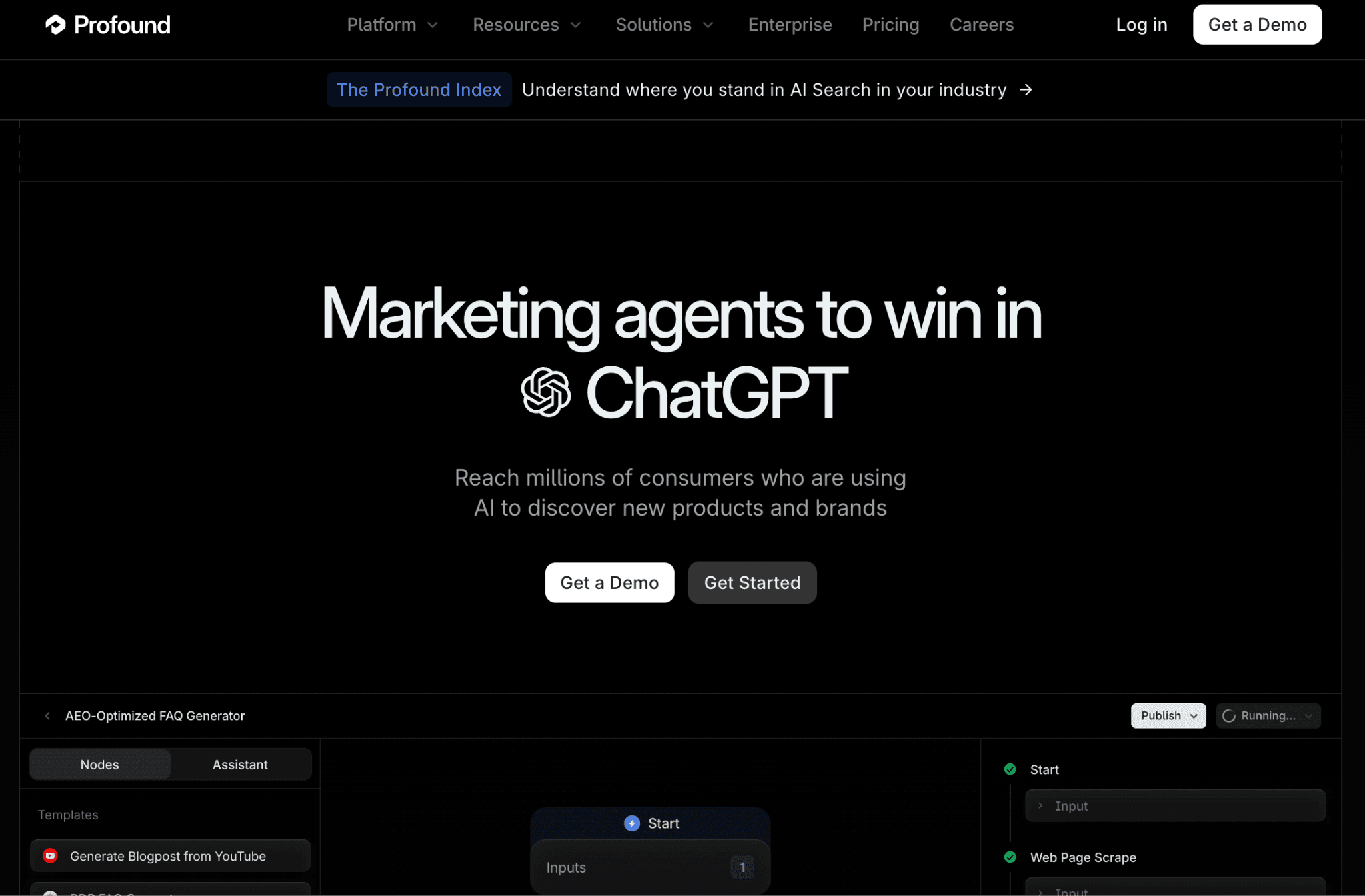
Profound is the enterprise standard for AI visibility monitoring.
The platform runs over 15 million prompts per day and covers up to 10 AI engines on its Enterprise tier, including ChatGPT, Perplexity, Google AI Overviews, Gemini, AI Mode, Copilot, Meta AI, Grok, DeepSeek, and Claude.
What sets Profound apart at the enterprise level is analytical depth. The Conversation Explorer feature lets teams analyze how AI systems construct answers, not just whether your brand appears, but which sources are being cited, what language is being used, and how competitor positioning is shaping the category narrative.
Profound also includes crawler analytics showing how AI bots interact with your site at the page level. For large teams managing complex content architectures, this is a meaningful diagnostic layer.
For companies that need auditability, governance, and integration with existing data infrastructure, Profound is the most complete platform available. The trade-off is price and onboarding complexity, and it is not designed for small teams. If you are deciding between Profound and Visby, this detailed comparison covers where each one wins.
Best for: Enterprise marketing and SEO teams that need deep analytics, multi-engine coverage, and integration with BI and data warehouse infrastructure
Pricing: From $499/month. Enterprise pricing on request.
3. Semrush AI Visibility Toolkit
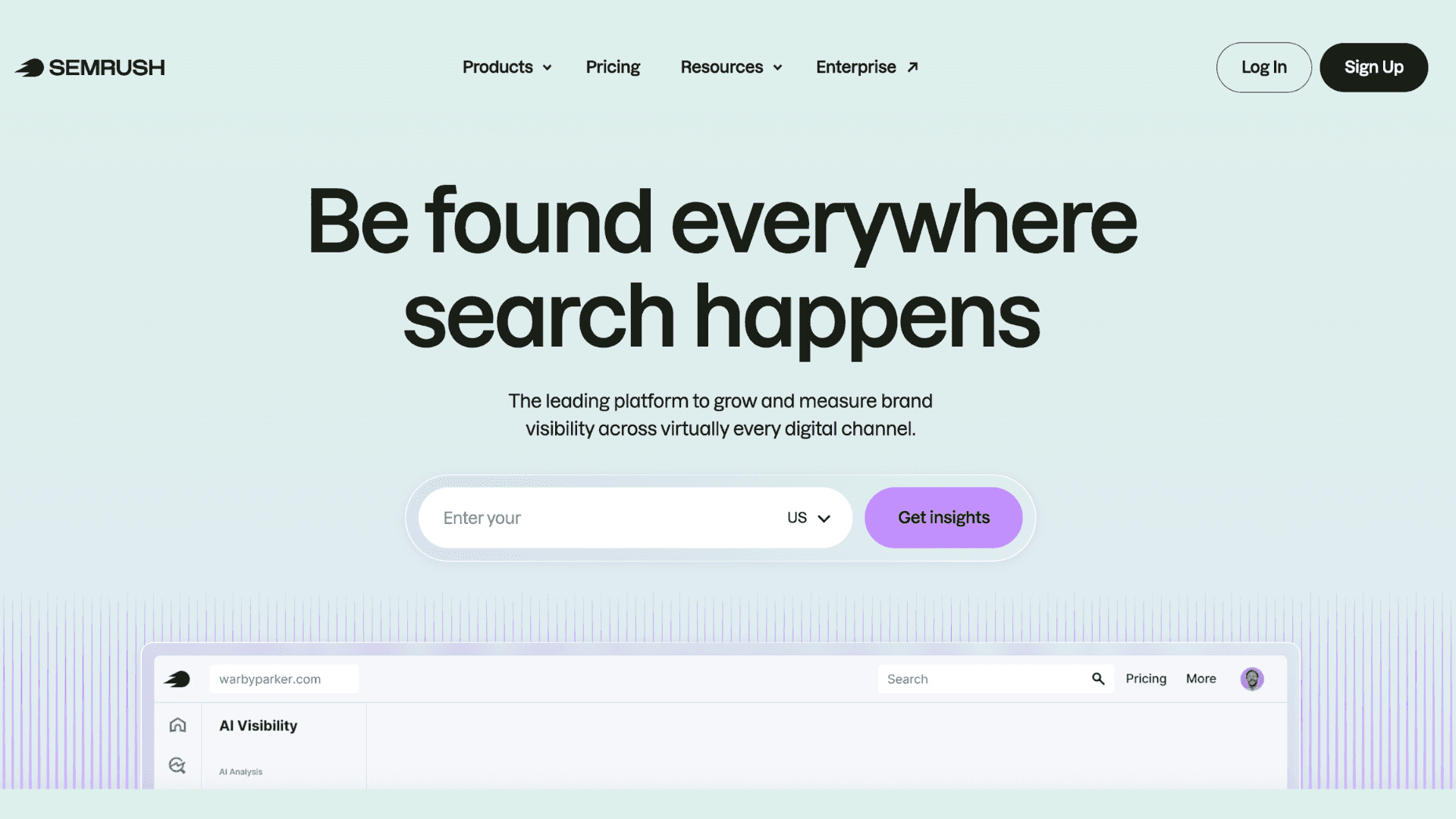
Semrush is the most widely used SEO platform in the market, and its AI Visibility Toolkit extends that ecosystem into GEO tracking.
For teams already running Semrush for keyword research, competitor analysis, and content performance, the AI add-on is the path of least resistance. It tracks brand mentions across ChatGPT, Google AI Overviews, Gemini, and Perplexity from within the same interface used for traditional SEO reporting.
The workflow advantage is real. Seeing AI citation data alongside organic rankings and traffic in one place reduces context-switching and makes it easier to report on both layers to stakeholders.
The limitation is scope. The AI Visibility Toolkit is an add-on to a general SEO platform, not a purpose-built GEO tool. Teams that need deep prompt-level analysis, funnel-based tracking, or AI-specific optimization tasks will hit the ceiling fairly quickly. But for teams that want a consolidated starting point without switching platforms, it is a practical choice.
Best for: Marketing teams already using Semrush who want AI visibility data without adding a separate platform
Pricing: $99/month add-on. Requires an existing Semrush subscription.
4. Peec AI
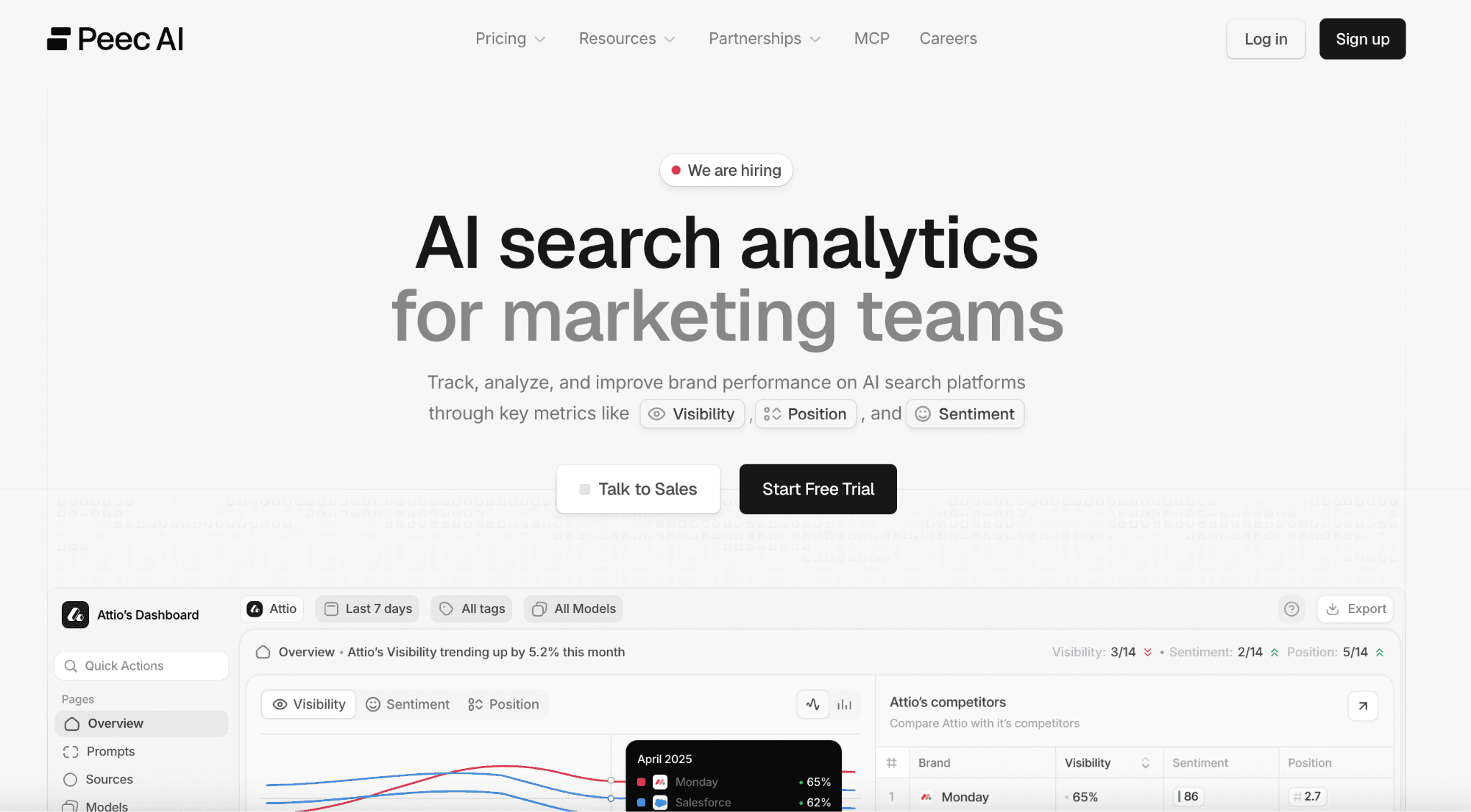
Peec AI occupies a clear niche in the market, focused on reliable competitive benchmarking for mid-market teams.
The key technical differentiator is data collection. Instead of using API calls to query AI models, Peec scrapes the actual chat interfaces. This means it captures the responses users see in practice, including web augmentation, citations, and personalized retrieval layers that API responses sometimes omit.
This matters because API outputs and interface outputs can differ. Teams tracking AI visibility for decision-making purposes benefit from data that reflects what real users actually experience.
Peec also offers attribute-level sentiment analysis. You can track not just whether your brand is mentioned, but how it is described. This is particularly useful for brands managing their reputation inside AI-generated comparisons and recommendation responses.
Unlimited seats on all plans make it practical for larger teams where sales, support, and marketing all need access to AI brand performance data.
Where Peec falls short compared to Visby is on the execution side. Peec shows you where you stand and how you compare to competitors. It does not generate optimization tasks tied to your specific site. Teams that need to move from insights to execution will need to bring in additional tooling to close that gap. There is a full head-to-head comparison of Peec AI and Visby if you want to dig into the specifics.
Best for: Mid-market B2B teams focused on competitive benchmarking and accurate AI visibility tracking across multiple markets
Pricing: From €85/month
5. Otterly AI
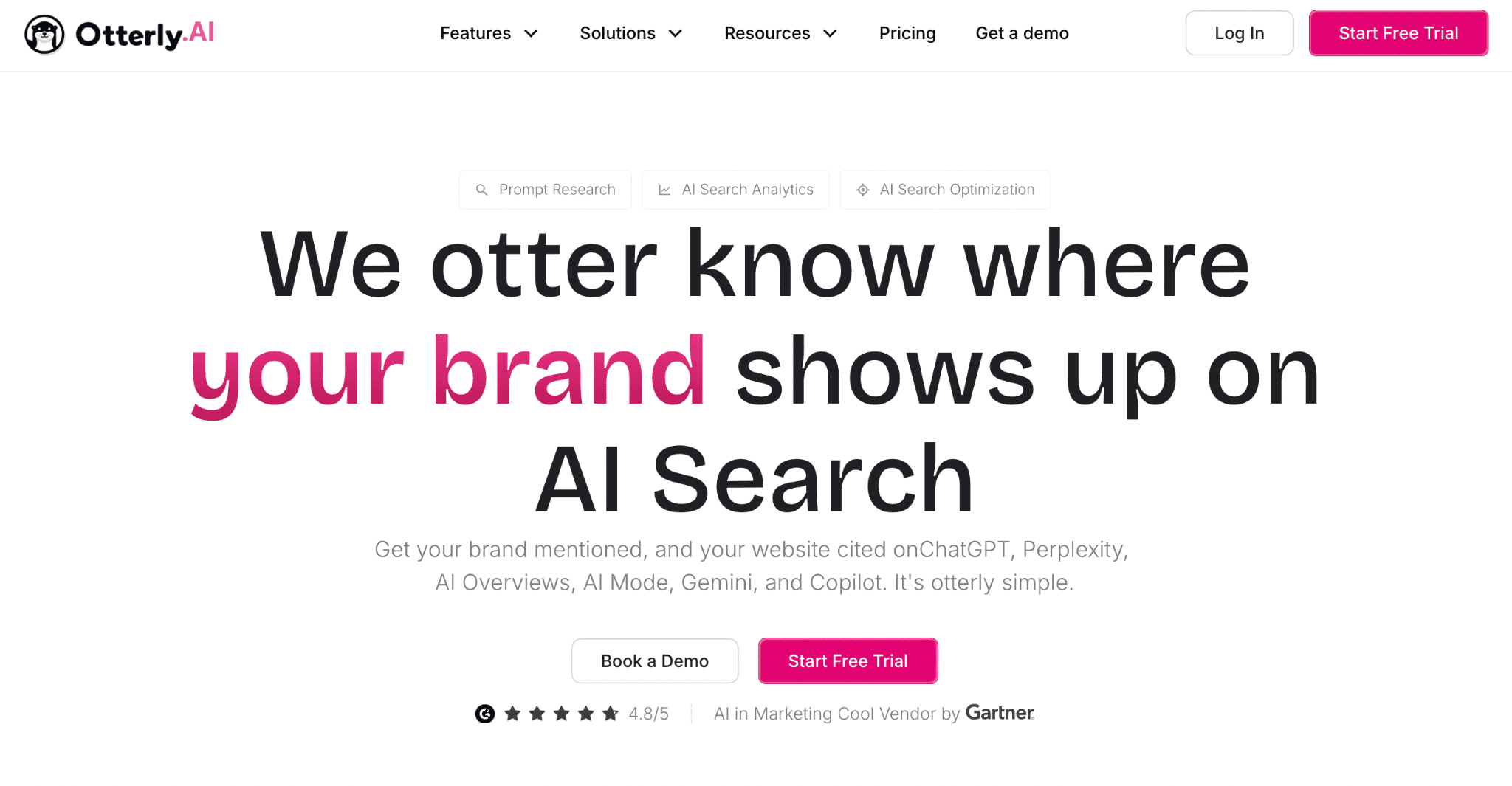
Otterly AI is the clearest entry point in the GEO category. Straightforward monitoring, fast setup, and a low monthly cost.
The platform covers major AI engines, surfaces brand mentions and citation trends, and provides competitive positioning data in a dashboard designed for teams that are new to GEO. There are no complex configuration requirements, and the interface is built for quick orientation rather than deep analysis.
For solo consultants, small marketing teams, or companies doing initial GEO exploration before committing to a more comprehensive platform, Otterly removes the financial and operational barriers to getting started. If you are at this stage, the GEO best practices guide for beginners is a good companion read alongside any monitoring tool.
The limitation is depth. Otterly is built for fast time-to-value, not detailed diagnostics. Teams that outgrow basic monitoring, particularly those that need funnel-level analysis, task-driven optimization, or multi-market tracking, will find themselves needing a more capable platform within a few months.
Best for: Beginners, small teams, and consultants who want to start tracking AI visibility without a steep learning curve or significant upfront investment
Pricing: From $29/month
How to Choose the Right AI Search Visibility Tool
AI search visibility tools sit on a spectrum from monitoring to optimization. Where you need to be on that spectrum depends on how you plan to use the data. If you're at the beginning of your AI search visibility journey and want to understand the basics, Otterly gives you a low-cost way to start tracking brand mentions across AI platforms. If you're an enterprise team that needs analytical depth across ten AI engines with BI integration, Profound is the right starting point.
For teams already inside the Semrush ecosystem, the AI Visibility Toolkit offers the fastest path to adding an AI search visibility layer without changing your existing workflow. The more important distinction is between teams that want to monitor and teams that want to improve. Monitoring tells you where you stand. It does not change the outcome.
Visby is designed for the second group. If your goal is to actively improve your AI search visibility, close the gap between where your brand is today and where it should be, you need a platform that turns insights into specific actions, tracks your progress, and connects those improvements with your broader SEO strategy. That's the gap most tools in this category don't close.
What Will AI Search Visibility Look Like in the Next 12 Months?
AI search visibility is evolving faster than any other area of marketing technology right now. A few patterns are becoming clear. AI search engines are expanding their coverage, and more queries are being routed through generative answer layers, not just AI chatbots. Google AI Mode, Perplexity's growing user base, and ChatGPT's expanded search integration are all pulling more discovery away from traditional blue links.
At the same time, the data available to AI search visibility tools is improving. Prompt-level visibility data is becoming richer, and tools are getting better at explaining not just where brands appear but also why. They can identify which content signals, third-party sources, and structural factors are driving AI recommendations. For teams investing in AI search visibility today, the advantage goes beyond performance. It creates a strong baseline. The data you collect today becomes the foundation for measuring progress over the next 12 to 18 months, including how your brand appears across AI queries, how competitors are positioned, and which prompts you are winning or losing. That kind of longitudinal data cannot be recreated later.
Starting now means building a real picture of how AI search is affecting your brand before the category becomes a standard budget line in every marketing plan.
Frequently Asked Questions About AI Search Visibility Tools
How do AI search visibility tools compare to each other?
The main differences come down to depth, price, and whether the tool focuses on monitoring or optimization. Entry-level tools like Otterly are built for fast setup and basic tracking. Mid-market tools like Peec AI offer more rigorous data collection and competitive benchmarking. Platforms like Visby go further by turning visibility data into specific optimization tasks. Enterprise platforms like Profound cover the most AI engines and offer the deepest analytics. Choosing between them depends on whether you need to understand where you stand or actively change it.
How do you improve AI search visibility in AI Overviews and AI-generated answers?
There's no direct equivalent to traditional ranking in AI-generated answers. Instead, AI systems select and cite sources based on content clarity, topical depth, structured formatting, and brand credibility signals across the web. To improve your AI search visibility, focus on covering topics thoroughly in a question-and-answer format, building mentions across authoritative third-party sources, and making sure your technical setup doesn't block AI crawlers. AI search visibility tools help by identifying the specific gaps between where you appear today and where competitors are being cited instead.
What should an AI search strategy include in 2026?
A complete AI search strategy in 2026 combines traditional search optimization with an AI search visibility layer. The traditional side covers technical health, keyword targeting, and backlink authority. The AI search visibility layer covers prompt-level visibility across AI platforms, content structured for AI selection, and reputation signals that influence how AI systems describe your brand. The two are connected: strong SEO creates the foundation, but AI search visibility work determines whether that foundation translates into AI citations.
Which AI search visibility tool is best for small businesses?
For small businesses and teams new to AI search visibility, Otterly AI provides the lowest barrier to entry. For small businesses that want to actively improve their AI search visibility rather than just monitor it, Visby AI offers the most complete workflow at an accessible price point.
How much do AI search visibility tools cost?
Pricing varies widely depending on what the platform actually does. Enterprise platforms like Profound start at $499/month. Visby sits in a different category altogether. At $79/month, it's the only platform in this range that combines AI search visibility monitoring with a full optimization task engine, competitor benchmarking, funnel-level tracking, and Google Analytics integration. For teams that want to both measure and improve their AI search visibility without enterprise-level spend, it's the most complete option available.

Emir Erçelen
Sr. SEO/GEO Executive at Visby
Latest posts
Discover other pieces of writing in our blog