All articles
·
14 min read
Best AEO Tools for 2026: 7 Answer Engine Platforms Tested
Here's what we found after digging into the best AEO tools in 2026, and which one is actually worth your time.

Search behavior is changing fast. More people are turning to ChatGPT, Claude, Gemini, and Perplexity to find products, compare services, and make decisions. Instead of clicking through a page of blue links, they get one answer that already pulls everything together.
That shift creates a new layer of competition for brands. Ranking on Google is no longer enough. You also need to be included, cited, or recommended inside the answer itself.
An AEO tool, short for Answer Engine Optimization, tracks how your brand shows up across AI generated answers, benchmarks that against competitors, and tells you what to fix. Some platforms stop at monitoring. Others turn that data into real optimization work.
We tested and compared the 7 best AEO tools in 2026 based on engine coverage, citation accuracy, competitive benchmarking, and how much each one actually helps you improve your AI visibility rather than just report on it. Since answer engine optimization and AI visibility tracking often go hand in hand, this comparison of the best ai visibility monitoring tools is a useful next read if you want to measure how those answers perform.
How We Evaluated the Best AEO Tools?
We evaluated each AEO platform based on AI engine coverage, prompt and citation tracking, competitor analysis, optimization features, integrations, and starting price.
The comparison is based on our own testing and publicly available vendor information.
AI engine coverage
Prompt and citation tracking
Competitor benchmarking
AEO and optimization features
Integrations and reporting
Pricing and overall value
Best AEO Tools Comparison Table in 2026
Here’s a side by side comparison of the AEO tools covered in this guide, based on their core strengths, ideal use case, and starting price.
Tool | Best For | Key Insight | Starting Price |
|---|---|---|---|
Visby AI | Turning AI citation gaps into prioritized, site-specific tasks | Prompt level AEO tracking plus automated task generation across ChatGPT, Claude and Gemini | From $79/mo |
Profound | Enterprise AI visibility monitoring | Deep multi engine analytics with Conversation Explorer and crawler data | From $99/mo |
Peec AI | Lightweight prompt tracking and sentiment | Interface scraped data that mirrors what real users see | From $95/mo |
Ahrefs (Brand Radar) | SEO teams extending into AEO | AI citation tracking layered onto keyword and backlink data | From $199/mo (add-on) |
Semrush (AI Toolkit) | Existing Semrush users | AI citation data inside the familiar Semrush dashboard | From $99/mo |
Scrunch | Enterprise AI search monitoring | Broad engine coverage with a security first, agency friendly setup | From $250/mo |
Otterly AI | Fast, low cost entry point | Simple citation and mention tracking with minimal setup | From $29/mo |
What is an AEO Tool?
An AEO tool tracks and helps you understand how your brand appears inside AI generated answers, the responses ChatGPT, Claude, Gemini, and Perplexity give when someone asks a question relevant to your category.
Unlike traditional SEO tools that measure rankings, traffic, and backlinks, AEO tools measure presence inside the answer itself. They show which prompts trigger your brand, whether your content is actually cited as a source, and how often a competitor takes your spot instead.
If you’ve come across the term AI search visibility instead, it’s describing largely the same shift from a different angle. Our best AI search visibility tools guide covers a similar set of platforms with that framing. The more useful platforms go a step further. They don’t just report the gap, they tell you what to do to close it, which pages to update, which topics to cover, and which structural or authority signals are holding you back.
Why Does AEO Need Its Own Toolset?
Many teams assume their existing SEO stack already covers this. It doesn’t, and that assumption creates a real blind spot.
Traditional SEO platforms are built around rankings, keyword volume, and organic traffic. Those signals still matter, and if you want a fuller picture of that side of the stack, our roundup of the best AI SEO tools covers it in more depth. But none of those signals tell you whether ChatGPT recommends your product when a user asks for options in your category.
AI-generated answer systems create a different measurement challenge from traditional search. Instead of only tracking rankings and clicks, brands also need to understand whether they are mentioned, cited, recommended, or omitted across different prompts and AI platforms. That requires tools designed to monitor AI-generated answers directly and compare visibility against competitors.
The 7 Best AEO Tools in 2026
1. Visby

Visby is an AEO and AI visibility platform that combines prompt-level tracking, citation monitoring, competitor analysis, and prioritized optimization tasks. It helps teams identify where their brand appears across AI-generated answers and turn visibility gaps into actionable SEO and GEO improvements.
The platform tracks AEO performance across ChatGPT, Claude, and Gemini at the prompt level, then turns visibility gaps into site-specific SEO and GEO tasks. These aren’t generic best practices. Each one is tied to your actual gaps, the exact prompts where competitors are cited and you’re not, the content you’re missing, and the structural fixes most likely to earn a citation.
It also maps your visibility across the funnel. Awareness, consideration, and conversion prompts are tracked separately, so you can see not only whether you’re cited, but where in the buyer journey you’re losing ground. That’s what makes it possible to prioritize fixes by business impact instead of chasing every visibility metric at once.
Every task comes with clear instructions and an expected outcome. That can mean content expansion for missing query coverage, FAQ and structured content recommendations, internal linking aligned with AI citation patterns, technical fixes for how AI crawlers read your pages, or reputation signals that shape how AI models describe your brand.
Visby also connects AEO data with traditional SEO signals and with Google Analytics, so you can see AI referred traffic from ChatGPT, Gemini and Claude directly in the same dashboard, tying citation gains to actual sessions rather than just mention counts.
Best for
SEO teams, growth marketers, and product led companies that want prompt level AEO tracking, competitor gap analysis, and actionable tasks, not just a monitoring dashboard.
Visby Pros
Tracks AEO performance at prompt level across ChatGPT, Claude and Gemini
Shows exactly where competitors are cited instead of you
Automatically generates prioritized, site specific AEO and SEO tasks
Funnel based tracking for awareness, consideration, and conversion prompts
Ties AEO gains to real traffic and conversions through Google Analytics
Connects visibility data with prioritized SEO and GEO tasks
Visby Cons
Advanced features are still expanding as the product evolves
Teams brand new to AEO may need a short ramp up to use the task system fully
Visby Pricing
Starter plan starts at $79 per month
Growth plan starts at $199 per month
Enterprise plan uses custom pricing
Visby Verdict
Visby is best suited to teams that want AI visibility tracking and optimization workflows in the same platform. Its main distinction is connecting prompt-level visibility, competitor gaps, and funnel insights with prioritized SEO and GEO tasks, rather than stopping at reporting.
2. Profound

Profound is the enterprise standard for AI visibility monitoring, built for teams that need depth across a large number of AI engines.
The platform covers up to 10 AI engines on its Enterprise tier, including ChatGPT, Perplexity, Google AI Overviews, Gemini, AI Mode, Copilot, Meta AI, Grok, DeepSeek, and Claude. Its Conversation Explorer feature lets teams analyze how AI systems construct an answer, which sources are cited, what language is used, and how competitors are positioned.
Profound also includes crawler analytics showing how AI bots interact with your site at the page level, a useful diagnostic layer for teams managing large content footprints.
Best for
Enterprise marketing and SEO teams that need multi engine coverage, deep analytics, and integration with BI infrastructure.
Profound Pros
Broad engine coverage, up to 10 AI platforms on Enterprise
Conversation Explorer gives real insight into how answers are constructed
Crawler level analytics for large content operations
Strong fit for governance and auditability requirements
Profound Cons
Entry plan only covers ChatGPT
Pricing and onboarding complexity favor larger teams
Mostly an insights layer, turning data into action still falls on your team
Profound Pricing
Starter plan starts at $99 per month and covers ChatGPT only
Growth plan starts at $399 per month and covers three engines
Enterprise plan uses custom pricing
Profound Verdict
Profound is the right pick for large teams that need the deepest available AEO dataset and are prepared to work through a sales process to get it. Smaller teams needing broad coverage on a lower budget will likely outgrow the entry tier quickly.
3. Peec AI
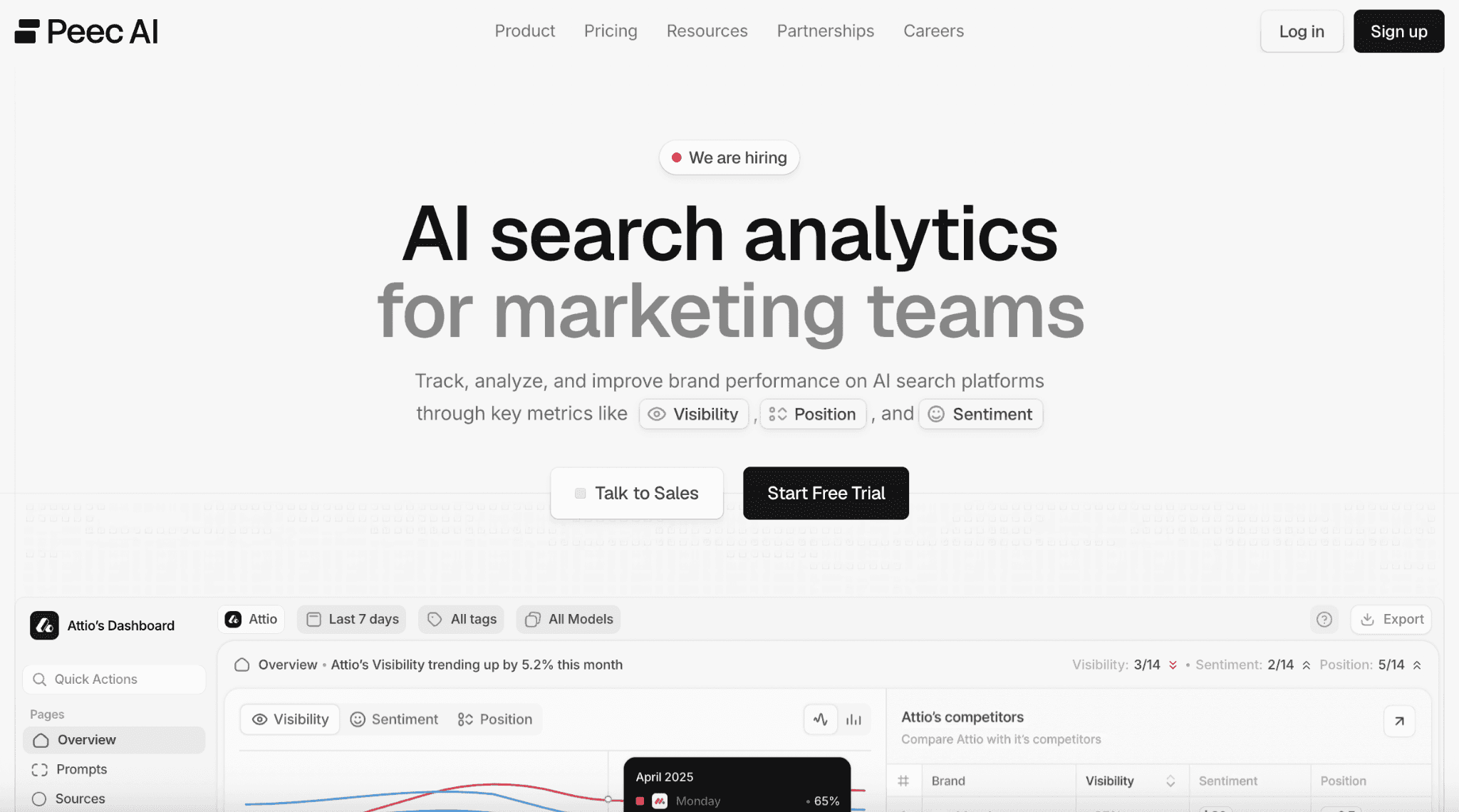
Peec AI is a lightweight AEO tool focused on prompt tracking and sentiment, built for fast onboarding over deep configuration.
Its key differentiator is how it collects data. Instead of querying AI models through an API, Peec scrapes the actual chat interfaces, capturing the responses real users see, including web augmentation and citations that API only tools can miss.
It also offers attribute level sentiment analysis, so you can see not just whether you’re mentioned, but how you’re described, which is useful for reputation sensitive categories.
Best for
Growing startups and mid market teams that want simple, accurate prompt visibility tracking without a complex setup.
Peec AI Pros
Interface scraped data reflects what real users actually see
Attribute level sentiment tracking
Clean interface, fast onboarding
Unlimited seats on all plans
Peec AI Cons
Focused mainly on monitoring, not execution
No built in task system to act on the gaps it finds
Additional engines and advanced features require higher tiers
Peec AI Pricing
Starter plan starts at $95 per month
Pro plan starts at $245 per month
Advanced plan starts at $495 per month
Enterprise plan uses custom pricing
Peec AI Verdict
Peec is a solid choice for teams that prioritize accurate, sentiment aware visibility reporting over built in execution. Teams that also want a platform to tell them what to fix will likely need to pair it with something else, or choose a tool like Visby that does both.
4. Ahrefs (Brand Radar)
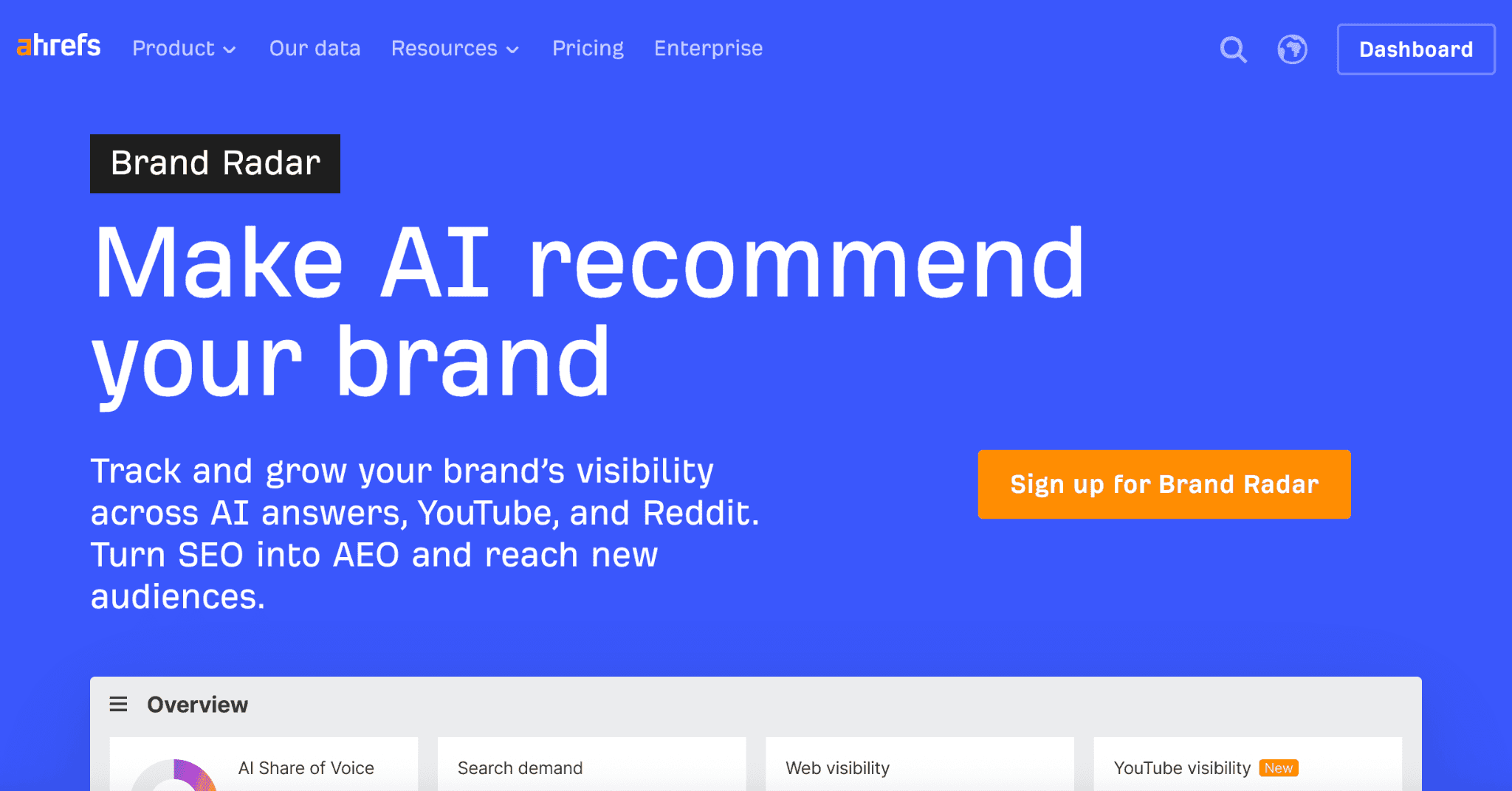
Ahrefs extends its well known SEO ecosystem into AEO with Brand Radar, letting teams track AI citations while staying inside familiar keyword and backlink data.
For teams already running Ahrefs for organic search, this is the path of least resistance. AI visibility sits next to the SEO metrics you already track, and historical data makes trend analysis straightforward.
Best for
SEO professionals already using Ahrefs who want AI citation tracking without adopting a new platform.
Ahrefs (Brand Radar) Pros
Strong integration with existing keyword and backlink data
Large scale tracking across AI generated answers
Historical data supports trend analysis
Ahrefs (Brand Radar) Cons
AI visibility features are less mature than dedicated AEO specialists
Requires an active Ahrefs subscription plus add on pricing
Leans toward analysis over actionable next steps
Ahrefs (Brand Radar) Pricing
Starts at $199 per month per AI platform, and requires an active Ahrefs plan from $129 per month
Full platform access runs up to $699 per month
Ahrefs (Brand Radar) Verdict
Brand Radar makes the most sense for teams that already run their SEO program inside Ahrefs. Teams without an existing subscription, or that need deep Claude coverage, will likely get more from a purpose built AEO tool for the price.
5. Semrush (AI Toolkit)
Semrush layers AEO tracking onto its existing SEO platform through its AI Toolkit, giving teams a familiar place to add AI citation data.
It tracks brand mentions across ChatGPT, Google AI Overviews, Gemini, and Perplexity from inside the same interface used for organic rankings and traffic, which helps cut down on context switching when reporting to stakeholders.
Best for
Existing Semrush users who want AEO data without adding a new platform to the stack.
Semrush (AI Toolkit) Pros
Seamless integration with Semrush’s existing SEO workflows
Clear reports and dashboards
Low friction adoption for current Semrush customers
Semrush (AI Toolkit) Cons
An add on to a general SEO platform, not a purpose built AEO tool
Limited prompt level depth and customization
Requires higher tiers or add ons to scale
Semrush (AI Toolkit) Pricing
Starts at $99 per month, with additional features and limits available through add ons
Semrush (AI Toolkit) Verdict
The AI Toolkit is a practical add for teams already inside the Semrush ecosystem. Teams without an existing subscription will likely find more prompt level depth in a dedicated AEO platform.
6. Scrunch

Scrunch is an AEO platform built for enterprise AI search monitoring, with a particular emphasis on data security and multi brand agency use.
It tracks visibility across multiple AI systems with real time insight into how AI content interacts with your site, and supports competitor analysis across topics, audiences, and regions, which is handy for agencies managing several brands at once.
Best for
Enterprises and agencies that need broad AI engine coverage, strong security standards, and multi brand competitor insight.
Scrunch Pros
Coverage across multiple AI platforms
Real time insight into AI content interaction
Strong fit for agencies managing multiple brands
Security posture built for enterprise requirements
Scrunch Cons
Primarily a monitoring tool, acting on insights takes internal resources
Pricing and complexity can be a lot for smaller teams
Scrunch Pricing
Core plan starts at $250 per month and covers four engines
Enterprise plan uses custom pricing
Scrunch Verdict
Scrunch fits enterprises and agencies that specifically need security first, multi brand AEO monitoring. Teams mainly looking for broad coverage at a lower price point will find better value elsewhere.
7. Otterly AI
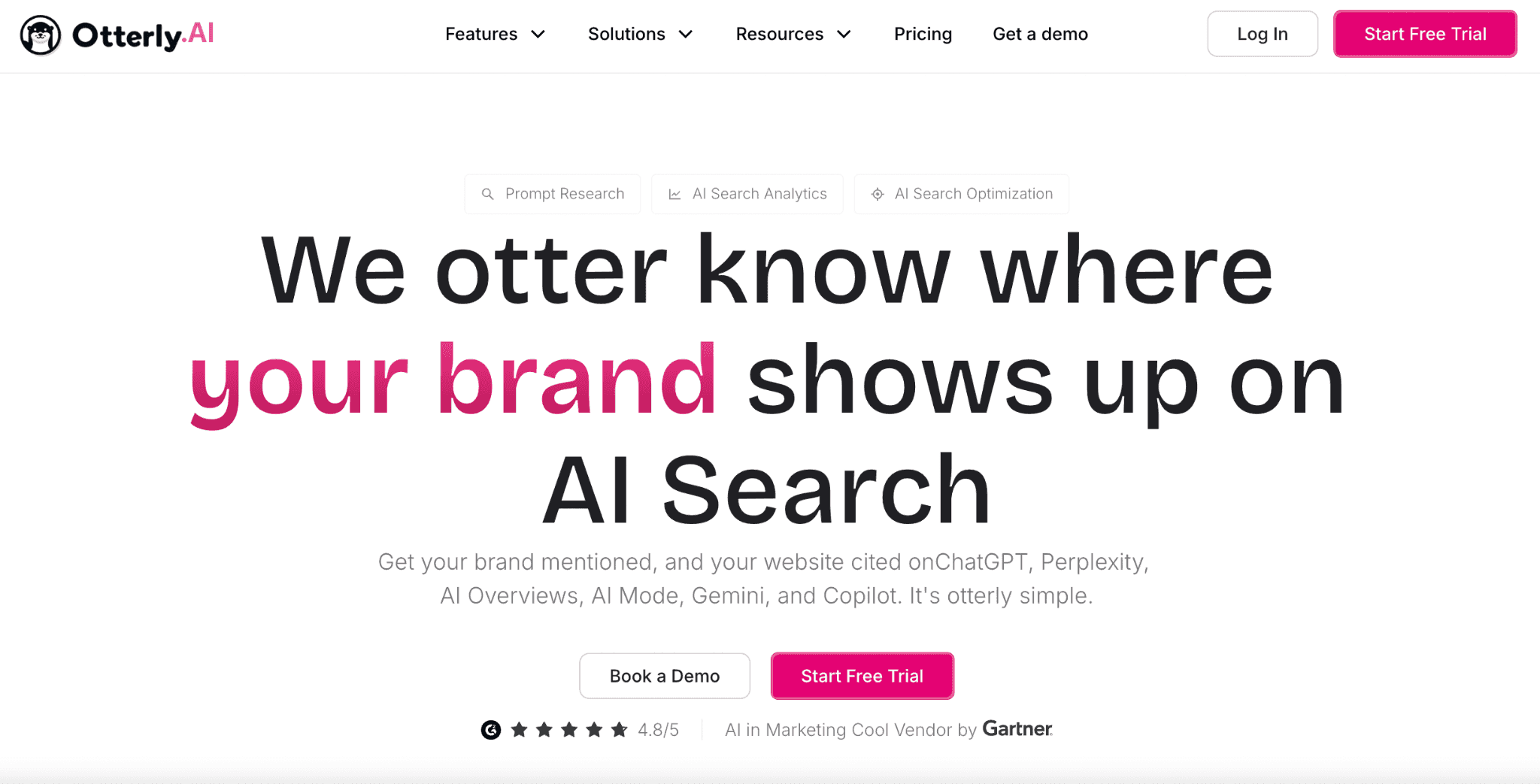
Otterly AI is a lower-cost entry point for teams that want straightforward AEO monitoring and fast setup.
It covers the major AI engines, surfaces brand mentions and citation trends, and presents competitive positioning in a dashboard built for teams that are new to AEO rather than deep analysis.
Best for
Beginners, small teams, and consultants who want to start tracking AEO without a steep learning curve or a big upfront spend.
Otterly AI Pros
Low starting price and fast setup
Covers major AI engines out of the box
Simple dashboard, minimal configuration
Otterly AI Cons
Built for fast time to value, not deep diagnostics
No funnel level analysis or task driven optimization
Otterly AI Pricing
Starts at $29 per month
Otterly AI Verdict
Otterly is a sensible starting point for teams that just need to know whether they’re showing up in AI answers. Once you need to act on that data, you’ll likely need to graduate to a more complete platform.
How to Choose the Right AEO Tool?
AEO tools sit on a spectrum from monitoring to optimization. Where you need to be on that spectrum depends on how you plan to use the data.
If you’re new to AEO and just need a baseline, Otterly AI gives you a low cost way to start tracking brand mentions across AI platforms.
If you’re already inside Ahrefs or Semrush, Brand Radar or the AI Toolkit are the lowest friction way to add AEO data to a workflow you already run.
If you need enterprise scale coverage and governance, Profound or Scrunch offer the deepest multi engine analytics and security posture for large teams.
If you want clean, sentiment aware competitive benchmarking, Peec AI is built for exactly that, with fast onboarding.
If you want to actually close the citation gap instead of just measuring it, Visby is built for this. It’s the only platform here that turns prompt level AEO data into prioritized, site specific tasks and ties them back to real traffic and conversions.
That last distinction, monitoring versus improving, is the one that matters most. Monitoring tells you where you stand. It doesn’t change the outcome. If your goal is to close the gap between where your brand is and where it should be in AI generated answers, you need a platform built to act on the data, not just display it. For engine specific comparisons, see our guides to the best ChatGPT rank tracker tools and best Claude rank tracker tools.
FAQ About AEO Tools
What is an AEO tool?
An AEO tool, short for Answer Engine Optimization tool, tracks how your brand appears inside AI generated answers and helps you improve that presence. Instead of measuring rankings, these tools measure whether your brand is mentioned, cited, or recommended by platforms like ChatGPT, Claude, Gemini, and Perplexity.
What does AEO mean in SEO?
AEO stands for Answer Engine Optimization. It focuses on how your brand is represented inside AI generated results, through visibility tracking, prompt level analysis, and understanding how AI systems interpret and recommend your brand. Think of it as a complement to traditional SEO rather than a replacement for it.
Which is the best AEO tool?
The best AEO tool depends on your needs. Some platforms focus mainly on monitoring, while others combine visibility tracking with optimization workflows. Compare engine coverage, citation tracking, competitor analysis, integrations, and whether the platform helps you act on the data, not just report it.
How do AEO tools work?
AEO tools run a defined set of prompts across AI systems and evaluate how your brand shows up in the responses. They track mentions, identify citation sources, and benchmark your visibility against competitors over time. More advanced platforms go further and translate those gaps into recommended content, technical fixes, internal linking, and authority building actions.
Is AEO different from SEO or GEO?
AEO and GEO, short for Generative Engine Optimization, are largely used as synonyms in the industry. Both describe optimizing for AI generated answers rather than search rankings. Traditional SEO focuses on rankings, traffic, and keywords on classic search engines, while AEO focuses on whether content is selected, cited, and presented inside AI generated answers. The two are connected and increasingly run side by side. If you want a closer look from the GEO side specifically, our guide to the best GEO tools covers a lot of the same ground.
Can AEO performance be measured?
Yes, though the discipline is still evolving. AEO tools measure signals like brand mentions, prompt coverage, citation sources, and share of voice across AI platforms. The more advanced platforms also connect that visibility data to traffic and conversions, so teams can see business impact rather than just presence.
How much do AEO tools cost?
Pricing varies widely by platform and feature depth. Entry level tools like Otterly AI start under $30 per month, mid market platforms like Peec AI and Visby start around $80 to $100 per month, and enterprise platforms like Profound and Scrunch scale into the hundreds or require custom pricing. Visby’s task based approach means teams can start on the Starter plan and scale as their AEO program matures.

