Back

ChatGPT Now Shows Products Visually

OpenAI's new visual shopping experience is live!

24 Mar 2026

ChatGPT Now Shows Products Visually

Until recently, ChatGPT shopping results were mostly text. You'd ask for a product recommendation and get a list of names, maybe a short description, and a link to go figure out the rest yourself. That experience is now gone.

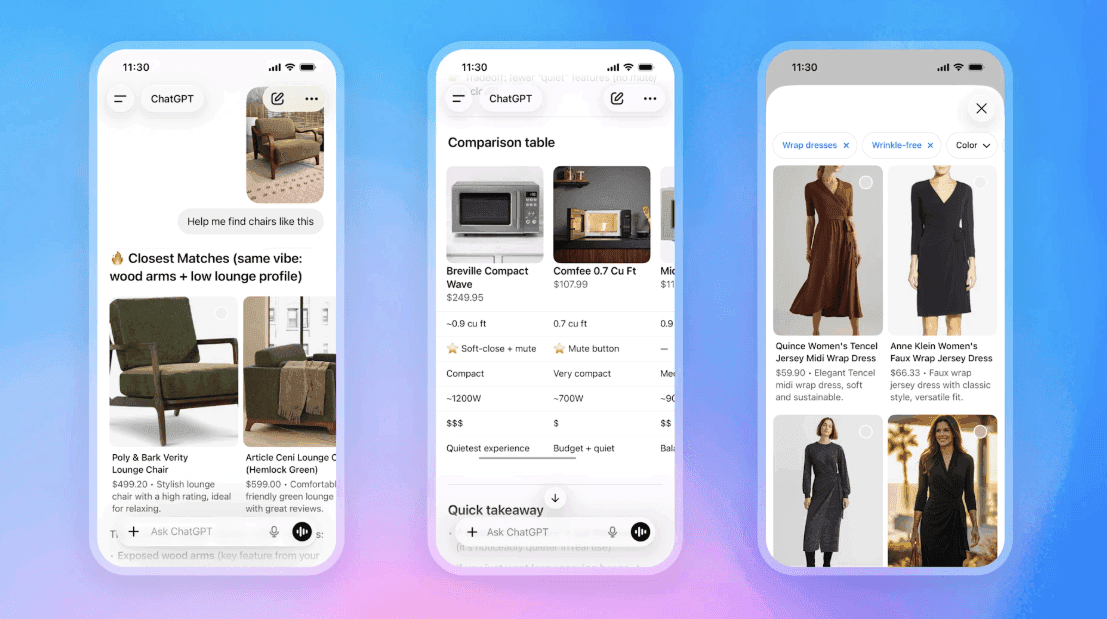
As of March 24, 2026, ChatGPT displays products in a fully visual format. You can see product images, prices, and key specs side by side, all inside the chat. You can also upload a photo of something you already own and ask ChatGPT to find similar items. The interface feels closer to a curated storefront than a search result page.

For brands, this shift is significant. Being mentioned in a text response is one thing. Appearing, or not appearing, in a visual product grid is another. The stakes just got higher.

Side-by-Side Comparisons: A Game Changer for Shoppers
chatgpt shopping comparisons

One of the most practical additions in this update is the comparison table. When a user asks ChatGPT to help them choose between products, ChatGPT now generates a structured table showing price, key features, and tradeoffs in one place.

This means shoppers no longer need to open five tabs and piece together a decision. ChatGPT does that work for them. For a user asking "best quiet microwave for a small kitchen," the new experience returns a clean comparison of four options with noise levels, mute features, size, and a clear recommendation.

For brands, this creates a new competitive dynamic. Your product is either in that table or it isn't. And if a competitor is consistently showing up while you're not, that gap compounds over time as more shoppers default to ChatGPT for purchase research.

What Is the Agentic Commerce Protocol (ACP)?

The infrastructure powering this new experience is called the Agentic Commerce Protocol, or ACP. OpenAI is expanding ACP specifically to support product discovery, allowing merchants to share structured product feeds, pricing, and promotions directly with ChatGPT.

In practical terms, ACP is what makes ChatGPT's product results accurate and up to date. Without it, ChatGPT would be guessing from whatever content it scraped from the web. With it, merchants can feed clean, complete product data straight into the system.

Major retailers including Target, Sephora, Nordstrom, Lowe's, Best Buy, The Home Depot, and Wayfair have already integrated into ACP. For Shopify merchants specifically, product data flows into ChatGPT automatically through Shopify Catalog. No extra setup required.

If your brand is not on Shopify and has not integrated with ACP directly or through a provider like Salesforce or Stripe, your product data may be incomplete or missing from ChatGPT results entirely.

How Does the New Visual Shopping Experience Work?
chatgpt ai shopping changes

When a user opens a shopping-related conversation in ChatGPT, the platform now launches a visual interface. The user describes what they're looking for, and ChatGPT asks clarifying questions about budget, preferences, and constraints before surfacing results.

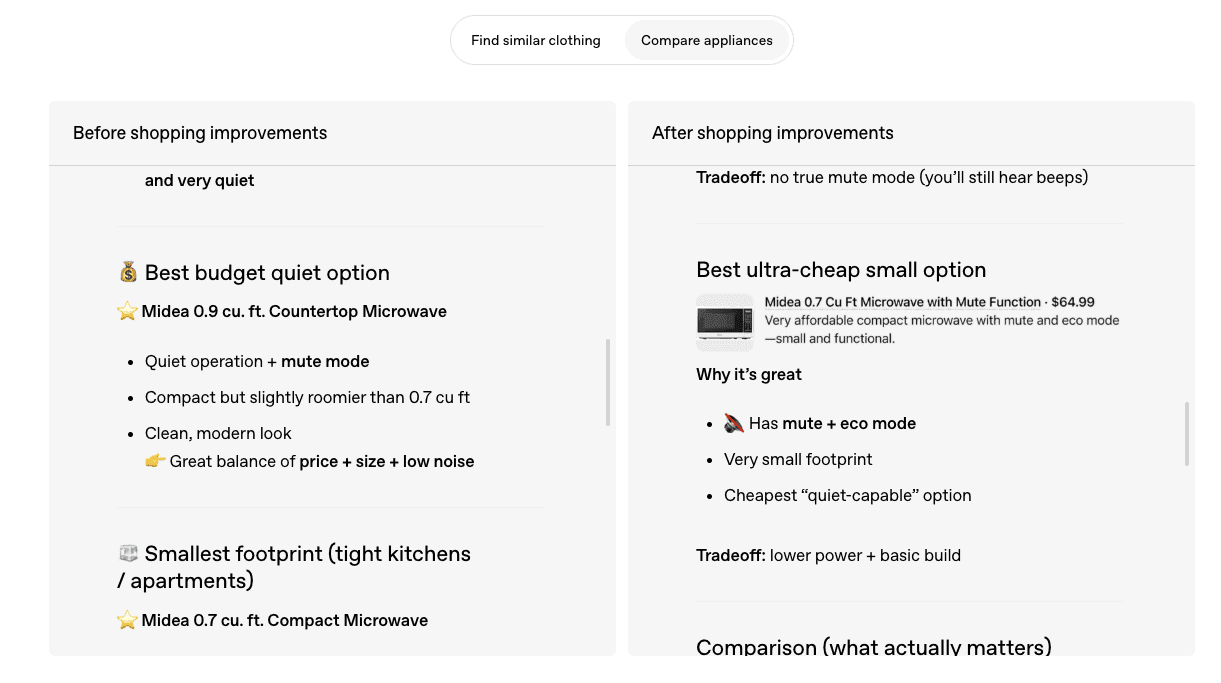
Products appear as visual cards with images, prices, and short descriptions. Users can filter results, mark items as "more like this" or "not interested," and refine the search conversationally in real time. For complex decisions like electronics or home appliances, ChatGPT takes a few minutes to research across the web and build a personalized buyer's guide.

If a user wants to purchase, they click through to the retailer's own website. OpenAI has moved away from its earlier Instant Checkout model and is now focused on product discovery, routing high-intent shoppers to merchant sites instead.

The system is powered by a version of GPT-5 mini specifically trained for shopping tasks, with a reported 64% accuracy rate in matching products to user needs, up from 37% with standard ChatGPT responses.

Why Are Brands Starting to Lose Visibility - Without Even Knowing It?

Most brands are not tracking what happens when someone asks ChatGPT about their product category. They're optimizing for Google rankings, running ads, and monitoring social mentions, but the AI channel is a blind spot.

The problem is that ChatGPT doesn't pull results the way Google does. There's no keyword ranking to check, no position to track, no impression data in Search Console. If your brand isn't showing up in AI-generated product recommendations, you simply won't know unless you're actively testing it.

This is already happening at scale. Shoppers in the US are now asking ChatGPT over 84 million shopping-related questions every week. Nearly two thirds of consumers plan to use AI chatbots for shopping in 2026, with roughly one in four planning to make it their default way to shop. Brands that aren't visible in these results are losing ground right now, not in some future scenario.

What Signals Does ChatGPT Use to Recommend Products?

ChatGPT doesn't rank products the way a search engine ranks pages. Instead, it evaluates a combination of signals to decide which products are relevant, trustworthy, and worth recommending.

The most important factors are structured product data, external reviews and mentions, and content relevance. Schema.org microdata including Product, Offer, and Review markup is a basic threshold. Without it, AI either ignores the source or uses it only partially. Completeness of attributes also matters: the fewer clarifications the AI needs to fill gaps in your product data, the higher the chance of a recommendation.

Off-site mentions matter too. ChatGPT looks at review platforms, forums like Reddit, and third-party sites to assess a product's reputation. A brand with strong structured data on its own site but no external mentions will still underperform against a competitor with broader coverage.

Pricing and availability accuracy are also critical. Outdated or inconsistent product data is a strong negative signal. If your site shows one price and a reseller shows another, ChatGPT may deprioritize your product entirely.

How Can You Track and Improve Your Brand's Presence in ChatGPT Shopping?

Improving your AI shopping visibility starts with knowing where you actually stand. That means running structured prompts across ChatGPT and other AI platforms to see when and how your brand appears, which competitors are showing up instead, and what kind of context surrounds your mentions.

This is exactly what Visby is built for. Visby tracks your brand's visibility across ChatGPT, Claude, and Gemini monitoring which prompts trigger mentions of your brand and how your share of voice compares to competitors. Beyond tracking, Visby generates actionable GEO tasks based on your current visibility gaps, so you know what to fix and in what order.

On the content side, improving your ChatGPT shopping presence means cleaning up your structured data, building out your product schema, earning more third-party reviews, and creating content that directly answers the questions shoppers are asking AI platforms. Visby's Task Board surfaces these exact tasks based on your site's current state and your visibility data.

Is 2026 the Year AI Takes Over Shopping? Here's What the Data Says

ChatGPT is not the only platform making moves here. OpenAI's update today is one piece of a much larger shift happening across every major AI platform at the same time.

Meta is currently testing a shopping research feature in Meta AI, returning product carousels with brand, price, and website information directly in chat. Google's AI Mode and AI Overviews are integrating product results into search in ways that increasingly bypass traditional organic listings. Perplexity has been building out its own commerce layer with payment integrations.

One in five of Walmart's referral clicks in August came from ChatGPT, up 15% from the previous month. Target, Etsy, and eBay are seeing similar growth. ChatGPT has grown from less than 1% of Amazon's weekly search volume to over 8% in less than a year.

The data is clear. AI shopping is not an emerging trend to watch. It's a live channel driving real traffic and real purchase decisions right now. Brands that treat AI visibility as optional in 2026 are making the same mistake many made with mobile optimization in 2012 or social media in 2014.

The difference now is that the window to act early is much shorter.

FAQ

Does ChatGPT show my products automatically?

Only if your product data is accessible and structured correctly. Shopify merchants benefit from automatic integration through Shopify Catalog. Other brands need to connect through ACP partners or ensure their product pages use proper schema markup and are indexed by OpenAI's crawlers.

How is ChatGPT shopping different from Google Shopping?

Google Shopping ranks products based on bids, keywords, and product feed quality. ChatGPT shopping uses a conversational model that evaluates structured data, reviews, and off-site mentions to make personalized recommendations. There's no paid placement in ChatGPT results.

Can I track whether my brand appears in ChatGPT shopping results?

Yes. Visby let you monitor your brand's AI visibility across ChatGPT and other platforms, tracking which prompts trigger mentions and how your presence compares to competitors over time.

What is the Agentic Commerce Protocol (ACP)?

ACP is OpenAI's infrastructure layer that connects merchant product feeds to ChatGPT. It allows brands to share accurate, up-to-date product data, pricing, and promotions directly with the platform. Major retailers like Target, Sephora, and Wayfair have already integrated.

Do I need to optimize differently for AI shopping vs. traditional SEO?

Yes. Traditional SEO focuses on keywords and backlinks. AI shopping optimization focuses on structured product data, review coverage across multiple platforms, content that answers conversational queries, and consistent pricing and availability signals.

Until recently, ChatGPT shopping results were mostly text. You'd ask for a product recommendation and get a list of names, maybe a short description, and a link to go figure out the rest yourself. That experience is now gone.

As of March 24, 2026, ChatGPT displays products in a fully visual format. You can see product images, prices, and key specs side by side, all inside the chat. You can also upload a photo of something you already own and ask ChatGPT to find similar items. The interface feels closer to a curated storefront than a search result page.

For brands, this shift is significant. Being mentioned in a text response is one thing. Appearing, or not appearing, in a visual product grid is another. The stakes just got higher.

Side-by-Side Comparisons: A Game Changer for Shoppers

chatgpt shopping comparisons

One of the most practical additions in this update is the comparison table. When a user asks ChatGPT to help them choose between products, ChatGPT now generates a structured table showing price, key features, and tradeoffs in one place.

This means shoppers no longer need to open five tabs and piece together a decision. ChatGPT does that work for them. For a user asking "best quiet microwave for a small kitchen," the new experience returns a clean comparison of four options with noise levels, mute features, size, and a clear recommendation.

For brands, this creates a new competitive dynamic. Your product is either in that table or it isn't. And if a competitor is consistently showing up while you're not, that gap compounds over time as more shoppers default to ChatGPT for purchase research.

What Is the Agentic Commerce Protocol (ACP)?

The infrastructure powering this new experience is called the Agentic Commerce Protocol, or ACP. OpenAI is expanding ACP specifically to support product discovery, allowing merchants to share structured product feeds, pricing, and promotions directly with ChatGPT.

In practical terms, ACP is what makes ChatGPT's product results accurate and up to date. Without it, ChatGPT would be guessing from whatever content it scraped from the web. With it, merchants can feed clean, complete product data straight into the system.

Major retailers including Target, Sephora, Nordstrom, Lowe's, Best Buy, The Home Depot, and Wayfair have already integrated into ACP. For Shopify merchants specifically, product data flows into ChatGPT automatically through Shopify Catalog. No extra setup required.

If your brand is not on Shopify and has not integrated with ACP directly or through a provider like Salesforce or Stripe, your product data may be incomplete or missing from ChatGPT results entirely.

How Does the New Visual Shopping Experience Work?

chatgpt ai shopping changes

When a user opens a shopping-related conversation in ChatGPT, the platform now launches a visual interface. The user describes what they're looking for, and ChatGPT asks clarifying questions about budget, preferences, and constraints before surfacing results.

Products appear as visual cards with images, prices, and short descriptions. Users can filter results, mark items as "more like this" or "not interested," and refine the search conversationally in real time. For complex decisions like electronics or home appliances, ChatGPT takes a few minutes to research across the web and build a personalized buyer's guide.

If a user wants to purchase, they click through to the retailer's own website. OpenAI has moved away from its earlier Instant Checkout model and is now focused on product discovery, routing high-intent shoppers to merchant sites instead.

The system is powered by a version of GPT-5 mini specifically trained for shopping tasks, with a reported 64% accuracy rate in matching products to user needs, up from 37% with standard ChatGPT responses.

Why Are Brands Starting to Lose Visibility - Without Even Knowing It?

Most brands are not tracking what happens when someone asks ChatGPT about their product category. They're optimizing for Google rankings, running ads, and monitoring social mentions, but the AI channel is a blind spot.

The problem is that ChatGPT doesn't pull results the way Google does. There's no keyword ranking to check, no position to track, no impression data in Search Console. If your brand isn't showing up in AI-generated product recommendations, you simply won't know unless you're actively testing it.

This is already happening at scale. Shoppers in the US are now asking ChatGPT over 84 million shopping-related questions every week. Nearly two thirds of consumers plan to use AI chatbots for shopping in 2026, with roughly one in four planning to make it their default way to shop. Brands that aren't visible in these results are losing ground right now, not in some future scenario.

What Signals Does ChatGPT Use to Recommend Products?

ChatGPT doesn't rank products the way a search engine ranks pages. Instead, it evaluates a combination of signals to decide which products are relevant, trustworthy, and worth recommending.

The most important factors are structured product data, external reviews and mentions, and content relevance. Schema.org microdata including Product, Offer, and Review markup is a basic threshold. Without it, AI either ignores the source or uses it only partially. Completeness of attributes also matters: the fewer clarifications the AI needs to fill gaps in your product data, the higher the chance of a recommendation.

Off-site mentions matter too. ChatGPT looks at review platforms, forums like Reddit, and third-party sites to assess a product's reputation. A brand with strong structured data on its own site but no external mentions will still underperform against a competitor with broader coverage.

Pricing and availability accuracy are also critical. Outdated or inconsistent product data is a strong negative signal. If your site shows one price and a reseller shows another, ChatGPT may deprioritize your product entirely.

How Can You Track and Improve Your Brand's Presence in ChatGPT Shopping?

Improving your AI shopping visibility starts with knowing where you actually stand. That means running structured prompts across ChatGPT and other AI platforms to see when and how your brand appears, which competitors are showing up instead, and what kind of context surrounds your mentions.

This is exactly what Visby is built for. Visby tracks your brand's visibility across ChatGPT, Claude, and Gemini monitoring which prompts trigger mentions of your brand and how your share of voice compares to competitors. Beyond tracking, Visby generates actionable GEO tasks based on your current visibility gaps, so you know what to fix and in what order.

On the content side, improving your ChatGPT shopping presence means cleaning up your structured data, building out your product schema, earning more third-party reviews, and creating content that directly answers the questions shoppers are asking AI platforms. Visby's Task Board surfaces these exact tasks based on your site's current state and your visibility data.

Is 2026 the Year AI Takes Over Shopping? Here's What the Data Says

ChatGPT is not the only platform making moves here. OpenAI's update today is one piece of a much larger shift happening across every major AI platform at the same time.

Meta is currently testing a shopping research feature in Meta AI, returning product carousels with brand, price, and website information directly in chat. Google's AI Mode and AI Overviews are integrating product results into search in ways that increasingly bypass traditional organic listings. Perplexity has been building out its own commerce layer with payment integrations.

One in five of Walmart's referral clicks in August came from ChatGPT, up 15% from the previous month. Target, Etsy, and eBay are seeing similar growth. ChatGPT has grown from less than 1% of Amazon's weekly search volume to over 8% in less than a year.

The data is clear. AI shopping is not an emerging trend to watch. It's a live channel driving real traffic and real purchase decisions right now. Brands that treat AI visibility as optional in 2026 are making the same mistake many made with mobile optimization in 2012 or social media in 2014.

The difference now is that the window to act early is much shorter.

FAQ

Does ChatGPT show my products automatically?

Only if your product data is accessible and structured correctly. Shopify merchants benefit from automatic integration through Shopify Catalog. Other brands need to connect through ACP partners or ensure their product pages use proper schema markup and are indexed by OpenAI's crawlers.

How is ChatGPT shopping different from Google Shopping?

Google Shopping ranks products based on bids, keywords, and product feed quality. ChatGPT shopping uses a conversational model that evaluates structured data, reviews, and off-site mentions to make personalized recommendations. There's no paid placement in ChatGPT results.

Can I track whether my brand appears in ChatGPT shopping results?

Yes. Visby let you monitor your brand's AI visibility across ChatGPT and other platforms, tracking which prompts trigger mentions and how your presence compares to competitors over time.

What is the Agentic Commerce Protocol (ACP)?

ACP is OpenAI's infrastructure layer that connects merchant product feeds to ChatGPT. It allows brands to share accurate, up-to-date product data, pricing, and promotions directly with the platform. Major retailers like Target, Sephora, and Wayfair have already integrated.

Do I need to optimize differently for AI shopping vs. traditional SEO?

Yes. Traditional SEO focuses on keywords and backlinks. AI shopping optimization focuses on structured product data, review coverage across multiple platforms, content that answers conversational queries, and consistent pricing and availability signals.

Cem Ozcelik

Growth Marketer at Visby